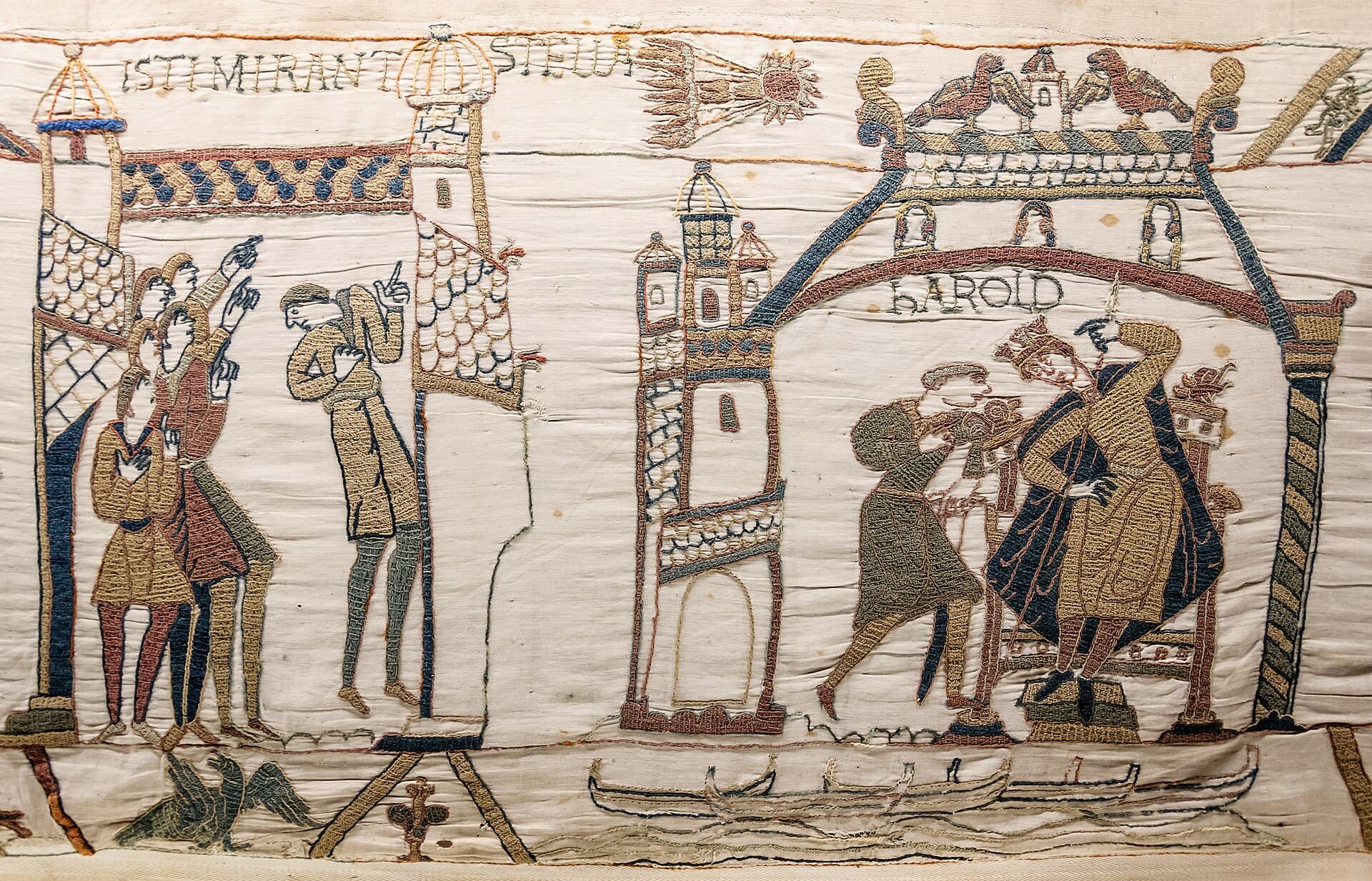
It is called a tapestry, and it is not one. A tapestry is woven, with the picture built into the cloth on a loom. The Bayeux Tapestry is embroidery: colored wool stitched onto a long strip of plain linen by hand. It is roughly 70 meters long and only half a meter tall, a ribbon of story you could not take in all at once if you tried. And it survives, almost intact, from around 1070, which makes it one of the oldest and strangest history books on Earth, written entirely in thread.
What you're looking at
The tapestry tells the story of the Norman Conquest of England in 1066: how Duke William of Normandy crossed the Channel, defeated King Harold at the Battle of Hastings, and made himself William the Conqueror. It reads left to right like a strip of film, more than fifty scenes with short Latin captions above them: envoys ride, ships are built, a comet blazes, an army sails, and then, in a long and brutal final stretch, men and horses die at Hastings in a tangle of arrows and falling bodies. Our image is one of its most famous moments: a crowd points up in astonishment at a streaming star. The caption reads, roughly, "these men marvel at the star." The star is Halley's Comet, which really did appear over England in the spring of 1066, and which everyone at the time read as an omen that a king was about to fall.
What makes it special
It is journalism in wool. No painting or manuscript of the age comes close to this as a running, sequential, illustrated account of a real event, packed with the specific detail of a reporter: how a Norman ship was built, what the soldiers ate, how the cavalry charged. It is closer to a documentary than to art as its makers would have understood the word.
It was almost certainly made by the losing side. Most scholars believe the embroidery was produced in England, probably in Canterbury, by English needleworkers, for a Norman patron, likely Bishop Odo of Bayeux, William's half-brother. So the definitive visual record of England's conquest was stitched by the conquered, and some historians argue you can feel it: small sympathies for Harold, ambiguities the Norman story would rather not have.
It has survived everything. For nearly a thousand years this fragile cloth has dodged catastrophe. During the French Revolution it was reportedly grabbed to cover a military wagon and rescued at the last minute; Napoleon put it on display to stir up invasion fever; and during the Second World War the SS took an interest in it as Germanic heritage, and it spent time in the Louvre under Nazi control before returning safely to Normandy.
The story behind it
The embroidery is a piece of political spin, made for a winner who needed the conquest to look legal rather than like a land grab. Its early scenes work hard to show that Harold had sworn a sacred oath to support William's claim to the English throne, and then broke it by taking the crown himself. In the tapestry's logic, Hastings is not an invasion; it is a punishment. This is why the comet matters so much in the design: heaven itself, the cloth insists, was announcing that the oath-breaker's reign was doomed.
But the makers could not fully hide the cost. The bottom border, usually filled with decorative animals, turns near the end into a strip of the dead and the looted: fallen soldiers, severed limbs, men stripping armor from corpses. Above runs the official story of a just victory. Below, in the margins the patron cared less about, runs the truth of what a battle actually leaves behind.
One detail most people miss
Near the end, a figure appears to be pulling an arrow from his eye, and for centuries this was taught as the death of King Harold: killed by an arrow to the eye, the perfect image of divine punishment for the oath-breaker. Look closely and it is far less certain. The stitching has been repaired over the centuries, the caption's spacing is ambiguous, and scholars now argue endlessly about which falling figure is even Harold. The single most famous fact about the Bayeux Tapestry, the arrow in the eye, may be a legend the thread itself never actually told.
Where to see it
The tapestry has its own museum in Bayeux, Normandy, where it is displayed in a long dim curve so you walk its full length, scene by scene, like reading a wall-sized sentence. High-resolution photographs of every centimeter are free online, and worth an hour: it is the closest thing we have to standing in the year 1066 and being handed the news.