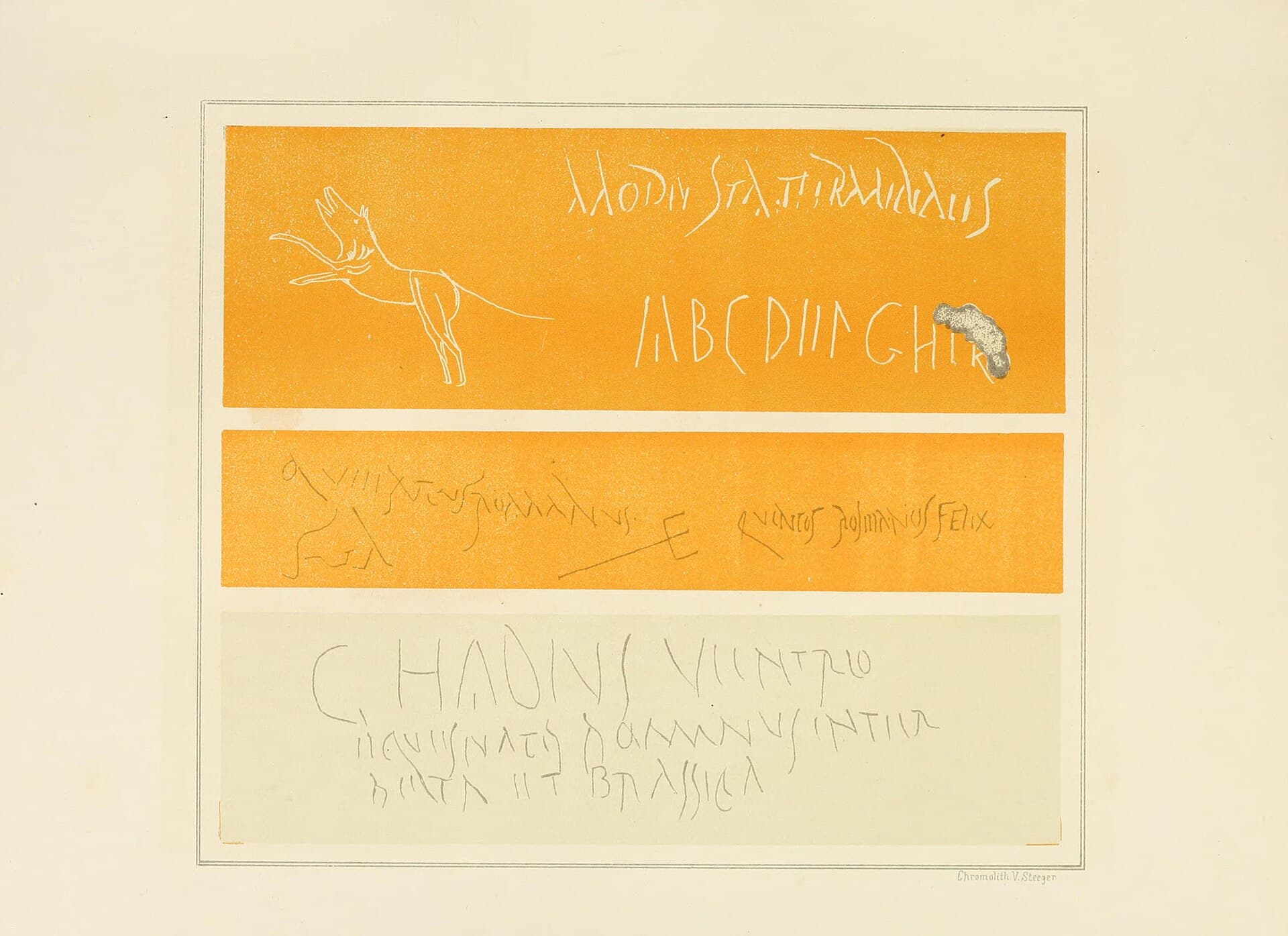
Almost everything we know about the ancient world comes from the top: the writings of emperors, generals, philosophers, and poets, the people rich and powerful enough to be recorded. The ordinary Roman, the baker, the barmaid, the bored teenager, left almost nothing behind. Except in one place. When Mount Vesuvius erupted in 79 AD and buried the town of Pompeii under ash, it sealed and preserved the walls of the town exactly as they were, and those walls were covered in graffiti: thousands of messages scratched by regular people who never imagined anyone would read them again. It is the closest thing we will ever have to hearing the ancient world talk with its guard down.
What you're looking at
The graffiti of Pompeii is not art in the modern spray-paint sense. It is writing and rough drawings scratched into plaster with a nail or a stylus, all over the town: on the outsides of houses, inside taverns, in the public baths, in the brothel, on tombs along the road. There are thousands of them, in Latin, ranging from single words to little poems, and archaeologists have carefully copied and catalogued them for over a century. Read together, they are less a set of monuments than a running conversation, a whole town talking, arguing, boasting, and flirting on its own walls.
What makes it special
It is the voice of the ordinary. No senator wrote these. They are the words of shopkeepers, slaves, lovers, drinkers, and children, the vast majority of humanity that history normally erases. Reading them is like a door opening on a street full of people you were never meant to meet.
It is astonishingly familiar. The content is not solemn or ancient-feeling at all. There are declarations of love ("Marcus loves Spendusa"). There are insults and boasts. There are complaints ("I'm amazed, wall, that you haven't collapsed, holding up the tedious scribblings of so many writers"). There are election slogans painted by supporters, bar tabs, prices, and plenty of jokes far too crude to reproduce. Two thousand years vanish instantly. These are just people.
It records a world about to end, without knowing it. Some graffiti can be roughly dated, and a few were scratched in the town's final months and days. People were writing about ordinary things, dinners, lovers, the games, right up until the mountain buried them. There is no premonition in the walls, which makes them unbearably poignant: an entire community, mid-sentence, when the sky went dark.
The story behind it
For most of history, Pompeii's graffiti was ignored or even considered an embarrassment, too low, too rude, too trivial for serious scholars who wanted grand temples and statues. That changed in the nineteenth century, when a German scholar named Karl Zangemeister began systematically collecting the inscriptions, treating this throwaway writing as a serious historical record. It turned out to be one of the richest sources we have for how Latin was actually spoken, not the polished literary language of the poets but the everyday slang, misspellings, and street talk of real Romans.
The graffiti rewrote our picture of the ancient town. From official ruins alone, Pompeii is marble and silence. From its walls, it comes alive: you learn which gladiators the girls swooned over, which candidate a neighborhood backed, who was sleeping with whom, what a cup of wine cost, and how a schoolboy practiced the alphabet. It is proof of something easy to forget when you stand among ancient columns, that the past was not populated by dignified statues, but by loud, funny, ordinary people, most of whose names we would never otherwise know.
One detail most people miss
Among the crude jokes and love notes, tucked here and there, are lines of real poetry, including quotations from Virgil, Rome's greatest poet. Someone, on an ordinary wall, scratched the opening words of the Aeneid: "Arma virumque cano," "I sing of arms and the man." It means that ordinary people in this small town knew and carried the great poem of their culture in their heads, well enough to graffiti it on a wall, the way someone today might scrawl a famous song lyric. High art and low graffiti, the epic and the scribble, sharing the same plaster. The wall did not care about the difference. Neither, it turns out, did the people.
Where to see it
Much of Pompeii's graffiti is still visible, in place, on the walls of the excavated town near Naples, though the most fragile has been copied and moved to the Naples National Archaeological Museum for protection. Walk the ancient streets and look, not up at the grand ruins, but at eye level, at the plaster, where a person exactly like you once stopped, took out a nail, and left a message for anyone passing by. It reached us. That was the whole idea.