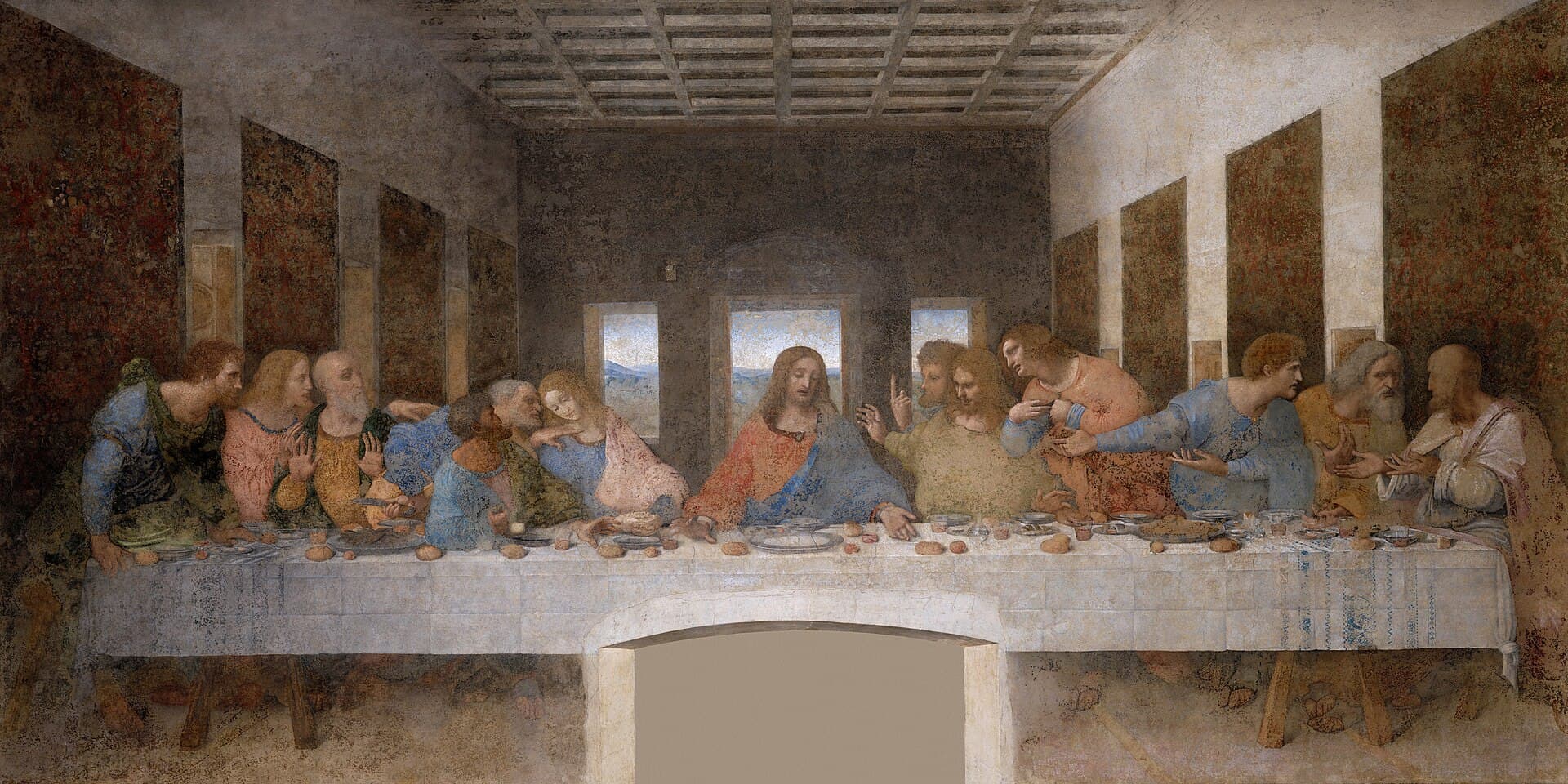
On the wall of a monastery dining room in Milan, Leonardo da Vinci painted the single most famous meal in human history: the last supper of Jesus and his twelve apostles. He chose the exact second when Jesus says, "One of you will betray me," and the sentence detonates down the table. It is one of the greatest paintings ever made. It is also, technically, a catastrophe, a work that began decaying within Leonardo's own lifetime because of a decision he made before he lifted a brush.
What you're looking at
The scene is the moment of maximum shock. Jesus sits at the center, calm, having just announced that a traitor is among the men he loves. To either side, the twelve apostles erupt in a wave of reaction: they recoil, they protest, they turn to one another in disbelief, they demand to know who. Leonardo groups them in four clusters of three, so the long table reads not as a row of figures but as a living crowd, each man a distinct personality caught in a distinct emotion. The room in the painting extends the real room it hangs in, and all its perspective lines converge on one point: the head of Jesus, so that the architecture itself points at him.
What makes it special
It froze a single instant. Earlier painters showed the Last Supper as a calm, timeless ritual, with Judas conveniently placed alone on the wrong side of the table. Leonardo did something radical: he painted a specific second of human drama, the shockwave of an accusation, with every apostle mid-reaction. It turned a religious symbol into a psychological event.
Every gesture is a character study. Leonardo filled notebooks studying how people move when they feel things, and it is all here: a hand thrown up, a body leaning back, fingers pointing, a face frozen in denial. You can read the personality of each apostle from his hands alone. It is acting, staged in paint.
Judas gives himself away in the details. For the first time, the traitor is not isolated but hidden in the crowd, third from Jesus on the left, clutching a small bag of silver, the payment for his betrayal. In some readings he has just knocked over the salt, an ancient omen of bad luck, and he leans back into shadow while the others lean into the light.
The story behind it
Leonardo's fatal choice was technical. A true fresco has to be painted fast, in wet plaster, patch by patch, and Leonardo worked slowly, obsessively, returning to a face for days, staring at it, changing nothing. So he refused to paint a fresco. Instead he invented his own method, painting in tempera and oil onto dry plaster, which let him take all the time he wanted. It also meant the paint never bound into the wall. It sat on the surface like a film, and within twenty years, while Leonardo was still alive, it was already flaking and clouding. By the middle of the next century a writer described it as a blur.
Then history piled on. Monks cut a doorway through the bottom of the wall, removing Jesus's feet. Napoleon's troops reportedly used the room as a stable and threw things at the apostles. Well-meaning restorers repainted it, badly, more than once. And in August 1943, an Allied bomb destroyed most of the refectory; the wall with the painting survived only because it had been sandbagged, standing open to the weather amid the rubble. A restoration finished in 1999 stripped away centuries of overpainting to recover what little of Leonardo's own hand remains. The truth is stark: only a fraction of what you see is actually his. The rest is the accumulated care of five centuries of people who could not bear to let it die.
One detail most people miss
Popular myth, fueled by a certain bestselling novel, insists that the youthful figure to Jesus's right is secretly Mary Magdalene. It is not. It is the apostle John, traditionally shown young and beardless in Italian painting, exactly as dozens of other artists depicted him. The real hidden detail is quieter and stranger: look at the hands near the center of the table. There is a hand holding a knife that, at a glance, seems to belong to no one, jutting out at an awkward angle. Scholars still argue about whose arm it is. In the most studied painting on Earth, there is a disembodied hand, gripping a blade, that five hundred years of experts cannot fully explain.
Where to see it
The Last Supper is still on its original wall, in the refectory of Santa Maria delle Grazie in Milan. Because the surviving paint is so fragile, only a small number of visitors are let in at a time, for fifteen minutes, after passing through climate-controlled chambers to strip the dust off their clothes. You must book weeks, sometimes months, ahead. It is worth every obstacle: you are given a quarter of an hour alone with a wounded, half-erased miracle, and it is still, unmistakably, one of the greatest things a human being has ever made.