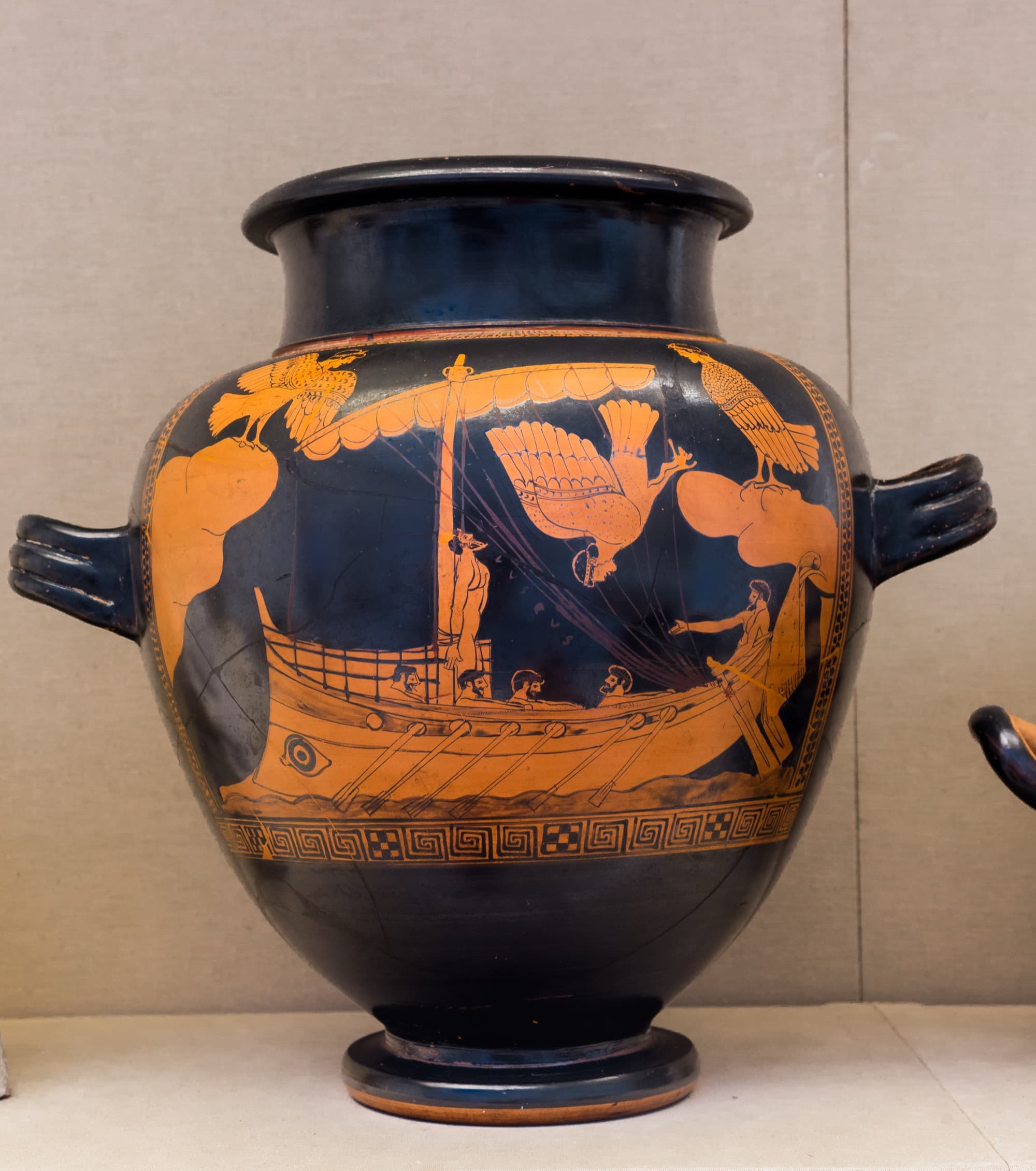
There is one song in the world that is certain to kill the man who hears it. The Sirens sing it from their island, and every sailor who listens steers toward them and dies on the rocks. Odysseus wants to hear it anyway. So he has his crew plug their own ears with wax, then tie him upright to the mast, and he orders them, in advance, to ignore his pleading and bind him tighter if he struggles. When the song comes, he thrashes and screams to be let loose. They row on. He hears the deadly music, and lives.
That scene, painted on the ancient vase shown here, is roughly three thousand years old, and it is already a startlingly modern idea: a man who knows his own weakness and arranges, ahead of time, to be protected from himself.
What you're reading
The Odyssey is one of the two great epic poems of ancient Greece, attributed to the poet Homer and composed around the eighth century BC. It follows Odysseus, a Greek king, on his ten-year struggle to sail home after the ten-year Trojan War. Along the way he blinds a one-eyed giant, resists a witch who turns his men into pigs, visits the land of the dead, slips between two sea monsters, and spends years trapped by a goddess who loves him. Meanwhile, at home on the island of Ithaca, his wife Penelope and son wait, besieged by suitors who assume he is dead.
What makes it special
The hero's superpower is his brain. Odysseus is strong, but what defines him is cleverness. He survives by lying, disguising himself, and inventing escapes, most famously telling the giant his name is "Nobody," so that when the blinded monster roars that "Nobody" has hurt him, no one comes to help. The Odyssey made cunning, not brute force, the mark of a hero.
It invented the shape of the adventure story. The long voyage, the string of strange islands, the monsters, the temptations, the yearning for home: this is the original template that films, novels, and video games still follow. The word "odyssey" itself now means any epic journey.
It takes homecoming seriously. Beneath the monsters, the poem is about something quiet and human: a man desperate to get back to his wife, his son, and his own bed, and a marriage tested by twenty years of separation. The adventures are thrilling, but the emotional engine is simply the ache to go home.
The story behind it
We do not really know who Homer was, or whether he existed at all. The poems come out of a long oral tradition, performed and reshaped by singers for generations before anyone wrote them down. The famous "Homeric question" asks whether one genius composed them or whether "Homer" is a name we have attached to the work of many. Either way, these were spoken and sung, meant for the ear, which is why they are full of repeated phrases and rolling rhythms that a performer could carry in memory.
One detail most people miss
Penelope is every bit as cunning as her husband. To avoid choosing a new husband from the crowd of suitors eating her out of house and home, she tells them she will decide once she has finished weaving a funeral shroud for her father-in-law. Every day she weaves; every night she secretly unravels the day's work. For years the shroud is never finished, and the trick holds the suitors off. Odysseus is called the man of many wiles, but he married his match.
How to read it
The Odyssey is in the public domain and free everywhere, including Project Gutenberg, in several English translations. Older verse translations are grand but can feel heavy; recent ones, such as Emily Wilson's brisk, clear version, make it move like the adventure story it is. It was built to be heard, so try reading a passage aloud, or listen to an audiobook, and let the oldest road trip in Western literature carry you along.