On January 29, 1845, a New York newspaper printed a poem about a man, a dead woman, and a talking bird, and the United States lost its mind. Within weeks "The Raven" was reprinted everywhere, parodied, memorized, recited in parlors across the country. Edgar Allan Poe, 36 years old and chronically broke, became instantly, nationally famous. He was reportedly paid somewhere between nine and fifteen dollars for it.
Then he did something no famous poet had done before. A year later, he published an essay explaining, step by step, how he had manufactured the poem, claiming there was no inspiration in it at all, only calculation.
What you're reading
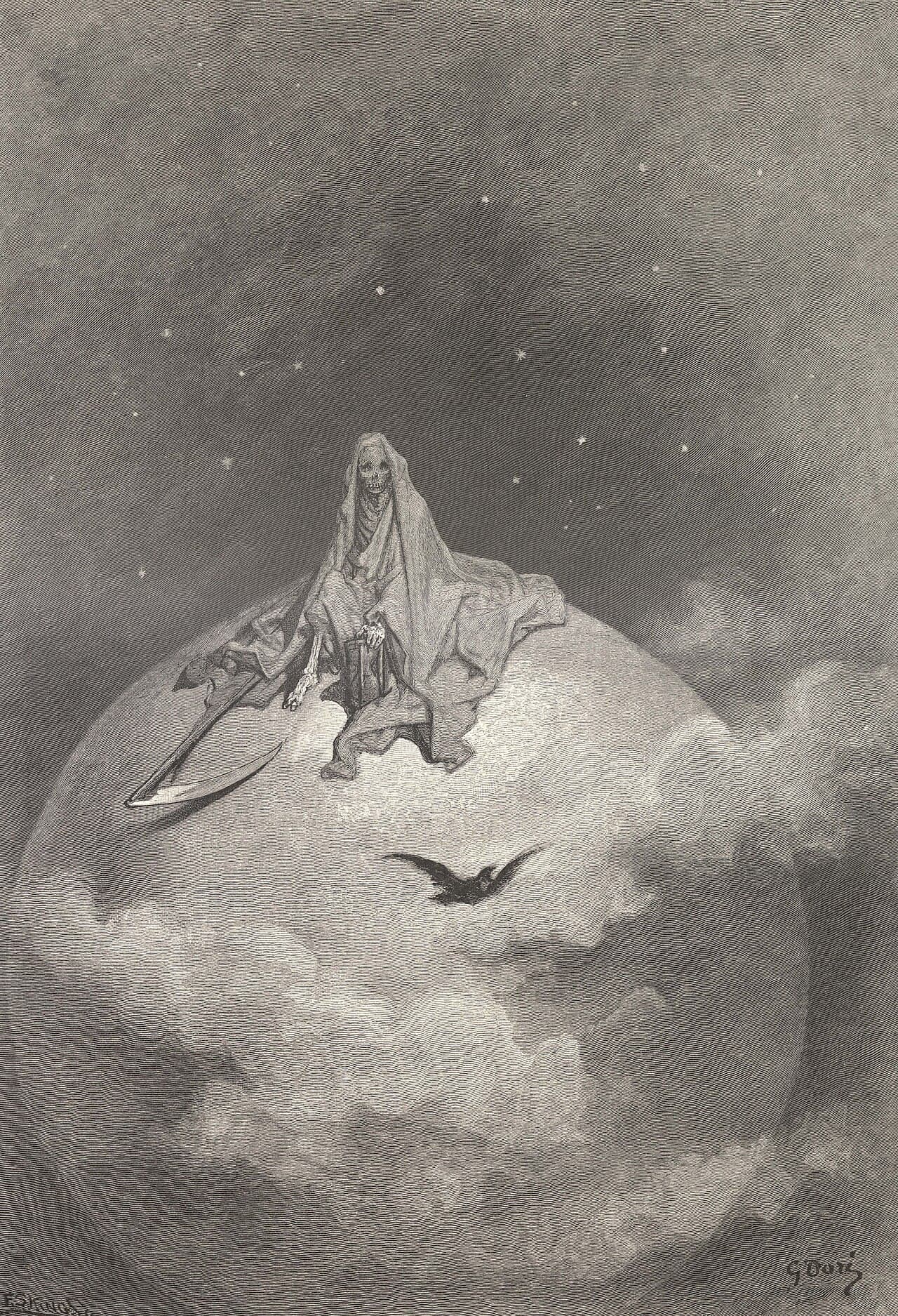
A narrator, half-asleep and grieving a lost love named Lenore, hears a tapping at his door on a bleak December midnight. He opens the window and a raven flies in, perching on a bust of Pallas Athena above his door. When he asks the bird its name, it answers, "Nevermore." At first it is almost comic. But the narrator keeps asking questions, each more desperate, and the bird's single word turns every one of them into a wound: Will he ever forget his grief? Will he see Lenore again in heaven? Nevermore. By the end he is screaming at the bird, and the raven has not moved, and it never will.
What makes it special
The sound does the haunting. Poe built the poem out of a hypnotic, galloping rhythm and dense internal rhymes ("Once upon a midnight dreary, while I pondered, weak and weary"). Read it aloud and it grips like a spell. The meaning matters less than the music, which is exactly what Poe wanted.
It is grief that refuses to end. The genius of the raven is that its answer never changes. The man is not really talking to a bird; he is interrogating his own despair, and it keeps giving him the worst possible answer. Anyone who has lain awake asking a silent room the same hopeless question knows this poem from the inside.
Poe told everyone how the trick worked. In 1846 he published "The Philosophy of Composition," claiming he wrote "The Raven" backwards: he decided first on the length, then the effect (melancholy), then the refrain, then the sound of the refrain, then chose a raven as the least unlikely creature to repeat it, then killed off a beautiful woman because, he wrote, that was "the most poetical topic in the world." Whether the essay is honest or an elaborate joke, scholars still argue. But it changed how writers thought about their own craft.
The story behind it
Poe had spent two decades as a brilliant, self-sabotaging magazine writer, poor and often drunk, editing other people's journals and watching lesser talents outsell him. "The Raven" was the breakthrough he had chased his whole life, and it was real: he was suddenly the most talked-about writer in America, invited to salons, mobbed at readings, where he would dim the lamps and recite the poem in a low voice.
But fame is not money. He still could not afford to keep his young wife Virginia warm; she was dying slowly of tuberculosis in a cold cottage, and the lost Lenore of the poem reads, in hindsight, like a rehearsal for a loss he could see coming. Virginia died in 1847. Poe survived her by two years, and then, in October 1849, was found delirious on a Baltimore street in clothes that were not his, and died days later at 40, of causes no one has ever settled. His last coherent works circle the same subject as his most famous one: a man who cannot let the dead go.
One detail most people miss
Look at where the raven sits: on a bust of Pallas, the goddess of wisdom. Poe said he chose it for the visual contrast of black bird on white marble, but the placement is the whole poem in one image. The man wants knowledge, certainty, an answer to whether love outlasts death. He has enthroned wisdom over his door. And the thing that lands on wisdom's head, and speaks, is not wise at all. It is a bird that knows one word, and that word is no.
How to read it
"The Raven" is in the public domain, free everywhere, including Project Gutenberg. It is 108 lines, six minutes aloud. Read it out loud, alone, at night, at least once. It was built to be heard, not skimmed, and it was built by someone who knew exactly what he was doing to you.