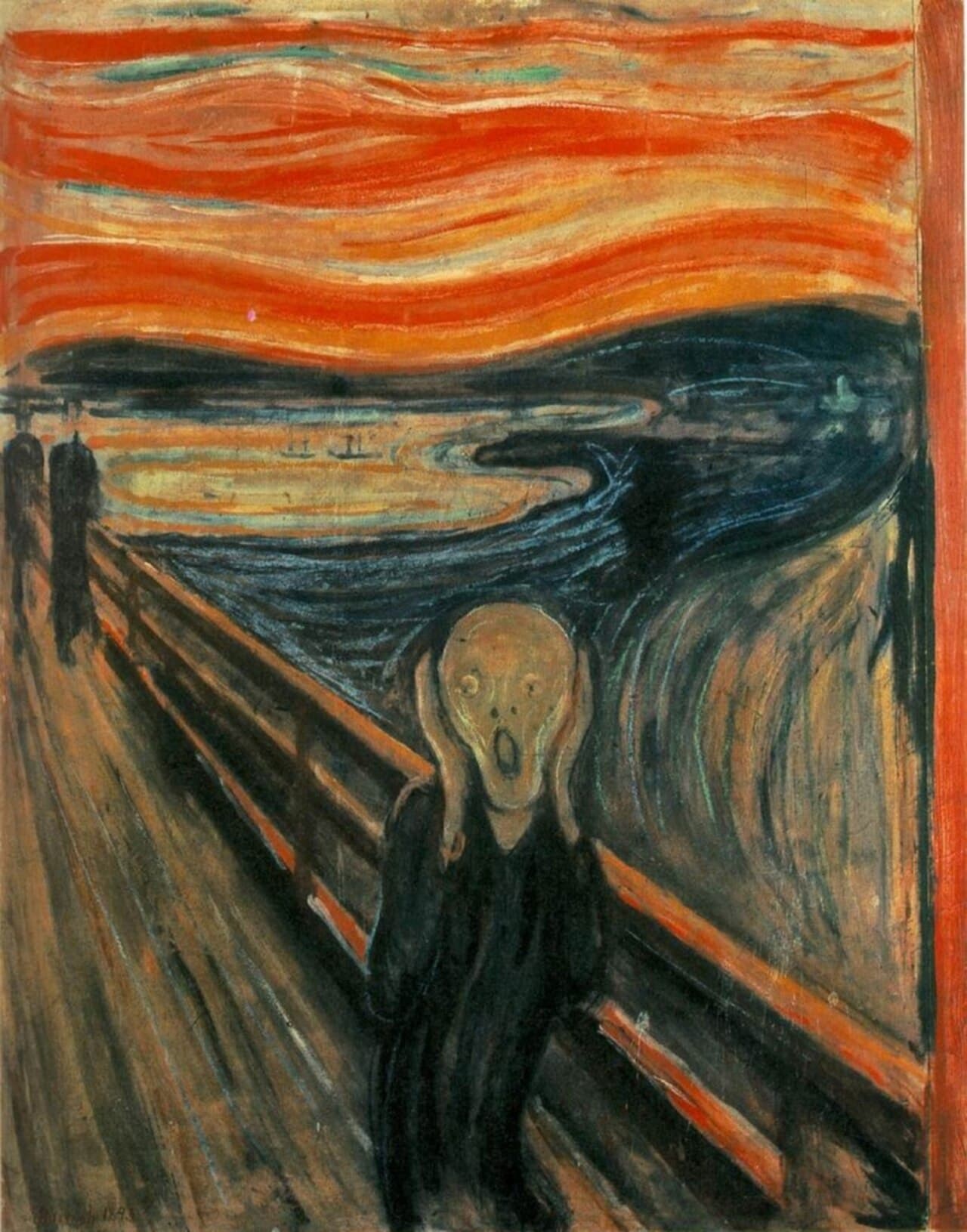
Everyone reads this picture the same way at first: a bald figure on a bridge, mouth open, screaming. Then you learn what Munch actually wrote about that evening, and the painting flips. The figure is not making the sound. He is trying to shut it out.
Edvard Munch, Norwegian, 29 years old, was walking at sunset above Oslo's fjord when, in his words, the sky turned blood red, he stopped, trembling with anxiety, and felt an infinite scream passing through nature. The two friends walking with him noticed nothing and kept going. That gap, between the calm world and one mind on fire inside it, is the entire subject of the painting.
What you're looking at
A bridge running diagonally out of the frame, two upright strangers in the distance, boats on the fjord, a sky in waves of orange and red, and in front, a figure like a lit candle beginning to melt, hands pressed to the sides of its head. Munch made four painted and drawn versions between 1893 and 1910, plus a print; this first one, on cheap cardboard, hangs in Oslo.
What makes it special
The landscape does the screaming. Look where the wavy lines are: the sky, the fjord, the figure. Now look at the bridge and the two friends: straight lines, firm and vertical. Munch splits the world in two geometries, solid for everyone else, liquid for the one who feels too much. It is the most accurate diagram of a panic attack ever drawn, sixty years before the term existed.
The face is barely human on purpose. Skull-like, sexless, ageless: Munch stripped away everything individual so the face could belong to anyone. That emptiness is why it became a universal container, endlessly borrowed by cartoons, protest posters, a horror-movie mask, and the screaming emoji on your phone.
The sky may be real. In 1883 the volcano Krakatoa exploded on the other side of the planet, and for months its dust turned European sunsets into furnace reds that newspapers reported with alarm. Some scientists argue Munch witnessed those skies. Whether memory or invention, he chose to paint the evening the atmosphere itself seemed to panic.
The story behind it
Munch's childhood supplied the dread: his mother died of tuberculosis when he was five, his beloved sister Sophie when he was thirteen, and his father filled the house with religious terror. Illness, madness and death, Munch said, were the angels that attended his cradle. He exhibited The Scream as part of a series called The Frieze of Life, about love, anxiety and death. Critics were appalled. The public never stopped looking.
The painting's later life matched its subject: the 1893 version was stolen from Oslo's National Gallery in 1994, during the opening day of the Winter Olympics, and recovered months later; the 1910 version was stolen at gunpoint in 2004 and recovered in 2006. A pastel version sold in 2012 for nearly 120 million dollars, then a record for any artwork at auction.
One detail most people miss
In the upper left corner of this first version there is a faint pencil line of handwriting: "Could only have been painted by a madman." For a century nobody knew whose hand it was. In 2021, infrared analysis confirmed it: Munch wrote it himself, most likely after hearing a medical student mock the painting at an early exhibition. The most anxious picture in art history carries its own review, written by its maker, agreeing with the insult and signing it anyway.
Where to see it
The National Museum in Oslo shows this version; the Munch Museum across town rotates the others, keeping them in low light because the colors are fragile. Stand back far enough to see both geometries at once, the straight world and the melting one. Most days, you can feel which one you are standing in.