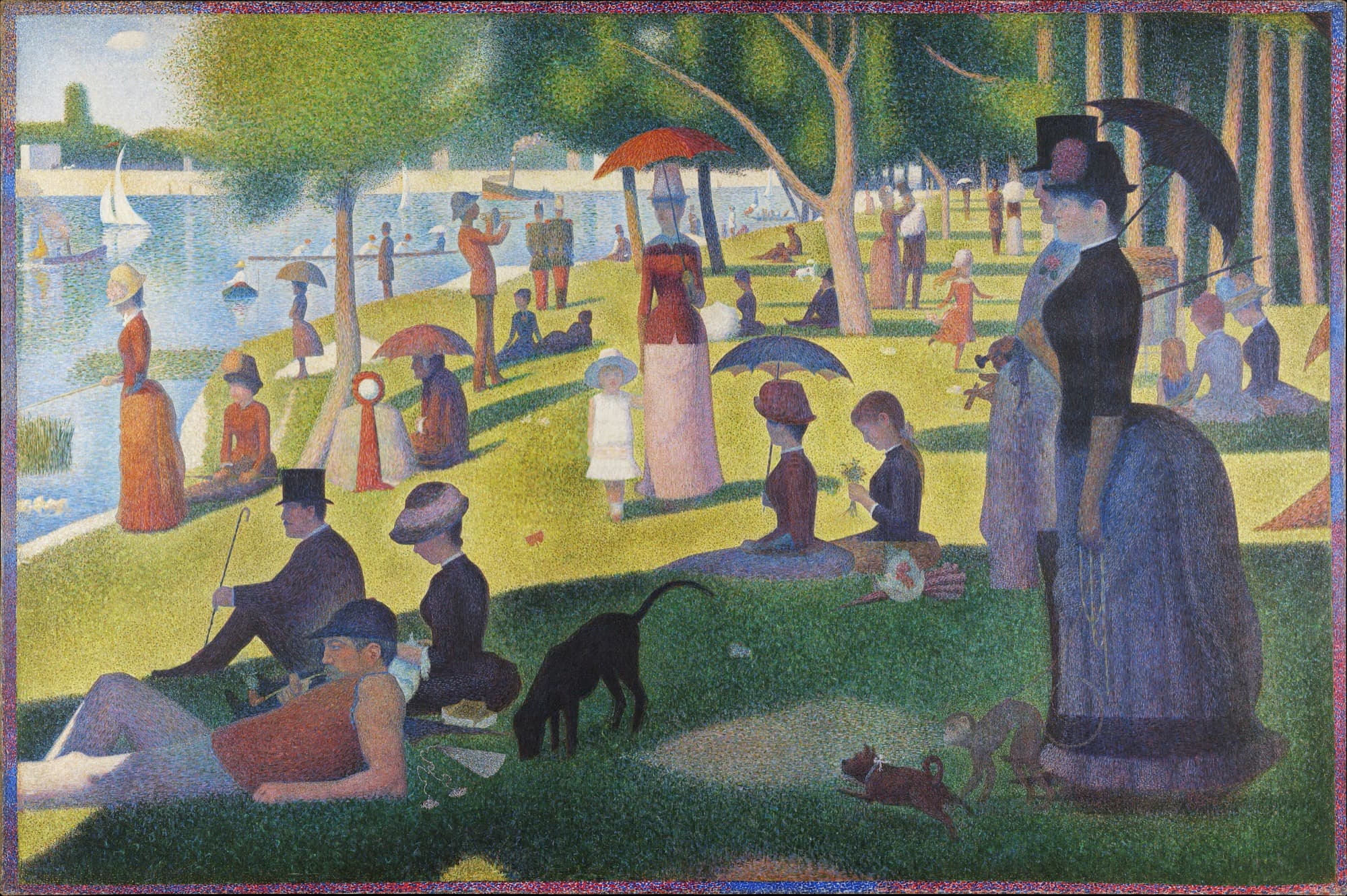
Stand close to this painting and it dissolves into chaos: millions of tiny, separate dots of pure color, blue beside yellow, orange beside violet, with almost nothing actually blended. Step back, and your own eye does the mixing it refuses to do on the canvas. Those blue and yellow dots fuse into green only in your head. The grass is not painted green; you are seeing green that is not physically there.
That is the trick at the heart of one of the most famous paintings in the world, and it was not a happy accident. Georges Seurat built it deliberately, out of color science, over roughly two years of relentless work.
What you're looking at
A huge canvas, about two meters tall and three wide, showing Parisians relaxing on a Sunday afternoon on La Grande Jatte, an island in the river Seine. People stroll, sit, and lounge in the sun: a woman with a parasol, a man reclining with a pipe, children, dogs, a boater, even a small monkey on a leash. The light is bright, the mood is calm, and yet the figures stand oddly stiff and still, like chess pieces or ancient statues. It has hung at the Art Institute of Chicago for almost a century and is one of that museum's most treasured works.
What makes it special
The colors mix in your eye, not on the canvas. This is Pointillism, and Seurat meant it as something close to optical engineering. Drawing on the color theories of his day, he believed that juxtaposing dots of pure color would produce a result more luminous than muddy palette-mixing ever could. Whether or not the science fully works, the shimmering effect is real.
It is hard science disguised as a lazy afternoon. Nothing about this relaxed scene was relaxed to make. Seurat produced dozens of preparatory drawings and small oil studies, working out every figure, every patch of light, before committing. The painting took him roughly two years. A casual Sunday in the park is, underneath, one of the most calculated images in art.
It freezes people like monuments. Seurat painted modern city-dwellers at leisure, but he posed them with the stiff, frozen dignity of ancient Egyptian figures, mostly in flat profile, strangely motionless. The effect turns an ordinary Sunday into something timeless and eternal, as if these strollers had always been here and always would be.
The story behind it
Seurat was only in his mid-twenties when he made it. He unveiled the painting in 1886 at the last of the famous Impressionist exhibitions, where it startled everyone and effectively launched a new movement, Neo-Impressionism, built on his dot-based method. Critics were baffled and often mocking. Seurat, intense and secretive about his technique, kept refining his color theories, but he had almost no time left: he died suddenly in 1891, probably of an infectious illness, at just thirty-one, with his revolution barely begun. A century later the painting inspired an entire Broadway musical, Stephen Sondheim's Sunday in the Park with George.
One detail most people miss
The dots do not stop at the edge of the scene. Seurat painted a border of dots around the whole composition, a painted frame of color, because he worried that an ordinary gold frame would clash with his careful optical effects and throw off the eye's mixing. Look at the outer margin of the canvas and you will see this dotted band, a painting that extends its own method right out to its boundary. He wanted even the frame to obey the science.
Where to see it
A Sunday on La Grande Jatte lives at the Art Institute of Chicago, which almost never lets it travel; it is too fragile and too central to the collection. Go see it in person if you can, because reproductions genuinely cannot do it justice. Stand far back to let the image snap into focus, then walk slowly toward it and watch the whole sunlit world crumble, before your eyes, back into the millions of separate dots it was always made of.