Wassily Kandinsky could hear his paintings. He had synesthesia, a real condition in which the senses cross over, so that for him a musical note might arrive with a color attached, and a color might carry a sound. A yellow could feel shrill, like a trumpet; a deep blue could feel calm and low, like a cello. He spent his career chasing a single strange goal: to paint not the things of the world, but the invisible music of pure color and shape.
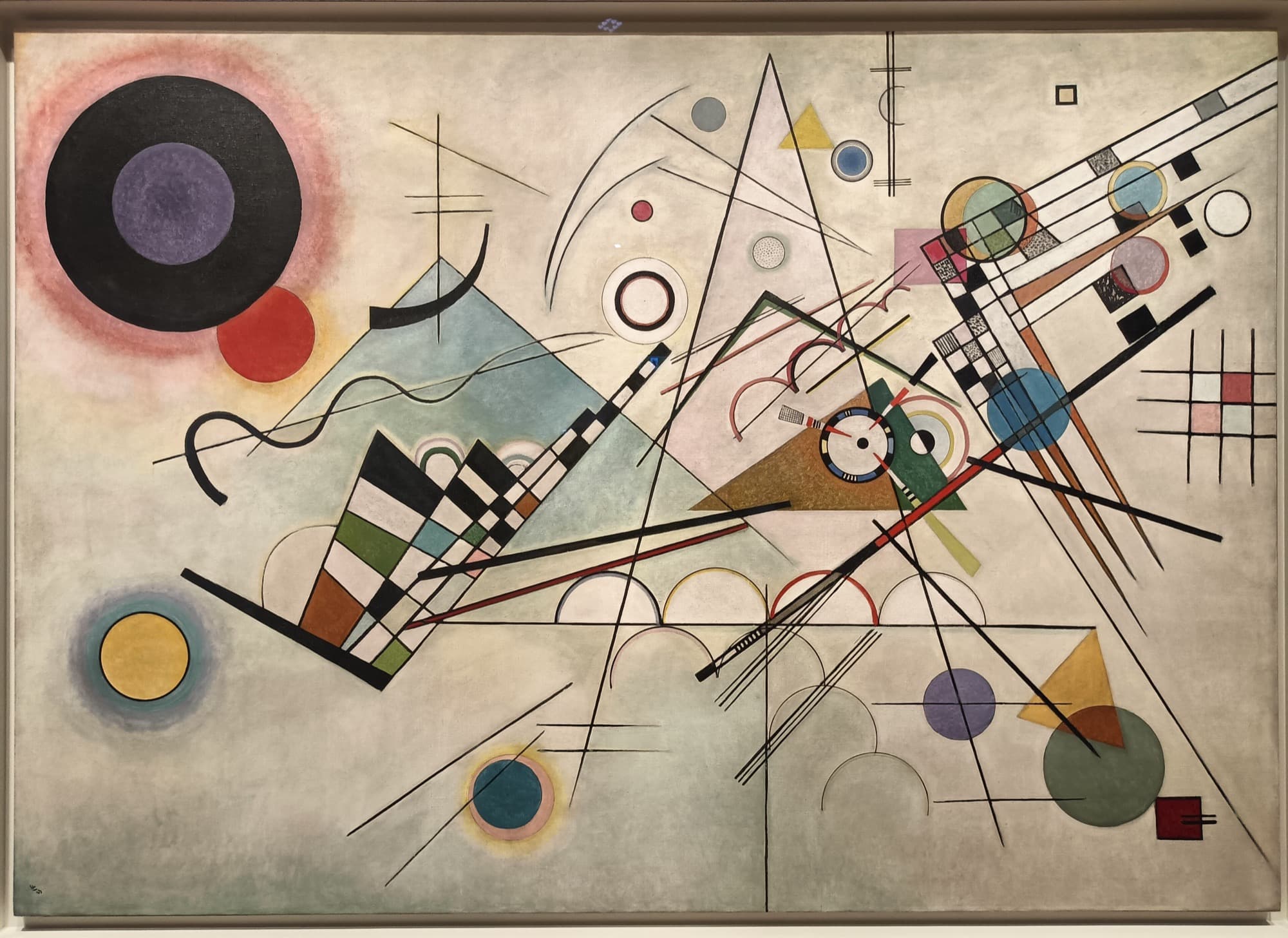
That is why this painting is called Composition, like a piece of music, and why it contains no people, no landscape, no objects at all. Kandinsky was not hiding the subject. The arrangement of circles, lines, and triangles is the subject.
What you're looking at
A large canvas, about two meters wide, covered in floating geometric forms against a pale ground. A big dark circle, ringed with a halo, hangs in the upper left like a sun or a struck gong. Around it drift smaller circles, sharp triangles, grids of fine lines, and shapes that seem to hover and collide in open space. There is no ground, no sky, no up or down in the usual sense. Painted in July 1923, it belongs to Kandinsky's years teaching at the Bauhaus, the famous German school of art and design, and it now hangs in the Guggenheim Museum in New York.
What makes it special
It is one of the first paintings of nothing. Kandinsky was among the handful of artists who first dared to remove the recognizable world from painting entirely. For centuries art had been a window onto something; he turned it into an object with its own inner life, where a shape means a shape and a color means a feeling, not a thing.
It is music made visible. He treated his most ambitious canvases like symphonies, planning them carefully and numbering them as a composer numbers works. Shapes are his notes, colors his instruments, the blank space his silence. The dominant circle, a form he considered the most peaceful and cosmic of all, acts almost like a sustained opening chord.
It is control after a storm. Kandinsky's earlier abstractions, like the turbulent Composition VII, were swirling, explosive, almost chaotic. By 1923, under the clean influence of the Bauhaus, he had tightened everything into crisp geometry. Composition VIII is deliberate and balanced, every element weighed and placed according to a theory of how shapes and colors act on the human spirit.
The story behind it
Kandinsky came to art late, abandoning a career in law in Russia after a series of jolts: the shimmering color of Monet's haystacks, which he could admire without even recognizing the subject, and, by his own account, the shock of walking into his studio at dusk and seeing one of his own paintings lying on its side, unrecognizable, and finding it beautiful as pure color. He laid out his beliefs in a famous book, Concerning the Spiritual in Art, arguing that art's real job was to express inner, spiritual states. He taught at the Bauhaus until the Nazis shut it down and branded his work "degenerate." He fled to France, where he died in 1944.
One detail most people miss
The painting is not a free-for-all of pretty shapes. Kandinsky assigned specific feelings, even temperatures and sounds, to his visual elements, and he arranged them as carefully as a composer scores a piece. In his theory, a yellow triangle was sharp, warm, and aggressive; a blue circle was deep, cool, and restful; the circle itself was the most spiritual form, a link to the cosmos. So the hovering shapes you see are closer to an orchestrated chord than to decoration. He expected you to feel them, not just look at them, the way you feel music without needing it to describe anything.
Where to see it
Composition VIII lives at the Solomon R. Guggenheim Museum in New York, itself a spiraling work of abstract architecture that suits the painting well. Stand back first to feel the overall balance, the way the big circle anchors everything, then move close to see how precisely each line and edge is placed. The Guggenheim also offers a high-resolution image online, and it rewards slow looking: try letting your eye drift as if you were listening rather than reading.