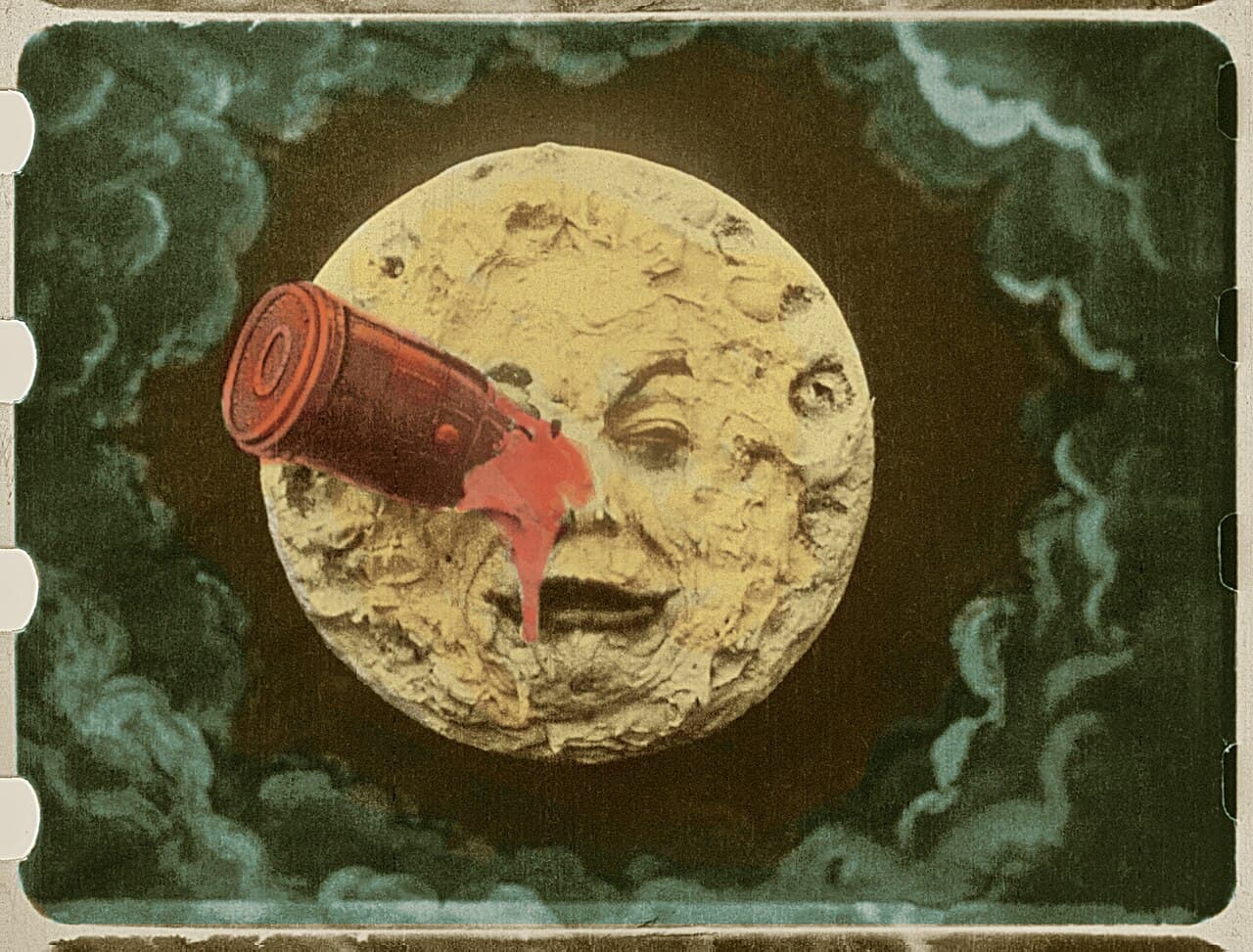
Before there were movie stars, before Hollywood existed, before anyone agreed that films should even tell stories - a French stage magician built a cardboard rocket, fired it into the eye of the Moon, and invented science-fiction cinema. The image of that rocket stuck in the Moon's face is still, more than 120 years later, one of the most recognizable pictures ever put on film. You have seen it even if you have never seen it.
Georges Méliès was a professional illusionist who owned a magic theater in Paris. In 1895 he attended the Lumière brothers' first film screening and understood something the Lumières themselves did not: this machine wasn't for documenting reality. It was the greatest magic trick ever built.
What you're watching
Fourteen minutes, no dialogue. A club of wizard-like astronomers builds a giant cannon, shoots six of them to the Moon in a capsule, where they nap, dream, fight insect-like Moon creatures called Selenites, get captured, escape, and fall back to Earth into the sea. It is closer to a dream than to a plot - and that is exactly the point.
What makes it special
It invented the special effect. Méliès discovered that if you stop the camera, change something, and start again, objects vanish, transform, or explode. Watch the Selenites: hit with an umbrella, they burst into smoke. That single trick - the edit as magic - is the direct ancestor of every effect you have ever seen, from King Kong to Marvel.
It invented the movie as a story. In 1902, most films were under two minutes long: workers leaving a factory, a train arriving. Méliès built sets, costumes, characters, a journey with a beginning, middle and end. The idea that you sit down and a film takes you somewhere starts here.
Every frame was painted by hand. There was no color film, so teams of women colored each frame with brushes, one by one - thousands of frames per print. The version embedded above includes that hand-colored restoration: watch the reds and golds flicker like living watercolor.
The story behind it
The film was a global sensation - and Méliès barely made a cent outside France. Pirated copies (including some made by Thomas Edison's company) circulated across America within months, and the profits went to the pirates. Méliès eventually went bankrupt, burned many of his negatives in frustration, and ended up selling toys and candy from a kiosk in a Paris railway station. In 1929, journalists rediscovered him, and France gave him a gala, a medal, and an apartment. Martin Scorsese's film Hugo (2011) tells this story.
The hand-colored version you can watch today survived by pure luck: a single decomposing print surfaced in Barcelona in 1993 and took nearly two decades to restore, frame by fragment, premiering at Cannes in 2011.
One detail most people miss
When the capsule hits the Moon's eye, the Moon winces. It is played by an actor in makeup, and that little grimace is the first special-effects shot in history that is also a joke. Cinema learned to amaze and to wink at you in the same second.
How to watch
Fourteen minutes, embedded above. Watch it the way its first audience did: not as a historical document, but as a magic show. Count the tricks. Then remember every one of them was being performed for the first time.