Nosferatu should not exist. In 1922 a German studio made a vampire film that was, quite openly, a theft: an unauthorized adaptation of Bram Stoker's novel Dracula, with the names filed off to dodge the copyright. Count Dracula became Count Orlok. Jonathan Harker became Thomas Hutter. Transylvania stayed roughly Transylvania. Stoker had died a decade earlier, but his widow, Florence, noticed, sued, and won. A court ordered every copy of the film destroyed. And yet here it is, a century later, one of the most influential horror films ever made, precisely because a few prints had already slipped out of the country before the verdict, and could not be burned.
What you're watching
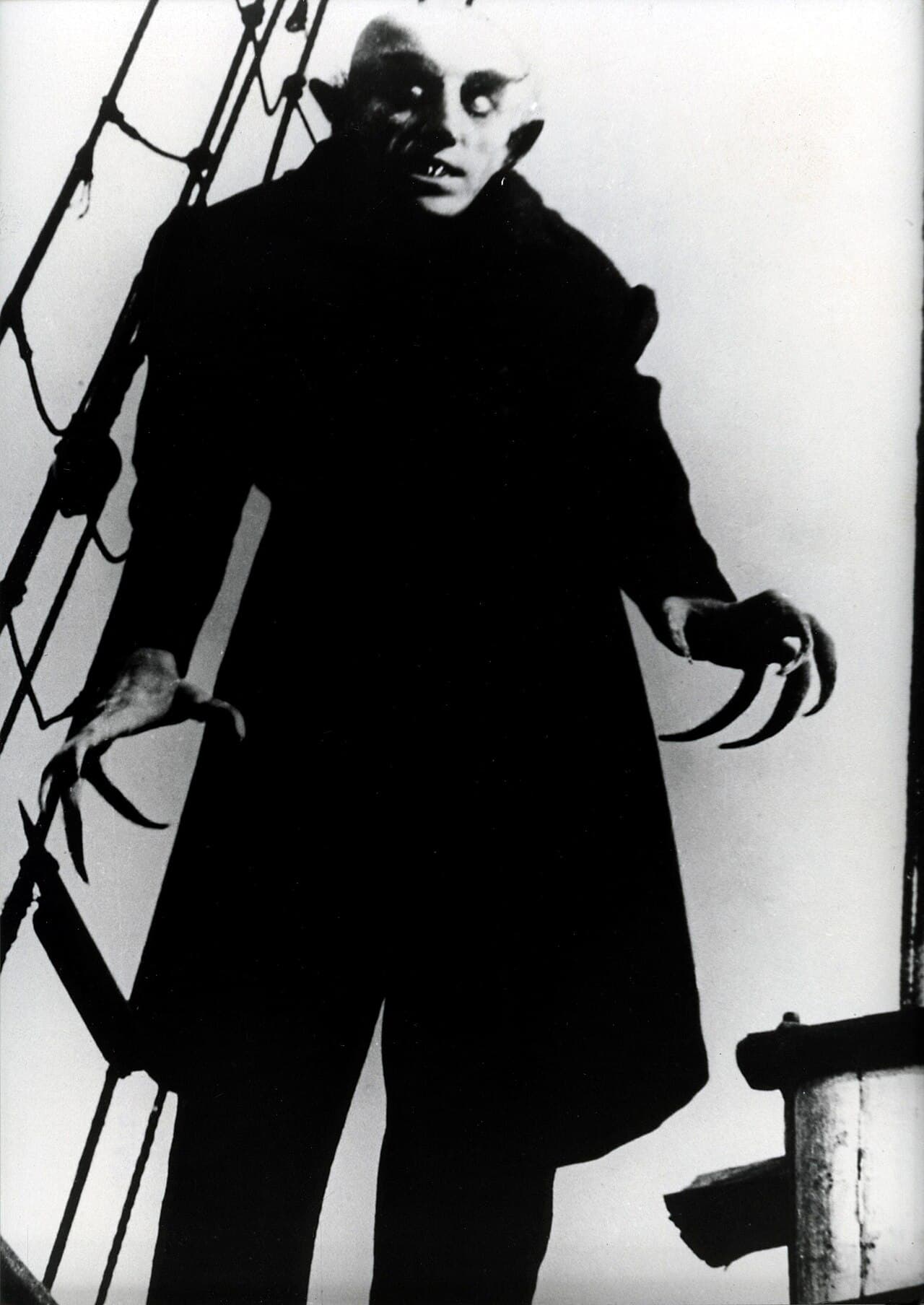
The plot is Dracula in disguise. A young estate agent, Hutter, travels to a remote castle in the Carpathians to close a property deal with a strange nobleman, Count Orlok. Orlok is not the suave aristocrat of later films. He is a walking corpse: bald, rat-toothed, with pointed ears and fingers that end in long claws, played by an actor named Max Schreck. Orlok buys a house across from Hutter's, sails to Germany in a ship whose entire crew he kills along the way, and brings plague with him. The film is silent, black and white, and slow by modern standards, and it is still, in places, genuinely unsettling, because its monster does not seduce. It simply arrives, like a disease.
What makes it special
It shot horror in the real world. Most scary films of the era were made on painted studio sets. Murnau took his camera into actual castles, forests, and mountains. The realness is what unnerves you: this ghastly creature is not moving through a fairy-tale backdrop but through recognizable places, under real skies.
Max Schreck became a legend of his own. Schreck was so committed and so strange in the role that rumors spread, then and since, that he never broke character, that no one saw him out of makeup, even that he was a real vampire. The legend was so durable that in 2000 someone made a whole film, Shadow of the Vampire, built on the joke that Schreck actually was undead.
It invented the sunrise. Here is the part that reaches you even if you have never seen the film. In Stoker's novel, sunlight does not kill Dracula; he walks around London by day. It was Nosferatu that decided the vampire must die at dawn, dissolving in the first light. That single invention became a universal rule of the genre. Every vampire since, in every film and book, who fears the sunrise is obeying a law written by a German silent movie in 1922.
The story behind it
The lawsuit is the film's real horror story. Florence Stoker spent years pursuing the German company that had plundered her late husband's novel, and in 1925 she won a judgment ordering the negative and all prints destroyed. The studio had already gone bankrupt, which almost helped: in the chaos, and because copies had been sold and shipped internationally before the ruling, the order could not be fully carried out. Prints survived in England, in the United States, in private collections, quietly passed around by people who had no idea they were preserving a masterpiece. Every version of Nosferatu you can watch today is descended from a copy that was supposed to be ash.
Its director, F. W. Murnau, went on to Hollywood and made more acclaimed films before dying in a car crash in 1931 at only 42. But nothing he made spread further than the film he was legally forbidden to have made at all.
One detail most people miss
Watch the most famous shot: Orlok climbing a staircase, seen only as a shadow thrown huge against the wall, his clawed hand reaching ahead of him. Murnau did not have to show the shadow. He could have shown the Count himself. But he understood something that has haunted horror ever since: the shadow of a monster is scarier than the monster, because your own mind fills it in. The single most imitated image in vampire cinema is not a creature at all. It is the dark shape a creature leaves on a wall.
How to watch
Nosferatu is in the public domain and freely available; press play above for the full film, a little over an hour. Watch it late, with the lights off, and try to forget that a court once ordered this exact experience erased from the world. It is only reaching you because someone, somewhere, refused to burn their copy.