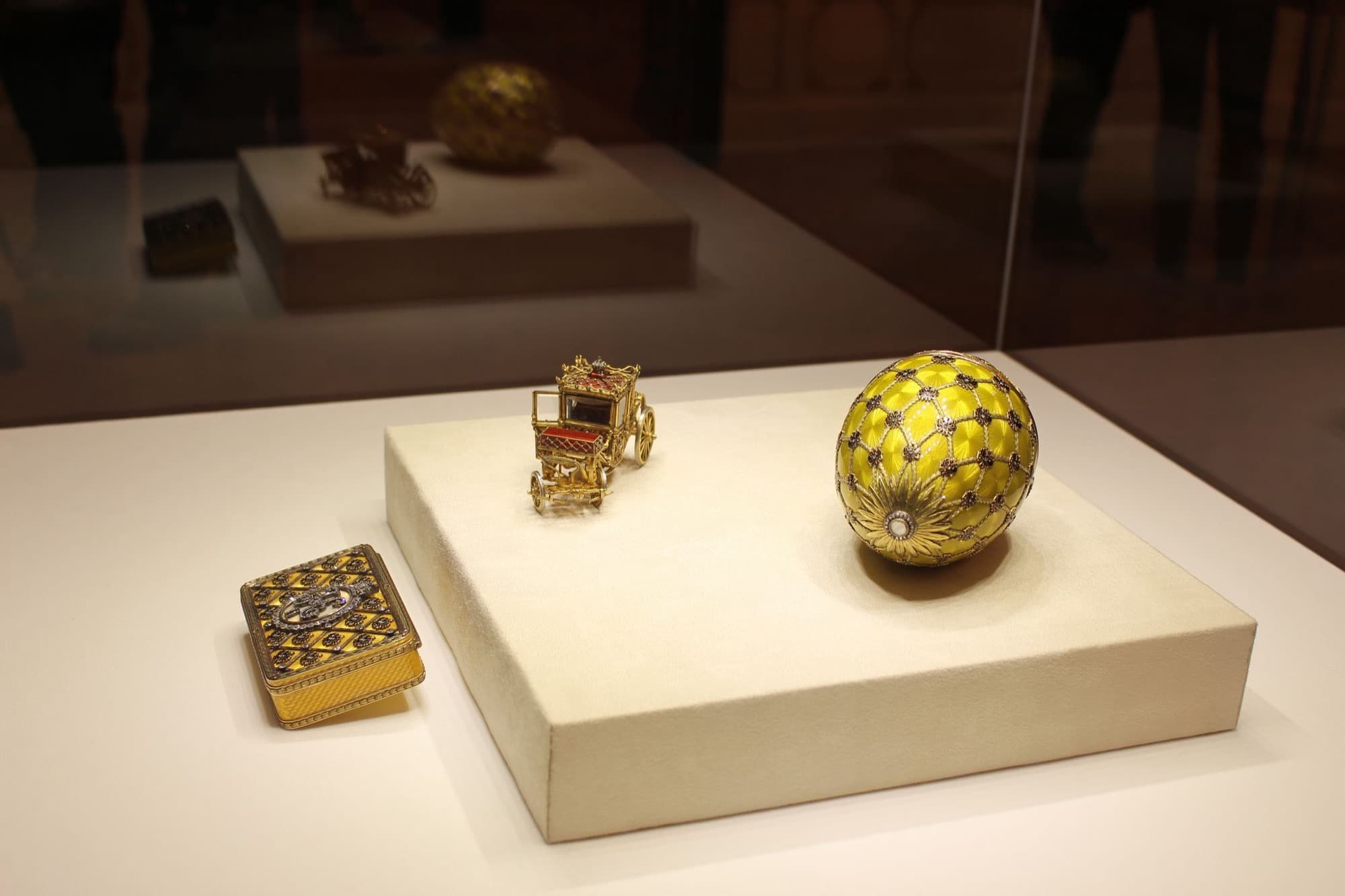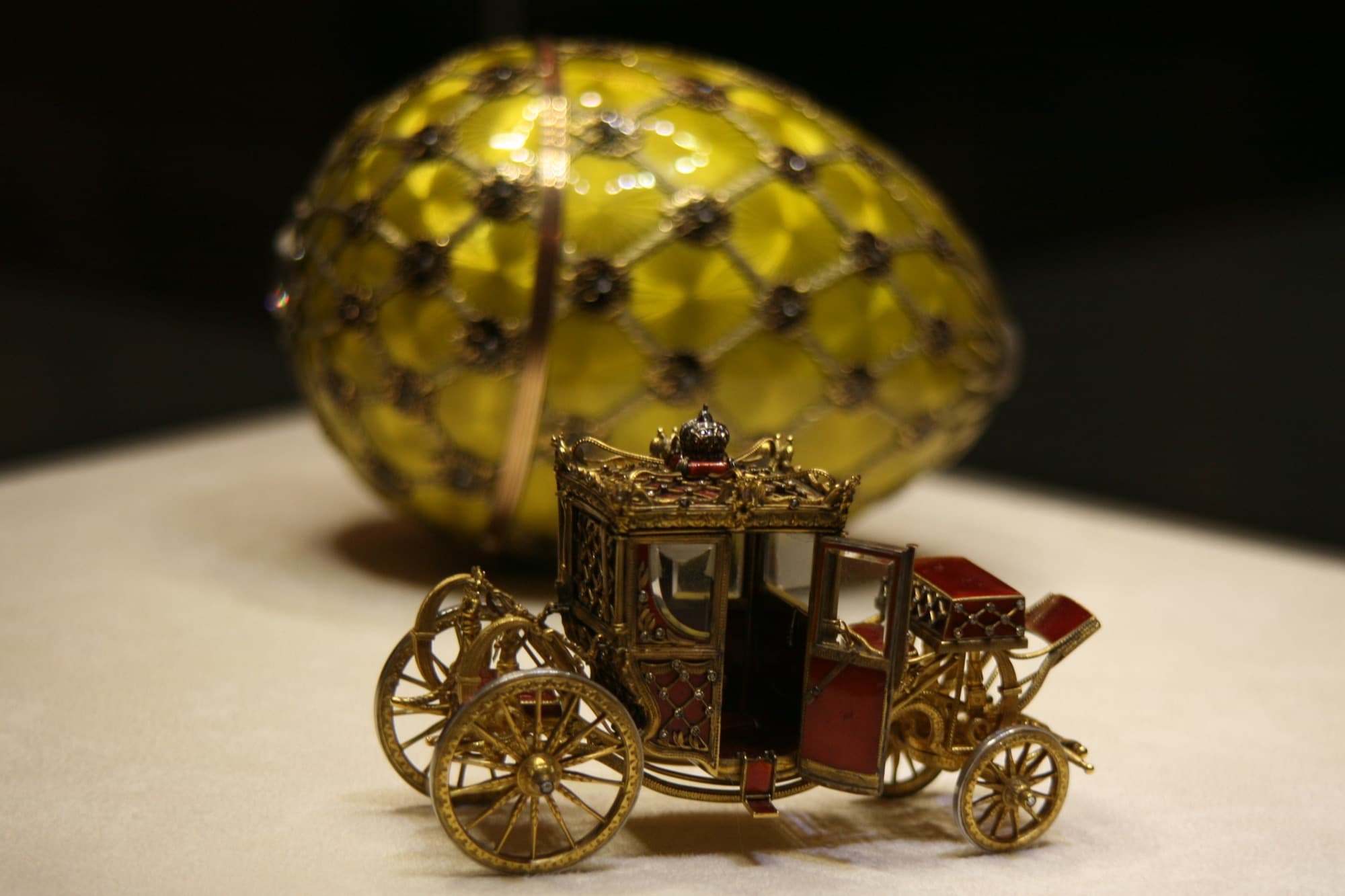
Inside this egg is a carriage. Not a picture of one, but a complete working model of the imperial coronation coach, under ten centimeters long, made of gold and translucent red enamel. Its doors open. A little step folds down. It rides on tiny curved springs, so that the whole thing rocks and sways exactly as the real, full-sized coach did. According to the workshop's accounts, the craftsman who built it spent about fifteen months on this one object, working sixteen hours a day.
That is the secret at the heart of the most famous Fabergé egg. The jeweled shell is only the container. The real feat of craft is the impossible little coach hidden inside it.
What you're looking at
An egg, about twelve and a half centimeters tall, made of gold and covered in shimmering, translucent lime-yellow enamel laid over an engraved sunburst pattern. Over that glowing surface runs a trellis of green-gold laurel, studded at each crossing with the golden double-headed eagle of imperial Russia. It was made in 1897 by the House of Fabergé, under the master craftsman Mikhail Perkhin, as an Easter gift from Tsar Nicholas II to his wife, Empress Alexandra. It commemorates their coronation the year before, and the coach inside is a replica of the one that carried her through Moscow on that day.
What makes it special
The surprise is the real masterpiece. Fabergé eggs were famous for hiding a "surprise" inside, and this is perhaps the greatest of them all. The miniature coach copies an eighteenth-century state carriage down to astonishing detail: engraved windows of rock crystal, a folding step, turning wheels, and working suspension that lets it rock. It is watchmaking precision applied to a toy fit for an empress.
The enamel is engineered light. That extraordinary glowing yellow is guilloché enamel: the gold beneath is machine-engraved with fine rays, then covered in translucent enamel, so light sinks in, reflects off the pattern, and returns shimmering. It is not painted color but trapped, bouncing light, and it is the signature Fabergé magic.
It belongs to a royal tradition of secrets. This is one of about fifty Imperial Easter eggs that Fabergé made for the Russian royal family between 1885 and 1916. Each year brought new eggs, each concealing a fresh surprise, in a private ritual of wonder between the jeweler and the throne. The Coronation Egg is widely considered the finest of them all.
The story behind it
The tradition began in 1885, when Tsar Alexander III gave the first jeweled egg to his wife; his son Nicholas II continued it, commissioning two every Easter, one for his mother and one for Alexandra. This egg celebrates the 1896 coronation, a glittering ceremony that was also shadowed by tragedy, since a crowd stampede during the public celebrations killed well over a thousand people. After the 1917 revolution swept the Romanovs away, the new Soviet state seized the eggs and sold many abroad for hard currency. The Coronation Egg passed through famous collectors, including the Forbes family, before the Russian businessman Viktor Vekselberg bought that collection in 2004 and brought the egg home to Russia.
One detail most people miss
The egg's glowing yellow-gold skin, with its net of laurel and eagles, is not just a pretty pattern. It was designed to reproduce the look of the actual cloth-of-gold robe that Empress Alexandra wore at her coronation. So the gift was deeply personal: Nicholas was handing his wife a jeweled miniature of the most important dress of her life, with a tiny golden copy of her coronation coach tucked inside. An entire sacred day, shrunk to something she could hold in one hand.
Where to see it
The Imperial Coronation Egg is in the Fabergé Museum in Saint Petersburg, housed in the restored Shuvalov Palace, alongside a remarkable group of other Imperial eggs. Seeing them in person is the only way to understand the scale, because photographs flatten both the glow of the enamel and the shocking smallness of the surprises hidden inside. Look for the coach, and remember that a man gave fifteen months of his life to a golden toy barely longer than your thumb.