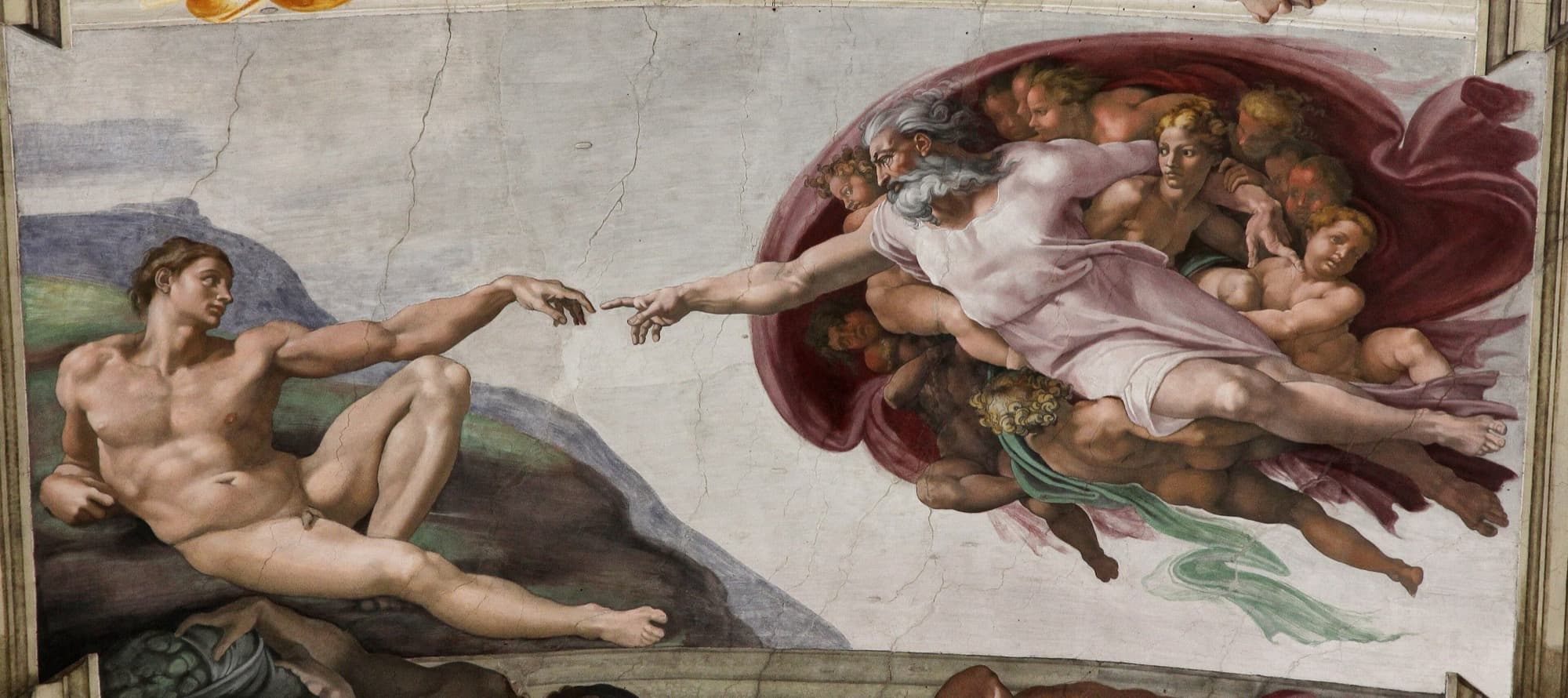
Look closely at the red cloak that swirls around God and the figures tucked inside it. In 1990 a physician named Frank Meshberger argued that the whole shape is an anatomically precise cross-section of the human brain, complete with the inner folds, the base, and a trailing brain stem. Michelangelo had dissected human corpses as a teenager to learn anatomy, and some scholars believe he hid the brain there deliberately, so that the thing God is passing to the first man is not just life, but intellect and the divine spark of the mind.
Whether or not you accept the theory, it captures why this image refuses to let go of us. It is a picture about the exact instant one thing passes into another, frozen forever a hair's breadth before it happens.
What you're looking at
A detail from the enormous ceiling of the Sistine Chapel in the Vatican, painted by Michelangelo between 1508 and 1512. On the right, God rushes in from the sky, borne on a billowing cloak and surrounded by angels, his arm thrown out with tremendous energy. On the left, the first man, Adam, reclines on the bare earth, newly formed, languid, not yet fully awake. Their hands reach toward each other, and their index fingers almost, but do not quite, touch. The spark of life is caught in the gap between them.
What makes it special
Everything happens in the space that stays empty. The two fingers never meet. Michelangelo could have shown them touching, but he chose the moment just before, so the whole painting hums with a tension that a completed gesture would have released. We supply the contact ourselves, in our heads, every time we look.
It contrasts two kinds of being. God is all motion, muscle, and purpose, flying in with a crowd and a plan. Adam is heavy, passive, and perfect, able only to lift a limp hand. One figure gives; the other is about to receive. The difference between creator and created is written entirely in their bodies.
It is painted, but it was made by a sculptor. Michelangelo thought of himself as a carver of marble and took the ceiling job reluctantly, under pressure from Pope Julius II. Yet the figures have the weight, the twist, and the muscular solidity of statues. He painted bodies the way he cut them from stone.
The story behind it
Michelangelo spent roughly four years on the ceiling, around five hundred square meters of it, and he did not enjoy it. He worked standing on scaffolding, head tilted painfully back, paint dripping into his face, a posture so grueling he wrote a comic poem complaining that his beard pointed at heaven and his spine was knotting up. The popular image of him lying flat on his back is a myth. He was upright the whole time, reaching over his own head for years. When the plaster of a fresco dries, it cannot be corrected, so each day's section had to be judged perfectly and painted fast, before the surface set.
One detail most people miss
Adam is not the only figure God is holding. Tucked under the deity's other arm is a young woman, gazing out at Adam with striking intensity. For centuries people assumed she was Eve, waiting to be created next. Many scholars now think she may be Eve, or the Virgin Mary, or wisdom itself, present in the mind of God before she ever enters the world. Whoever she is, she turns the scene from a simple handoff into something stranger: the first man meeting the eyes of a future that has not happened yet.
Where to see it
The Creation of Adam is on the ceiling of the Sistine Chapel, inside the Vatican Museums in Rome, where popes are still elected beneath it. You will have to look up, in a crowded room where talking is discouraged, among dozens of other scenes Michelangelo packed overhead. Find the two famous hands, then let your eye travel out to the brain-shaped cloak and the watching woman, and remember that every bit of it was painted by a man who insisted, to the end, that he was really a sculptor.