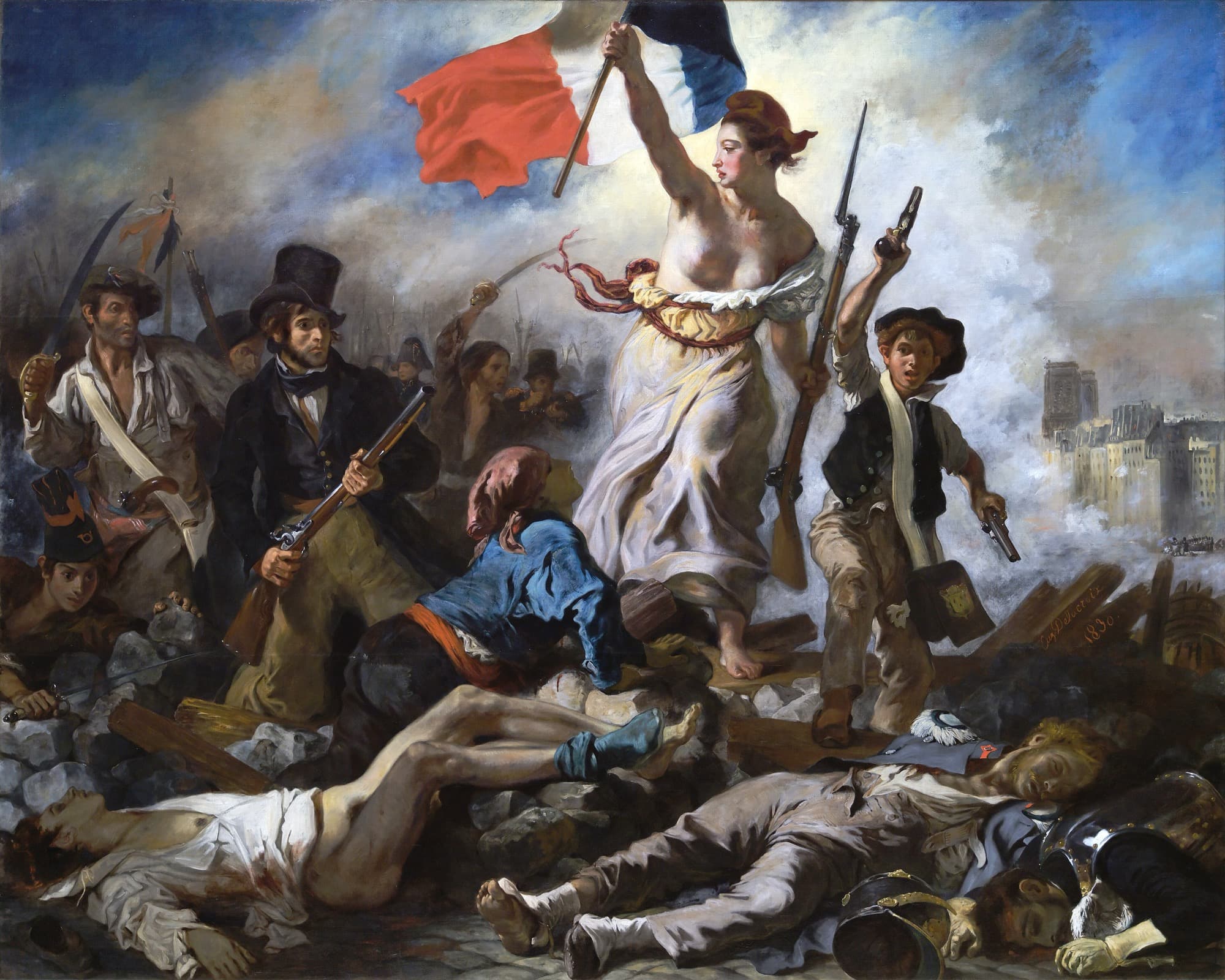
The most famous painting of the French Revolution is not a painting of the French Revolution. Almost everyone assumes this barricade scene, with its flag and its heroine, shows 1789, the storming of the Bastille, the guillotine, all of it. It does not. It shows a different, much shorter uprising forty years later: the "Three Glorious Days" of late July 1830, when Parisians rose up over three days and toppled the restored Bourbon king, Charles X.
That gap between what the picture shows and what we assume it shows is part of its power. Delacroix did not paint one revolution. He painted the idea of revolution itself, so convincingly that it swallowed the specific event and became the image of every uprising since.
What you're looking at
A woman strides forward over a barricade of rubble and bodies, bare-breasted, a red cap on her head, the tricolor flag of France raised in one hand and a bayoneted musket in the other. She is Liberty, not a real individual but the idea of freedom given a human form. Around her surges a cross-section of the city: a man in a top hat and frock coat gripping a gun, a young boy brandishing two pistols, a worker with a saber, students, fighters, and the fallen dead at her feet. Behind them, smoke and the rooftops of Paris. The canvas is huge, well over two and a half meters wide, and it hangs in the Louvre.
What makes it special
She is a goddess and a real woman at the same time. This is the daring heart of the painting. Liberty is an allegory, a symbol stepping out of myth, yet Delacroix paints her with dirty skin, visible body hair, and sweat, like a real woman who has been fighting in the street. In 1830 that fusion of the divine and the grubbily human shocked people. A symbol was supposed to be clean and remote; this one bleeds and strains.
It turns yesterday's news into myth. Delacroix took a political event that had happened only months earlier and gave it the scale and grandeur usually reserved for ancient heroes and gods. That instinct, to treat raw modern emotion and current events with epic intensity, is the essence of Romanticism, the movement he led in French painting.
It puts all of society on one barricade. Look at who is fighting: a well-dressed bourgeois, a ragged street child, a laborer, a student. Delacroix crowds the classes together behind Liberty, turning a messy real revolt into a single image of "the people" rising as one body.
The story behind it
Delacroix himself did not fight in the July uprising; he watched it as a bystander. But he wrote to his brother that if he could not fight for his country, at least he could paint for her, and he threw himself into this enormous canvas within months. The new government bought the painting, then quickly grew nervous about its raw revolutionary energy and kept it out of public view for years, worried it might inspire the very thing it depicted. Over time, the woman at its center merged with Marianne, the symbol of the French Republic, and the painting became one of the most reused political images in the world, echoing in everything from Victor Hugo's Les Misérables to banknotes and album covers.
One detail most people miss
Look to the far right, into the haze of smoke beyond the fighters. There, faint but unmistakable, rise the two towers of Notre-Dame cathedral, quietly pinning this mythic scene to a real place: Paris. Delacroix even sets a tiny tricolor flag flying from the cathedral in the distance, a small answering echo of the giant flag Liberty carries. It is easy to be so caught by the heroine and the flag that you never notice the actual city burning behind her.
Where to see it
Liberty Leading the People hangs in the Louvre in Paris, where it was given fresh brilliance by a major restoration completed in 2024. It is big enough to dominate its room, and it is usually surrounded by a crowd, so be patient. Stand back far enough to feel the upward surge of the whole composition toward the flag, then move closer to see the mud on Liberty's skin and the faces of the ordinary, mortal people Delacroix sent charging into history beside her.