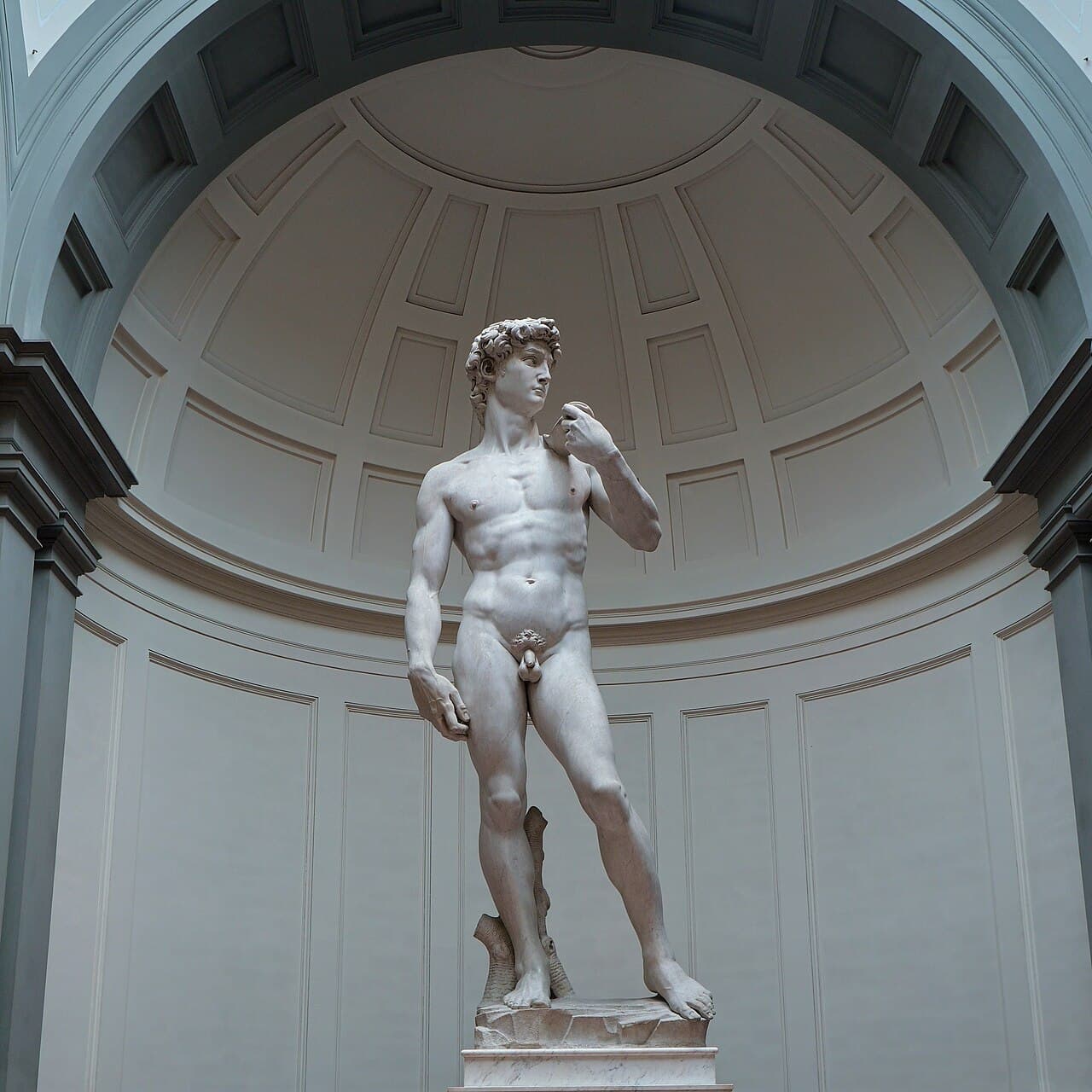
He is seventeen feet of marble, and the first thing people notice in the room is not his size. It is that he seems to be thinking. The brow tense, the eyes locked on something far away, the right hand hanging loose but its veins swollen, as if the blood already knows what is coming. This is not a monument to a winner. It is a portrait of the second before.
Michelangelo Buonarroti was 26 when he won the commission in 1501, and he inherited a problem, not a block: a colossal piece of marble that another sculptor had begun and botched forty years earlier. It had been lying in a cathedral courtyard ever since, nicknamed the Giant, considered ruined. Michelangelo looked at the damaged stone and said he could find the figure inside it.
What you're looking at
David, the shepherd boy of the Bible, in the minutes before he faces Goliath. The sling is draped over his left shoulder, almost invisible; the stone sits hidden in his right hand. He is completely naked, completely still, and completely focused. Three years of carving, finished in 1504, from a single block, no additions, no patches.
What makes it special
He chose the wrong moment on purpose. Every earlier David, including Donatello's famous bronze, shows the boy after the battle, with Goliath's head at his feet. Michelangelo removed the trophy, the sword, the victory. What is left is the decision itself: a young man measuring a giant and choosing not to run. It turns a Bible illustration into a picture of human resolve.
The proportions are deliberately wrong. The head and the right hand are too big. The statue was originally meant for the cathedral roofline, seen from forty meters below, so Michelangelo enlarged what distance would shrink. When the city saw the finished figure, it was too good to lift into the sky. The distortions stayed, and they read as intensity: a mind and a hand, oversized.
The stone was second-hand. The block was shallow, scarred and weathered. Michelangelo had to fit the entire figure into a slab other masters had rejected as unusable. Constraint became style: David's taut, compressed pose comes partly from the thinness of the ruined stone he was found in.
The story behind it
Florence in 1504 was a fragile republic surrounded by stronger powers, and it read the statue instantly: we are David, everyone else is Goliath. Instead of the cathedral, the city placed him at the entrance of its government palace, facing Rome. He stood there through riots, a lightning strike, and a 1527 uprising in which a thrown bench snapped off his left arm; a teenage admirer gathered the pieces. In 1873 he was moved indoors, a four-day journey through the streets on rails, into a gallery built around him like a shrine.
One detail most people miss
Walk around to the eyes, or find a close-up photograph: the pupils are carved in the shape of tiny hearts. It is a sculptor's trick, hollowing the pupil so it catches shadow and reads as alive from below. From the front, it simply looks like the gaze of someone who has already decided.
Where to see it
Galleria dell'Accademia, Florence. Go early or book ahead; then, on your way out, look at Michelangelo's unfinished Prisoners in the same corridor, figures still half-buried in their blocks. They show you exactly what he meant when he said the statue was already inside the stone.