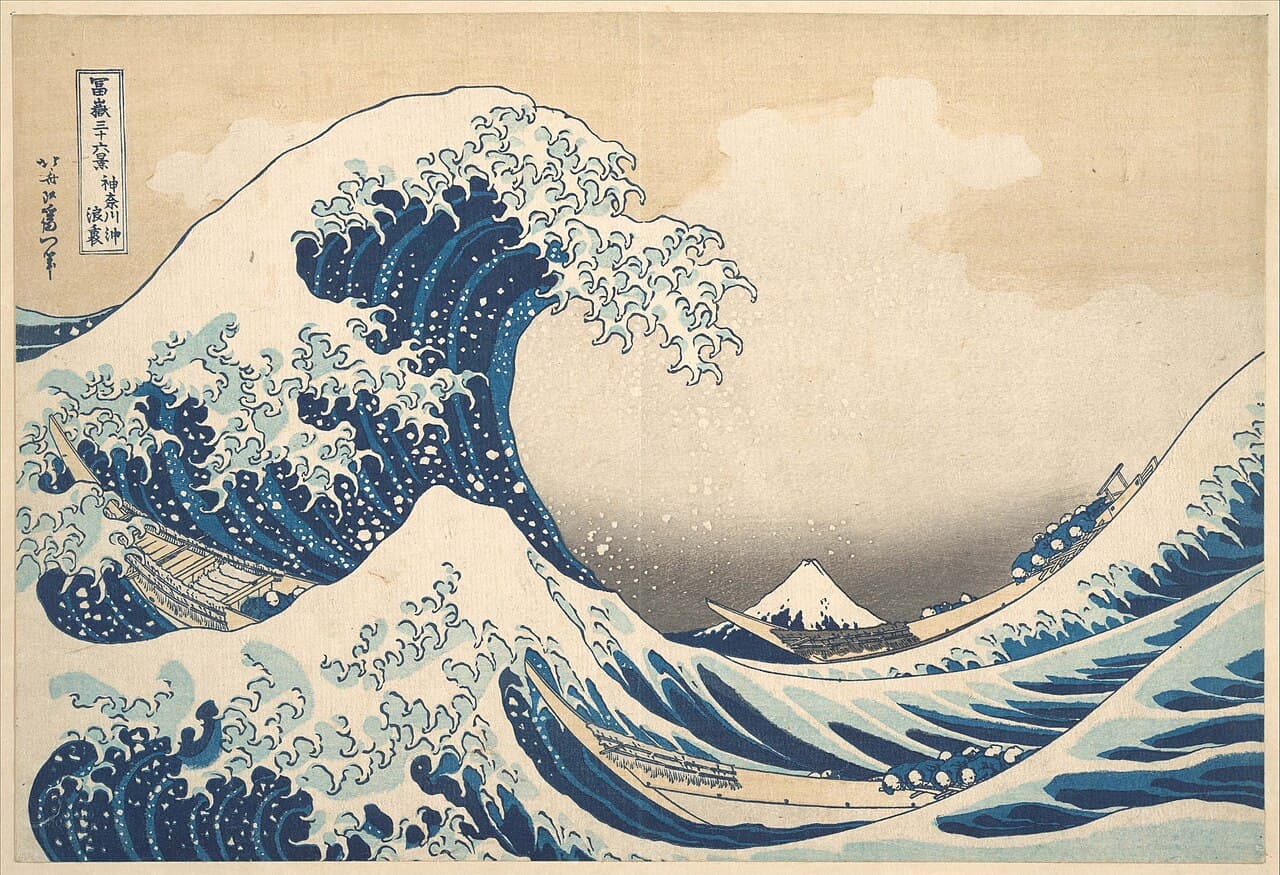
You know this wave. It curls on phone cases, T-shirts, tattoos, even an emoji. Its claws of foam hang over two slender boats, about to fall, forever. And in the distance, small enough to miss, sits the sacred mountain the picture is actually named after.
Katsushika Hokusai designed it around 1831 as part of a series called Thirty-six Views of Mount Fuji. He was about seventy years old, had already used more than thirty different artist names, and signed this period of his life, without irony, as "the old man crazy about painting."
What you're looking at
This is not a painting. It is a woodblock print: the design was carved into cherry-wood blocks, one block per color, inked and pressed onto paper by professional printers, thousands of times. Copies sold in Edo for roughly the price of a bowl of noodles. Museums around the world now guard surviving impressions like treasure, but the Wave was born as popular, disposable media.
What makes it special
The perspective is a trick borrowed from Europe. Traditional Japanese art rarely used deep perspective. Hokusai had studied smuggled Dutch engravings, and he uses the low European viewpoint to make the wave tower and Fuji shrink. The result reads instantly to any eye, Eastern or Western: distance itself becomes the drama.
The blue was brand new. That deep, electric blue is Prussian blue, a synthetic pigment recently imported into Japan and affordable for the first time. The entire series was marketed partly on the novelty of this color. The most Japanese image in the world is painted with Berlin chemistry.
The wave has claws. Look at the foam: it splits into hooked fingers reaching for the boats. In the trough below, oarsmen flatten themselves and hold on. Hokusai freezes the moment before impact, and gives the sea an animal's intent. Terror and beauty in one curve.
The story behind it
Fifty years after Hokusai's death, Japan opened to the West, and ukiyo-e prints flooded into Paris, sometimes literally as packing paper around ceramics. Monet collected them. Van Gogh copied them and owned a copy of the Wave. Debussy kept the image near while composing La Mer, and its first edition carried the wave on the cover. This influence had a name, Japonisme, and it loosened European art's grip on realism at exactly the moment Impressionism needed it.
One detail most people miss
Look at the foam on the wave's crest, then at the snow on Fuji's peak. Hokusai rhymes them: the sea wears the mountain's snow. The largest thing in Japan and the most violent thing in the sea, made of the same white. In a print about danger, that quiet rhyme is the eye of the storm.
Where to see it
Impressions survive in the Metropolitan Museum in New York, the British Museum in London, and elsewhere; because prints fade, they are shown in rotation. Hokusai, at 75, wrote that nothing he made before 70 was worth counting, and that at 110 every dot and line would be alive. He made it to 88, still drawing.