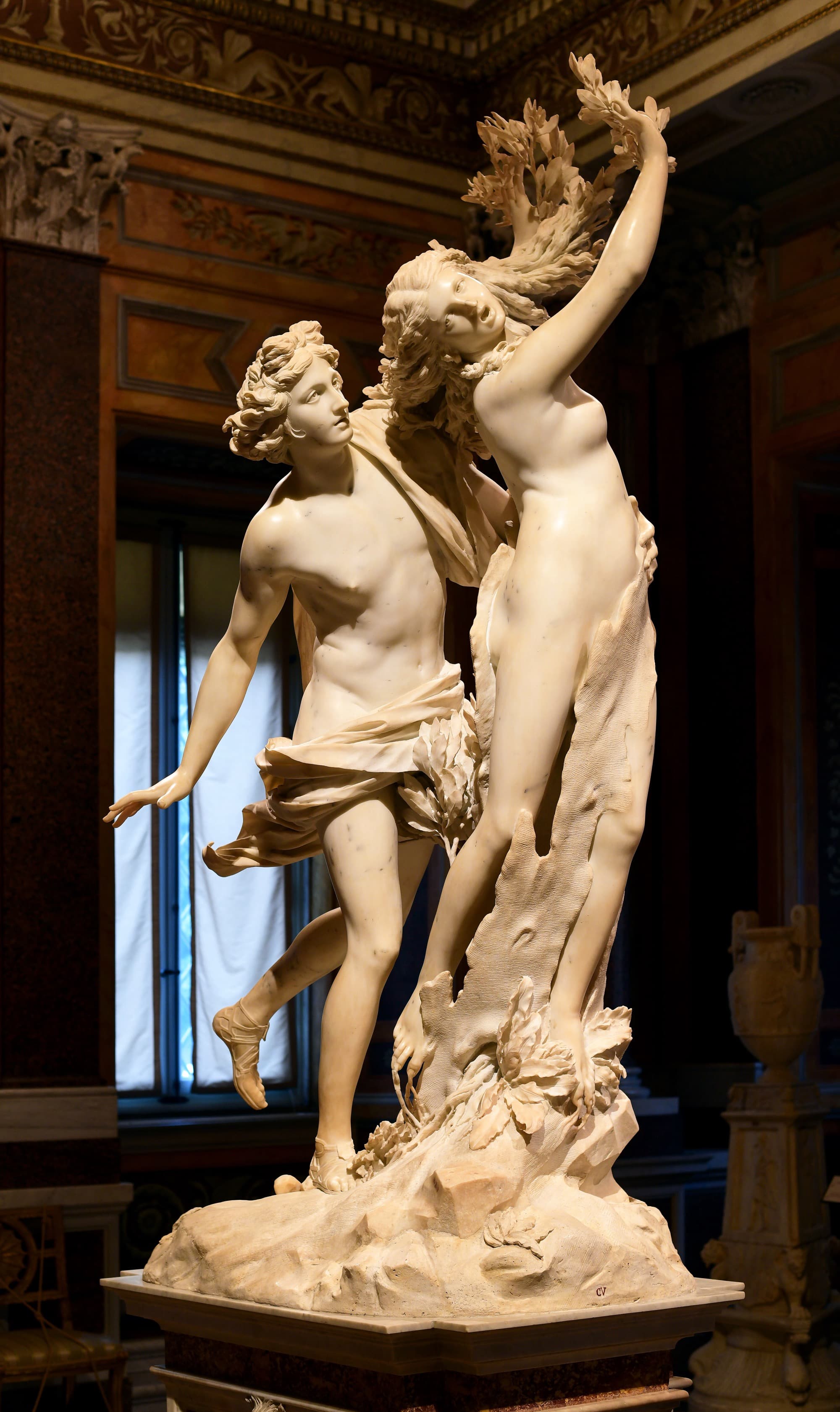
Carved into this block of marble are fingertips turning into sprouting leaves, and the leaves are shaved so thin that light actually passes through them. Bark climbs a running thigh. Toes stretch into roots that grip the ground. Hair stiffens into branches. All of it is one continuous piece of stone, and all of it was carved by a sculptor who was twenty-four years old.
Apollo and Daphne is the moment young Gian Lorenzo Bernini announced that he could make marble do anything. Not look like marble pretending to be a person, but look like flesh, wind, and foliage, caught in a single violent half-second of transformation.
What you're looking at
The sculpture tells a moment from an ancient myth. The god Apollo, maddened with desire, is chasing the nymph Daphne, who wants nothing to do with him. At the instant he finally catches her, she is being saved by a desperate magic: she is turning into a laurel tree. Bernini freezes them exactly there. Apollo is still running, reaching, his face shifting from triumph toward shock. Daphne twists away mid-stride, her mouth open in a cry, as the change races up her body. It stands, larger than life, in the Galleria Borghese in Rome, where it has been since Bernini finished it in 1625.
What makes it special
It captures a single impossible instant. Most sculpture shows a pose. This shows a transformation in progress, frozen at the one split-second when Daphne is half woman, half tree. A moment sooner and nothing has happened; a moment later and she is only a tree. Bernini found the exact frame.
It makes marble lie about what it is. Stone is heavy, cold, and brittle. Bernini makes it look like soft skin under a grabbing hand, like hair caught in the wind, like leaves delicate enough to tremble. The famous test is the foliage at her fingers, carved so fine and translucent it hardly seems possible it is the same material as the solid base.
It is built to be walked around. This is Baroque sculpture, made for movement, not for a single flat view. As you circle it, the story unfolds: from one side you feel the chase, from another the horror of the change. It behaves almost like theater staged in stone, unfolding differently depending on where you stand.
The story behind it
The myth comes from the Roman poet Ovid. Cupid, insulted by Apollo, fires two arrows: a golden one that fills Apollo with love, and a lead one that fills Daphne with revulsion. Apollo pursues; Daphne flees and, as he closes in, begs her father, a river god, to destroy the beauty that has doomed her. He answers by turning her into the laurel tree, which Apollo then claims as his sacred plant. That is why laurel wreaths crown poets and victors to this day. The sculpture was commissioned by Cardinal Scipione Borghese, a powerful collector, and it made the young Bernini the most sought-after sculptor in Rome, a position he held for the rest of a very long career.
One detail most people miss
A near-naked chase scene, driven by lust, was a slightly awkward thing to display in a cardinal's villa. So a solution was carved into the base: a moralizing Latin couplet, written by the cardinal's relative Maffeo Barberini, who would soon become Pope Urban VIII. Roughly translated, it warns that those who chase fleeting pleasures end up grasping nothing but bitter leaves. With that inscription, a story about a god's uncontrolled desire was quietly rebranded as a lesson in virtue, which is exactly how a pleasure object got to live respectably in a holy man's house.
Where to see it
Apollo and Daphne is in the Galleria Borghese in Rome, along with several other early Bernini masterpieces in the same rooms. The museum admits visitors in timed two-hour slots and you must book ahead, but it is worth the planning. When you get there, do not just face the sculpture. Walk a slow circle around it and watch the chase turn into a transformation, the way Bernini designed you to.