In the spring of 1820, a farmer on the Greek island of Milos was clearing stones from his field when he broke into a hidden niche and found, buried in pieces, a marble woman taller than himself. Within months she was on a ship to Paris, and within a few years she was the most famous statue in the world. She is missing both arms, and nobody has ever found them, and that absence has done more for her fame than any pair of arms ever could.
What you're looking at
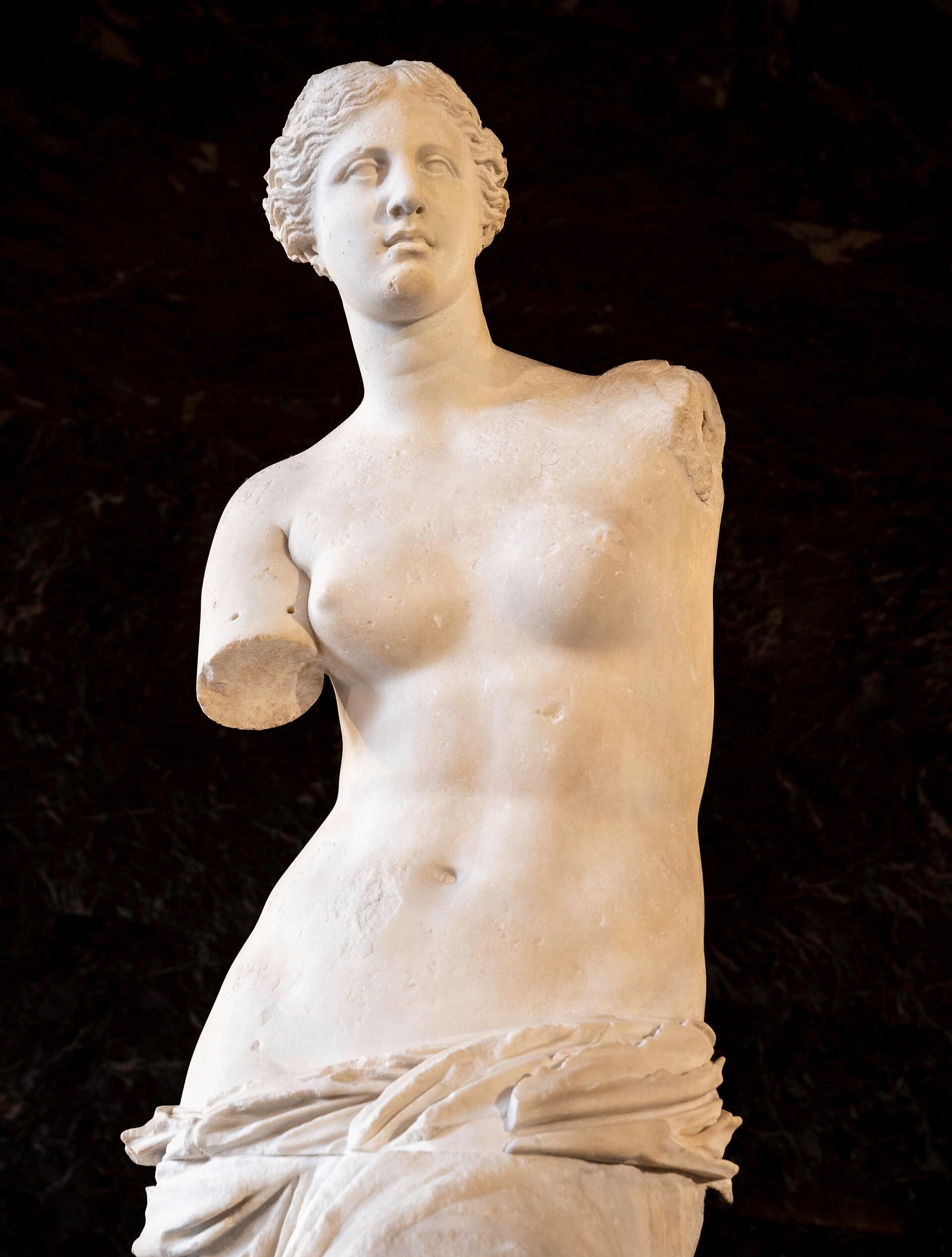
The statue shows Aphrodite, the Greek goddess of love, whom the Romans called Venus. She stands just over two meters tall, carved from gleaming white marble, nude from the waist up, with drapery slipping down over her hips as though about to fall entirely. Her body turns in a gentle spiral, weight on one leg, torso twisting, head tilting away, so that no matter where you stand she seems caught in a slow, living movement. She was made around 120 BC, late in the Greek tradition, by a sculptor most scholars now believe was named Alexandros of Antioch, from a lost inscription that once sat at her base.
What makes it special
She moves without moving. The whole figure is built on a spiral: the hips go one way, the shoulders another, the head a third. Your eye is pulled around her body in a curve, and the marble reads as flesh caught mid-turn. This sense of a frozen instant of motion is the signature achievement of Hellenistic sculpture, and she is one of its finest surviving examples.
The drapery is a magic trick. Look at where the cloth meets skin. The marble is carved so that the fabric seems soft and heavy, sliding, while the body beneath is smooth and warm. One material, worked two completely different ways, so convincingly that you forget it is all cold stone.
Her fame is partly French politics. When the Venus reached the Louvre in the 1820s, France had recently been forced to return another celebrated Venus, looted by Napoleon, to Italy. The French needed a replacement icon, and they promoted the new arrival relentlessly, declaring her a supreme masterpiece of the classical age. The hype worked. She became, and remains, one of the two or three most recognizable sculptures on Earth.
The story behind it
The missing arms are the great mystery, and almost everyone who has studied her has a theory. Fragments of a hand holding an apple were reportedly found nearby, which would make her Aphrodite holding the golden apple of the myth, a pun on the island's name, Melos, which sounds like the Greek for apple. Others think she was spinning wool, or holding a shield as a mirror, or resting an arm on a pillar. The truth is that we do not know, and probably never will, and the not-knowing is now inseparable from the statue. Generations of viewers have supplied her missing gesture from their own imaginations.
There is also the quieter loss. When she was found, she reportedly still had traces of the things ancient statues almost always had and that we have been trained to forget: color on her skin and hair, and metal jewelry, earrings, a bracelet, a headband, fitted into holes still visible in the marble. The pure white, unadorned goddess we admire as the essence of classical restraint is, in part, an accident of time stripping away everything the sculptor actually put on her.
One detail most people miss
Walk around her, if you ever can. From the front she is calm and frontal, almost posed. But step to her left side, the angle the sculptor clearly cared about most, and the spiral snaps into focus: the turn of the hips, the fall of the cloth, the twist of the spine all line up into a single sweeping curve. She was not made to be seen straight on, like a photograph. She was made to be walked around, revealing herself gradually, which is why every flat picture of her, including this one, quietly fails to capture what she actually is.
Where to see it
The Venus de Milo has her own place of honor at the Louvre in Paris, at the end of a long gallery so you approach her from a distance, the way her makers intended. Do the thing the crowds forget to do: walk past the front, around to her side, and watch a two-thousand-year-old piece of stone come to life.