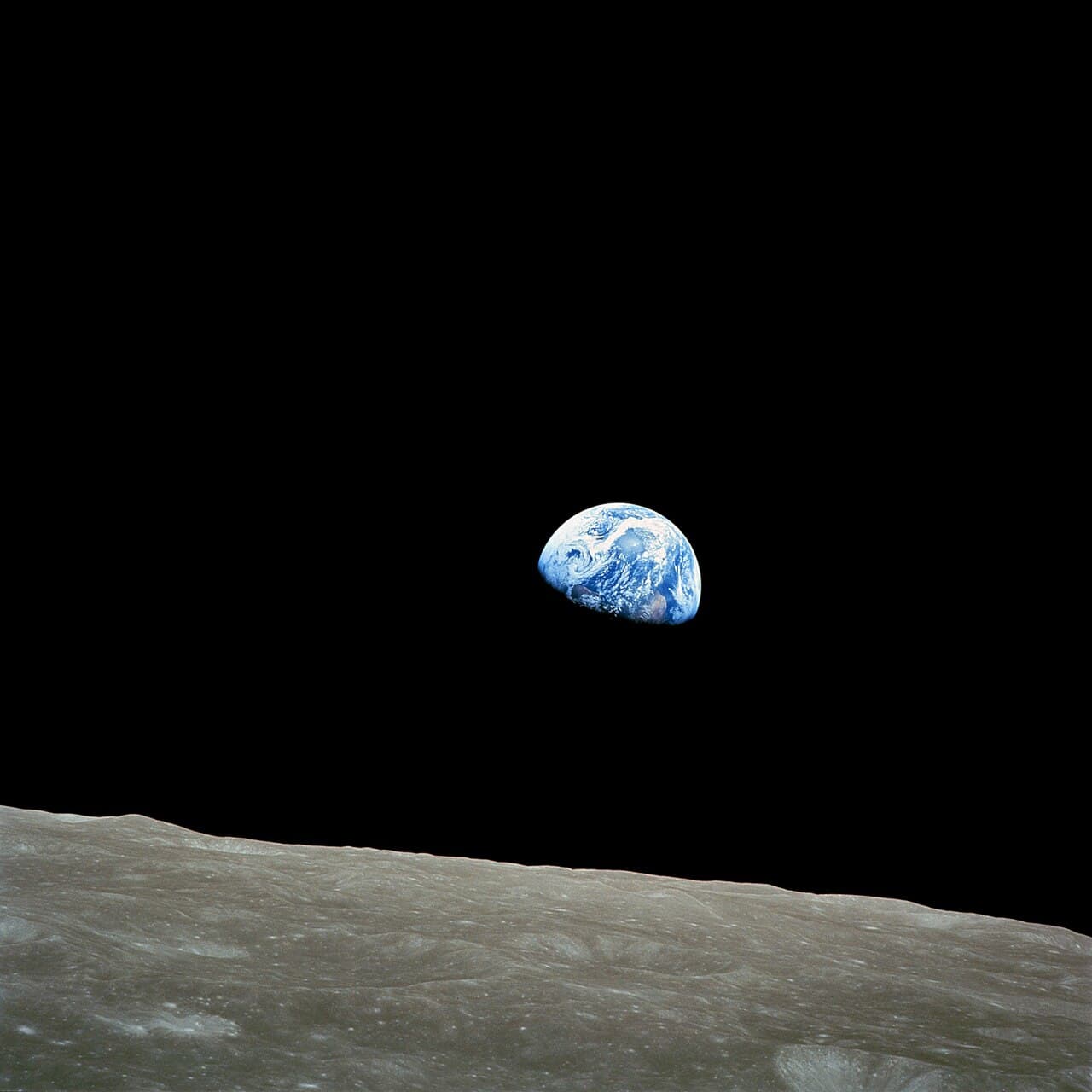
The photograph is upside down, in a sense. To the three men who took it, the Earth was not rising at all: it was simply hanging there, off to the side of a dead grey horizon, a blue and white marble in a black that has no end. Bill Anders would later put the whole mission in one sentence: we came all this way to explore the Moon, and the most important thing we discovered was the Earth.
Apollo 8, December 1968: the first time human beings ever left Earth's orbit. Frank Borman, Jim Lovell and Bill Anders spent twenty hours circling the Moon on Christmas Eve, tasked with photographing its surface to scout landing sites for the missions to come. The Moon was the assignment. The Earth was an interruption.
What you're looking at
The grey lunar horizon slices the bottom of the frame, airless and sharp. Above it, slightly more than half-lit, the Earth: the blues of ocean, the spiral white of weather, the browns of Africa somewhere under cloud. No stars, the exposure will not allow them, so the planet floats in pure black. It was shot on a Hasselblad camera with color film, through the window of a spacecraft moving at thousands of kilometers per hour.
What makes it special
It was not in the plan. The photo schedule was lunar surface, lunar surface, lunar surface. When the capsule rotated and Earth swung into the window, Anders called out for color film, fast, while Lovell hunted for a magazine of it and Borman, half-joking, pointed out that the shot was not scheduled. The most reproduced environmental image in history exists because a crew broke the flight plan by about ninety seconds.
It reversed the direction of the mission. Every eye on the project pointed outward: to the Moon, to the frontier, to beating the Soviets. The photograph pointed back. Nature magazine's wilderness photographer Galen Rowell later called it the most influential environmental photograph ever taken. Within sixteen months of its publication came the first Earth Day; within four years, sweeping environmental legislation. A picture taken by a military test pilot became the banner of the ecology movement.
The scale does the arguing. No caption is needed, and none would help. Everything anyone had ever fought over, every empire, every border, fits in a quarter of the frame, with visible room to spare. The photograph does not say the Earth is fragile. It lets you notice it yourself, which is why it worked.
The story behind it
That same Christmas Eve, the crew broadcast live to the largest television audience in history to that point, reading from Genesis as the Moon rolled beneath them. 1968 had been a brutal year, assassinations, war, riots, and a stranger famously telegraphed Borman afterward: thank you, Apollo 8, you saved 1968. Anders flew in space only that once. He said the Earth, seen from out there, looked like a Christmas tree ornament: colorful, shiny, and very breakable.
One detail most people miss
Anders was, by his own account, the crew member least interested in poetry: a nuclear engineer and fighter pilot with a checklist. The most spiritual photograph of the century was taken by its most matter-of-fact witness, on a stolen minute and a half. Awe, it turns out, is not a personality type. At sufficient altitude, it is simply the view.
Where to see it
Everywhere, which is fitting: it belongs to no museum and to everyone, a US government photograph, public domain from the moment of its creation. A print flew on every subsequent story about the whole Earth, from the covers of counterculture catalogs to classroom walls. The original negative rests with NASA. The subject is available nightly, underfoot.