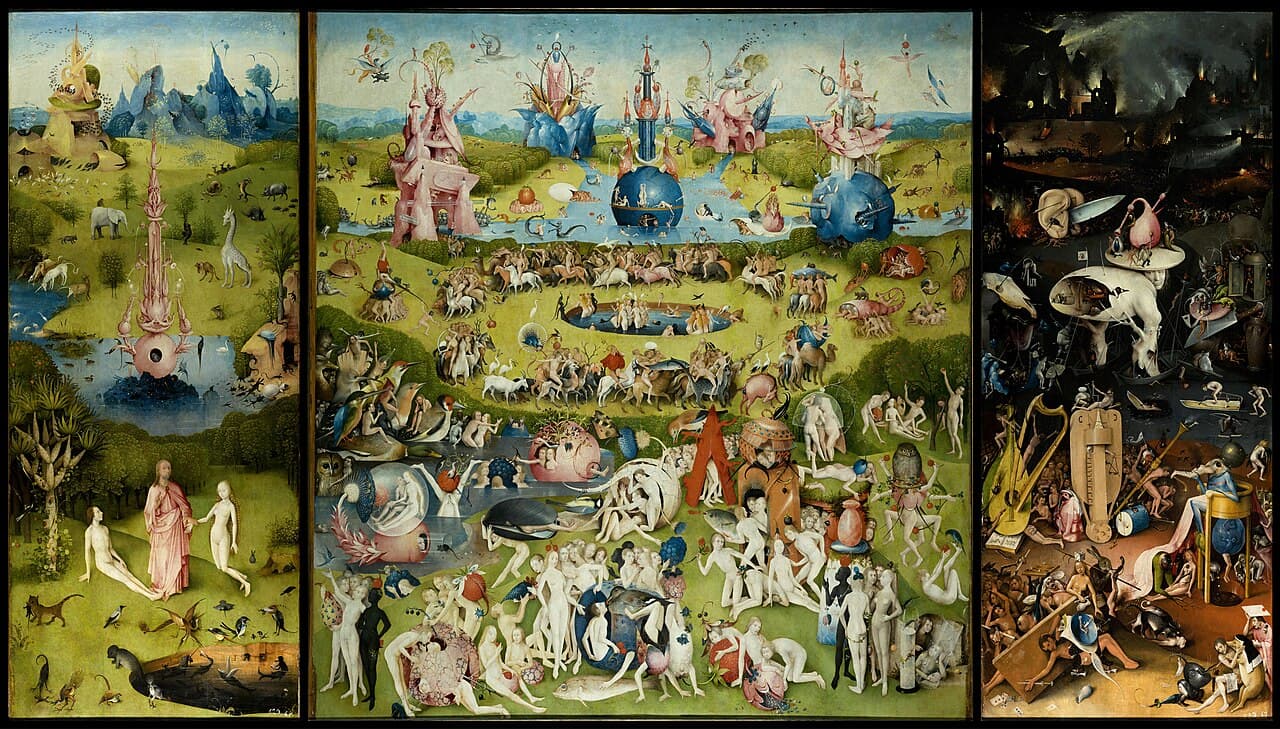
Somewhere on this triptych, a man is being serenaded by a demon with a flute lodged where flutes should never be. Elsewhere, a couple embraces inside a floating mussel shell, a procession of naked riders circles a pool of women on the backs of camels and unicorns, and a pair of ears armed with a knife advances across Hell like a tank. It was painted around 1500, for a wealthy family's palace in the Netherlands, and it remains, by a comfortable margin, the strangest famous painting in the world.
About Hieronymus Bosch the man, we know almost nothing: a respected painter in the prosperous town of 's-Hertogenbosch, a member in good standing of a pious religious brotherhood, dead in 1516. No letters, no diaries, no scandal. The mystery is not who he was. It is what he saw.
What you're looking at
Three panels. Left: Eden, where God presents Eve to a startled Adam, watched by a giraffe, an elephant, and creatures no zoology admits. Center, the largest: hundreds of naked figures feasting on giant berries, riding birds, cavorting in transparent spheres, a humanity wholly absorbed in pleasure, with not one visible consequence. Right: night, fire, and the consequences: a Hell of musical instruments turned into torture devices, a bird-headed prince devouring sinners whole, and, at its center, a pale tree-man with a broken eggshell body whose face turns to look directly at you. Close the wings and the outside shows the world on the third day of creation, a grey globe in glass, before any of it happened.
What makes it special
It reads in a direction, but will not say what it means. Paradise, pleasure, punishment: the sequence looks like a straightforward sermon, sin and its wages. But the middle panel refuses to behave like a warning. Nobody in the garden looks guilty; the frolicking is innocent, almost botanical. For five centuries scholars have argued: moral alarm, lost-paradise fantasy, secret heresy, satire. The painting outlasts every theory, which may be the design.
It invented a visual language from nothing. Hybrid demons, living machines, fruit as architecture, scale gone fluid: there was no tradition for this. Bosch built his other world from combinatorial play with this one, four hundred years before Surrealism made that a movement. When Dalí and Miró needed ancestors, the Prado had one waiting. His contemporaries already had a word for followers who imitated the manner; the manner has never gone out of production since.
The details reward obsession. This is a painting you read with your nose almost touching it: the owl peering from the fountain in Eden, the man crucified on a harp's strings, the pair of dancing figures inside a bubble growing from a flower. The Prado's high-resolution scans let you fall in for hours. Five hundred years of viewers have each found their own private corner of it; that intimacy at monumental scale is Bosch's quietest trick.
The story behind it
The painting was almost certainly commissioned by a noble family for display and conversation, not for a church; guests would have debated its meaning over dinner, exactly as scholars do now. Within decades it was acquired by Philip II of Spain, the most militantly Catholic monarch in Europe, who hung Bosch's visions in his austere palace monastery and reportedly contemplated them devoutly. The strangest painting of its age spent centuries as royal property of its least strange audience, and entered the Prado, where it now receives its pilgrims daily.
One detail most people miss
The tree-man of Hell, the composite giant whose body is a cracked egg propped on dying trunks, wears a face that is calm, wry, and turned outward, meeting your eye from the middle of the catastrophe. Many scholars have proposed it is Bosch himself. If so, it is the only self-portrait in history painted as the ruined centerpiece of the artist's own Hell, watching you tour it.
Where to see it
The Prado, Madrid, in a room it shares with nothing that can compete. Go twice: once from across the room, where it reads as a shimmering tapestry, and once at reading distance, where it dissolves into a thousand small impossible stories. The museum's website hosts a zoomable scan for the days in between.