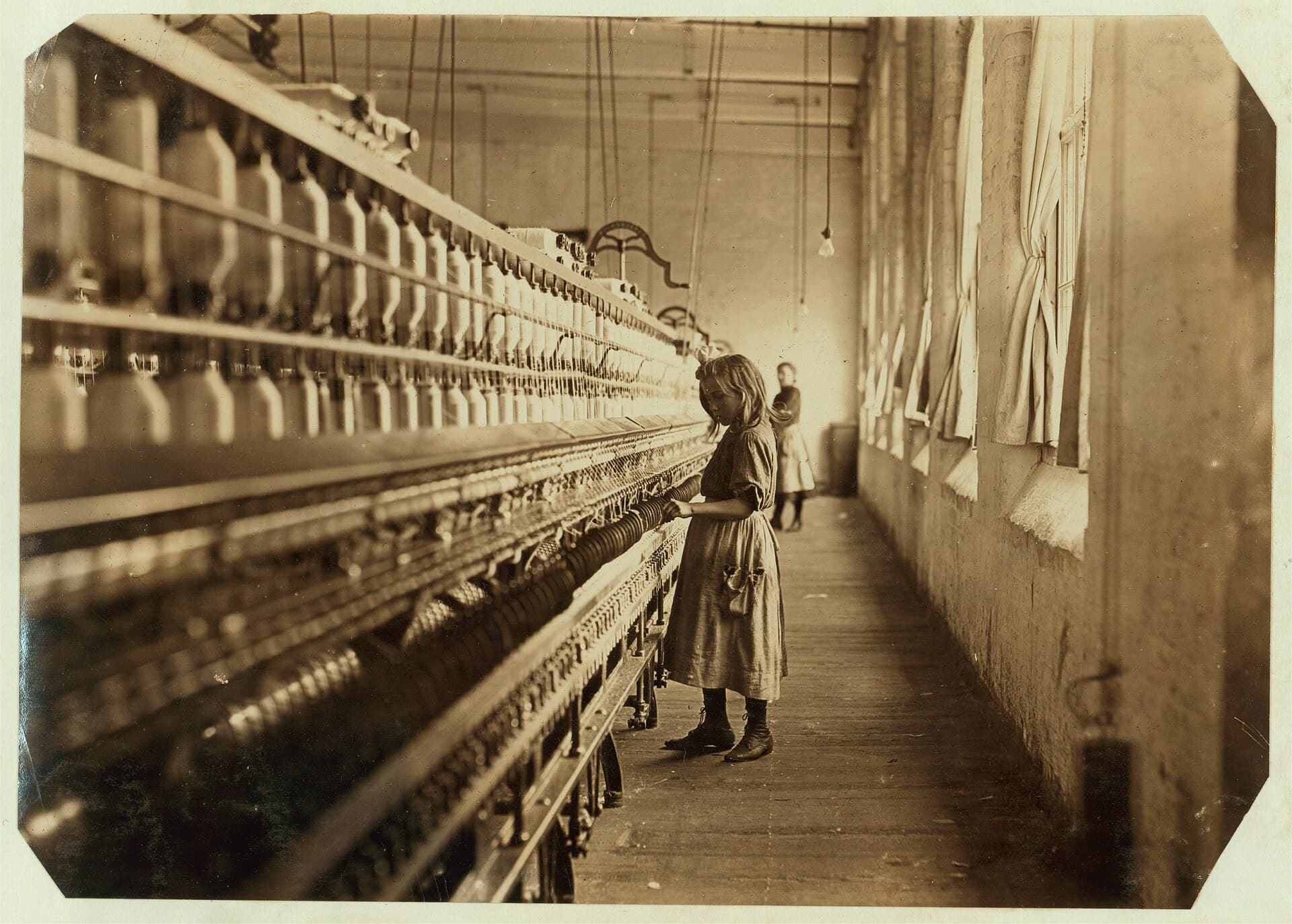
The caption Lewis Hine wrote for this photograph is a masterpiece of controlled anger, disguised as bureaucratic data: "Sadie Pfeifer, 48 inches high, has worked half a year. One of the many small children at work in Lancaster Cotton Mills. Nov. 30, 1908."
Forty-eight inches. He measured her against the machine because he knew nobody could argue with a number. Sadie was probably nine or ten - she said she did not know. In the photograph she stands dwarfed by the endless rows of a spinning frame, hands at the bobbins, a small girl operating machinery built for adults, stretching away behind her like a corridor with no end. That corridor is the point: the machine repeats, and so, Hine wants you to understand, does she - mill after mill, state after state, child after child.
What you're looking at
A working aisle of the Lancaster Cotton Mills in South Carolina, one of the largest in the world at the time. Sadie is a spinner: her job was to watch the whirling bobbins and repair broken threads with quick fingers, twelve hours a day, six days a week. Hine's composition is ruthless in its clarity - the machine's diagonal rushes from the top corner of the frame down to the girl, the light from the tall windows falls evenly on both, and the child and the equipment are rendered with exactly equal care. That equivalence is the accusation: to the mill, they were the same thing. Components.
What makes it special
It was made undercover. Mills did not welcome photographers asking about children. Hine got inside by lying - posing as a fire inspector, a bible salesman, an industrial photographer documenting machinery. He hid his notes in his pocket and estimated children's heights against his coat buttons. If the deception had failed, the man measuring textile machines would have been thrown out or worse. He kept doing it, mill after mill, for over a decade.
It is evidence engineered to be unimpeachable. Hine was a trained sociologist, and he treated every exposure like testimony: name, age, height, hours, location, date. When factory owners claimed his photographs were fakes, the paper trail held. That rigor is why the pictures worked where pamphlets had failed - they were not opinions. They were records.
It is also, inconveniently, beautiful. The geometry, the silver light, the girl's self-possessed profile - Hine composed like an artist even while working like an investigator. He understood the uncomfortable truth of persuasion: people look longer at a beautiful photograph, and the longer they look, the harder it becomes to unsee the child in it.
The story behind it
Hine made this picture as an investigator for the National Child Labor Committee, a reform organization fighting a fact that America preferred to keep abstract: around the turn of the century, well over a million and a half children worked in its mills, mines, canneries, and fields. Between 1908 and the early 1920s, Hine traveled tens of thousands of miles, photographing thousands of working children - breaker boys black with coal dust, oyster shuckers of six and seven, newsboys asleep on stairwells at midnight.
The photographs were deployed like artillery: lantern-slide lectures, pamphlets, exhibitions, magazine spreads. Committee investigators carried them into legislative hearings. Public opinion shifted state by state; child labor laws tightened through the 1910s and 20s, and the federal Fair Labor Standards Act of 1938 finally set national limits on child labor. No one claims the photographs did it alone. Everyone who was there agreed they made denial impossible.
Hine's own ending is the bitter footnote history keeps attached to him. The reformer who changed how a country saw its children died in 1940, poor and largely forgotten, having lost his house the year before. Recognition arrived, as it often does, when it could no longer help him.
One detail most people miss
Look at the far end of the aisle, in the haze where the machines converge. There is a second figure - another worker, barely resolved, deep in the perspective. Hine could have waited for a clean background; he chose not to. Sadie is not an unfortunate exception caught by chance. There is always another one, further down the row. The photograph's composition quietly does the arithmetic of an entire industry.
Where to see it
The National Child Labor Committee collection - more than 5,000 of Hine's photographs and captions - is held by the Library of Congress in Washington, which has placed the entire archive in the public domain online. Sadie's picture is there in full resolution, caption in Hine's typewriting. His negatives helped change the law; his archive now belongs to everyone the law protects.