In 1874, a group of young French painters who could not get into the official art shows organized their own. A critic named Louis Leroy went to mock it, and he found his weapon in the title of one small canvas: Impression, Sunrise. His scornful review was headlined "Exhibition of the Impressionists," and his point was cruel and simple. These were not finished paintings, he jeered, just loose, sloppy impressions, sketches a wallpaper pattern would be ashamed of.
The painters heard the insult, liked it, and kept it. From that day they were the Impressionists, and this hazy little harbor at sunrise is the painting that named one of the most beloved movements in the history of art.
What you're looking at
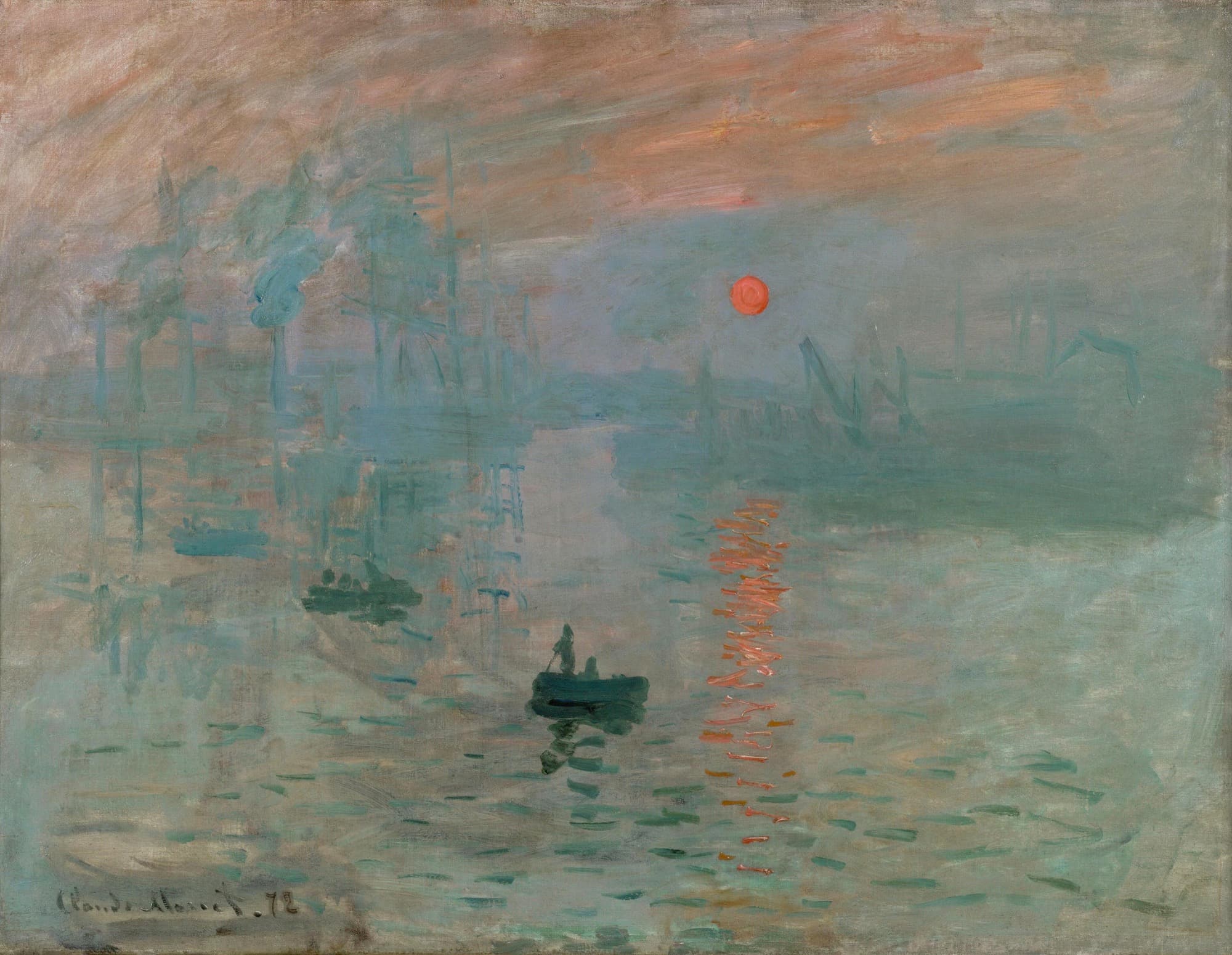
A harbor at dawn, the port of Le Havre, the French town where Monet grew up. Through a veil of morning mist, a small orange sun hangs low and lays a flickering orange path across the water. Dark little boats drift in silhouette. Behind them, barely there, loom the ghostly shapes of cranes, masts, and smoking chimneys, the working machinery of a modern port. Nothing is sharp. The whole scene is built from quick, broken strokes of color, as if Monet had to catch it before the light shifted, which is exactly the point.
What makes it special
It paints a moment, not a thing. Monet is not interested in giving you an accurate map of the harbor. He is after the sensation of a specific dawn: the damp air, the glare on the water, the way shapes dissolve in mist. The subject is really the light itself, and light will not hold still, so the painting had to be fast and loose to keep up.
The looseness is the achievement. What Leroy mocked as unfinished is the whole innovation. Those visible, hurried brushstrokes make the water shimmer and the air feel alive in a way that a smooth, detailed surface never could. Monet trusted your eye to assemble the marks into a scene, and it does.
It smuggles in the modern world. This is not a timeless, pretty landscape. Those faint shapes in the background are industry: steamships, cranes, factory smoke. The Impressionists wanted to paint their own era, trains and ports and city streets, not myths and kings, and here the new industrial world sits quietly in the haze.
The story behind it
Monet dashed the painting off quickly and, by his own account, did not even give it much thought as a title. When the organizers asked what to call it for the catalogue, he said it could not pass for a view of Le Havre, so they should just put "Impression." That offhand word, meant only to excuse the sketchiness, ended up naming the movement. The painting itself had a dramatic later life: it was stolen from its Paris museum in 1985 in a brazen armed robbery and was missing for five years before police recovered it.
One detail most people miss
That glowing orange sun, the brightest, most eye-catching thing in the picture, is almost exactly as bright as the grey sky around it. If you photograph the painting in black and white, the sun nearly disappears into the clouds. It only leaps out because of its color, its warm orange against the cool blues and greys, not because it is any lighter. Monet, perhaps by instinct, had stumbled onto something about how human vision works, and used it to make a sun that burns on the canvas without actually being bright at all.
Where to see it
Impression, Sunrise lives at the Musée Marmottan Monet in Paris, a quieter museum than the giants, built around the world's largest collection of Monet's work. The painting is smaller than its fame suggests, so get close and look at the frantic little strokes that make the water move, then step back and watch the harbor and its sun reassemble out of the mist, exactly as Monet caught them one morning over a century and a half ago.