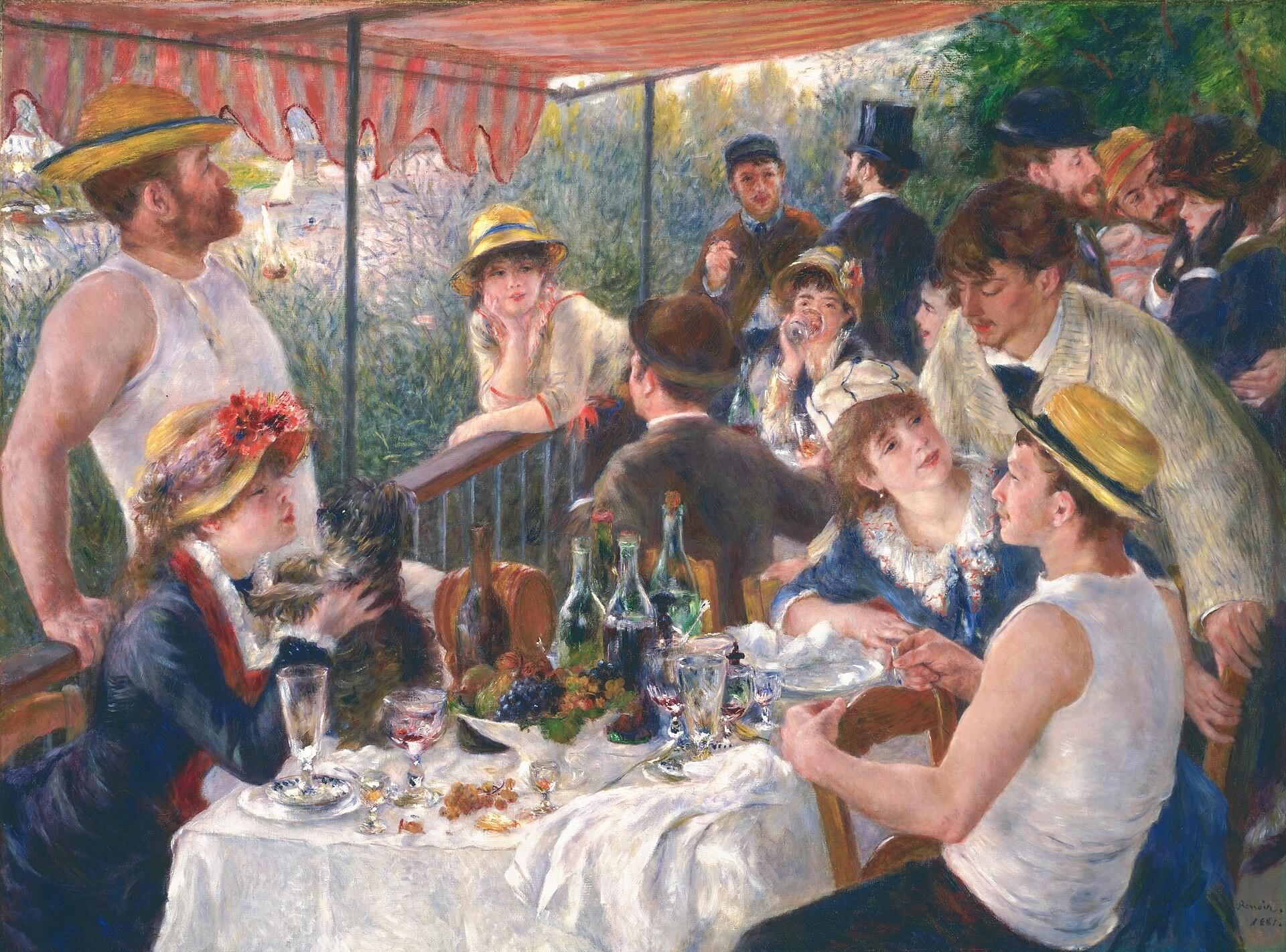
Renoir painted fourteen of his friends over one summer, on the terrace of a riverside restaurant about 15 kilometers west of Paris. The young woman at bottom left, cooing at a small dog, is Aline Charigot, a seamstress from Montmartre who became his wife. The man in the straw hat with his back to us at bottom right is Gustave Caillebotte, a fellow Impressionist and an heir to a textile fortune, who bought his poorer friends' paintings to keep them fed. The woman leaning on the railing is the restaurant owner's daughter. The man leaning next to her is the owner's son. Renoir paid for his lunches in paint.
The picture took months, from the summer of 1880 into 1881. Models came and went by train and did not always show up, so Renoir painted whoever was there and reworked the composition as he went. The result looks like a snapshot of a single lunch. It was in fact a season of them.
What you're looking at
A canopied terrace on a summer afternoon. Fourteen people have finished eating. The table is littered with glasses, bottles and a bowl of fruit. Through the gap in the awning you can see the river Seine and a sailboat. Nobody is posing: a woman drinks, a couple flirts, a man in a top hat chats, a girl in the back covers her ears against a man whispering to her. In the foreground a young woman in a flowered hat holds a terrier up to her face. The light comes in dappled through the striped awning and catches on the white tablecloth, the glass and the straw hats.
What makes it special
It is a portrait of a social moment. The restaurant, the Maison Fournaise at Chatou, was where Parisians went on Sundays to row, swim and eat on the river, a new kind of leisure made possible by the railway. The guests mix classes in a way that would have been impossible in a Paris salon: a baron, an actress, a critic, a shop girl, a bureaucrat. Impressionism was not only a way of painting light. It was a decision to paint this new, informal, modern life.
The still life on the table is a painting inside the painting. Look at the bottles and glasses. Each one is a small masterpiece of light on glass and liquid, painted with quick, loaded strokes, and together they form the brightest zone of the canvas. Renoir was trained as a porcelain painter as a teenager, decorating plates in a factory, and he never lost his love for the gleam of surfaces.
It is enormous for an Impressionist painting. Most Impressionist canvases were modest, meant to be painted quickly outdoors. This one is 1.3 by 1.7 meters, with fourteen full portraits, the size and ambition of an academic history painting. Renoir was making a claim: ordinary people at lunch deserve the same scale as kings and battles.
The story behind it
Renoir was 39 and tired of being poor. He had just had some success with society portraits and wanted to prove he could do something bigger. He wrote to a friend that he was painting a picture of boaters that he had been itching to do for a long time, that he was getting older and did not want to put it off, and that it was costing him a fortune in models. Some scholars argue the painting was partly an answer to a hostile critic who had said the Impressionists could not handle figures.
Each guest has a name. Besides Aline and Caillebotte there is the actress Ellen Andrée, raising her glass; Charles Ephrussi, the art historian and collector, in the top hat at the back; the poet Jules Laforgue beside him; and the painter's friends Paul Lhote and Eugène Pierre Lestringuez flanking the actress Jeanne Samary at top right. The baron Raoul Barbier, in a bowler, has his back to us as he talks to the owner's daughter.
The painting was shown at the seventh Impressionist exhibition in 1882 and praised even by critics who disliked the movement. In 1923 the American collector Duncan Phillips bought it for 125,000 dollars, an enormous sum then, and made it the centerpiece of the museum he had opened in his Washington home two years earlier. He called it the greatest painting in the world and said he had bought it so that Americans would not have to cross an ocean to see what Impressionism could do.
One detail most people miss
The Maison Fournaise still exists. The restaurant closed in 1906 and the building rotted for most of the century. The town of Chatou bought it in 1979, restored it, and reopened it in 1990 as a restaurant and small museum. You can eat lunch on the same terrace, under a striped awning, looking at the same bend of the Seine, which is one of the few places in the world where you can step into a famous painting and order the wine. Also, look at Aline's dog. It is the only figure looking straight back at her, and the only one, besides the viewer, who is fully absorbed in its companion.
Where to see it
The Phillips Collection in Washington, D.C., near Dupont Circle, where it has hung since 1923. It is a small museum in a former house, so you can usually stand in front of the painting with few people around, which is rare for a work this famous. The museum's website has a high-resolution image with a guide naming every guest. For the terrace itself, the Maison Fournaise is a 20 minute train ride from Paris Saint-Lazare to Rueil-Malmaison, then a short walk across the bridge to the island at Chatou.