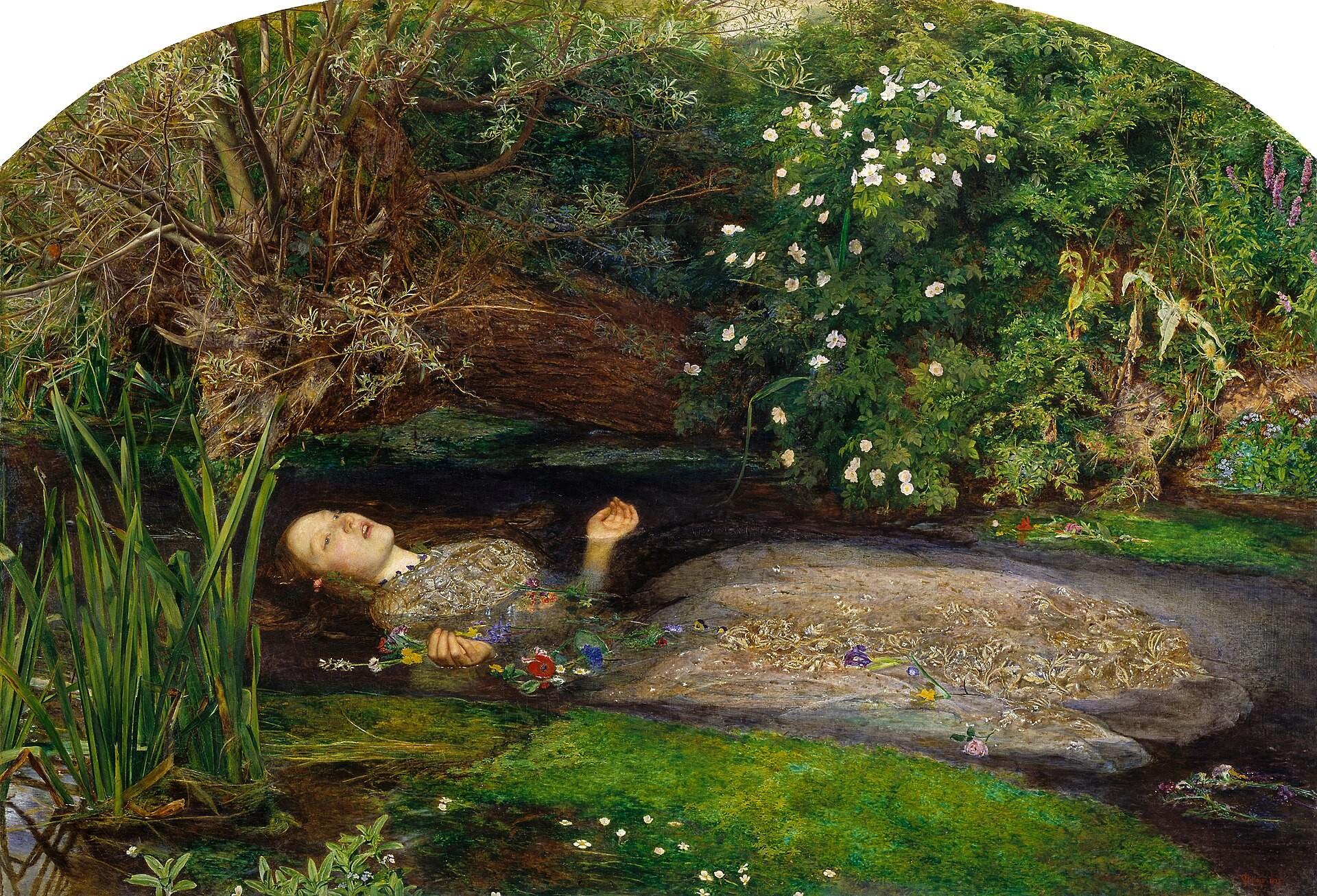
The model lay in a bathtub full of water for hours at a time, through the winter of 1851 to 1852, in a London studio. Oil lamps burned under the tub to keep the water warm. One day the lamps went out and the painter, absorbed in his work, did not notice. The model, a 22 year old named Elizabeth Siddal, said nothing and lay in the cold water until the session ended. She caught a severe cold. Her father threatened to sue; the painter paid the doctor's bills, about fifty pounds.
The painter was John Everett Millais, aged 22, and he had already spent five months on the picture before Siddal got into the tub. The riverbank behind her was painted outdoors on the Hogsmill River in Surrey, up to eleven hours a day, six days a week, from July to November 1851. He complained in letters of wind, flies, a bull in the field, and being threatened with prosecution for trespassing. The flowers and reeds were painted one by one, from life, in the order they bloomed.
What you're looking at
A young woman floating on her back in a narrow stream, her hands open, her mouth slightly parted, singing. Her embroidered dress billows with water. Flowers drift around her. The banks are a wall of green: willow, nettles, reeds, forget-me-nots, a dog rose, and a robin perched on a branch at left. There is no sky. The picture is almost square in feeling, a window onto a dense, wet, English summer in which a girl is quietly dying.
She is Ophelia, from Shakespeare's Hamlet, who goes mad after her father is killed and drowns while gathering flowers by a brook.
What makes it special
It paints a scene that is never shown. In Hamlet, Ophelia's drowning happens offstage. We learn about it from the Queen, who describes how a willow branch broke as the girl hung her garlands on it, how she fell, how her dress spread and held her up a while as she sang old songs, until the clothes grew heavy and pulled her down. Millais painted the Queen's speech almost line by line. The willow, the garland, the floating dress and the song are all there. The painting is an illustration of words that an audience only hears.
Every plant means something. The Pre-Raphaelites loved botanical accuracy and hidden meaning in equal measure. The poppy by her hand means death. The daisies mean innocence. The pansies floating on her dress mean love in vain. The violets around her neck are the flowers Ophelia herself gives out in the play, saying they withered when her father died. The nettles mean pain, the forget-me-nots mean what they say. Victorian viewers knew the language of flowers and read the picture as a poem.
The color is unlike anything painted before it. Millais worked on a white ground, laying pure color onto wet white so that the greens glow as if backlit. There is no brown shadow, no soft blur. The result shocked viewers used to the golden gloom of academic painting, and some critics hated it. Today it is simply how we imagine the scene.
The story behind it
Millais was a prodigy who had entered the Royal Academy schools at eleven. In 1848, aged 19, he and two friends, Dante Gabriel Rossetti and William Holman Hunt, founded the Pre-Raphaelite Brotherhood, swearing to paint truthfully from nature and to take serious subjects from literature. Ophelia was his bid to prove the method could produce a masterpiece.
The dress was the painter's own purchase. He wrote to a friend that he had bought "a really splendid lady's ancient dress, all flowered over in silver embroidery" for four pounds, and was pleased with the bargain. Siddal, a milliner's assistant who had been spotted in a hat shop by one of the brotherhood's friends, posed in it in the tub. She later became Rossetti's model, pupil and wife, and a painter and poet herself; she died of a laudanum overdose in 1862, aged 32. Her face in Ophelia has become the face of the whole movement.
The painting was shown at the Royal Academy in 1852 and sold for 300 guineas to a dealer. It passed through several collections before the sugar magnate Henry Tate bought it and gave it to the nation in 1894 as part of the founding gift of the gallery that bears his name. It has been one of the most visited pictures in Britain ever since, and one of the most reproduced images of the Victorian age.
One detail most people miss
Look at the right edge of the picture, in the dark foliage beside Ophelia's dress. Some viewers see the shape of a skull in the leaves and shadows. Whether Millais intended it is disputed; some scholars argue it is simply the pattern of light on leaves, and the painter never mentioned it. What he certainly did include is the robin on the willow branch at upper left. Ophelia in the play sings a snatch of an old ballad, "For bonny sweet Robin is all my joy." The bird is a line from her song, painted.
Where to see it
Ophelia hangs at Tate Britain in London, on Millbank by the Thames, in the rooms devoted to Victorian painting; admission is free. It travels occasionally and is always mobbed when it does. The Tate website has a high-resolution zoom and a long essay identifying every plant. If you want to stand where Millais stood, the Hogsmill River still runs through Ewell in Surrey, half an hour by train from Waterloo, and a local trail marks the stretch of bank he painted.