For about a hundred years, the credit for the most beautiful Tiffany lamps belonged entirely to one man: Louis Comfort Tiffany, the glass magnate whose name is on the company. Then, in 2007, researchers published a cache of newly discovered letters, and the real story came out. The Wisteria lamp, and many of the other famous flower-and-insect designs, were created by a woman named Clara Driscoll, who led a department of female artists the firm called the Tiffany Girls, and whose names had been quietly left off the record.
So the next time someone says "a Tiffany lamp," picture Clara Driscoll, bent over a table of colored glass, designing one of the most recognizable objects in American decorative art, and getting almost none of the credit.
What you're looking at
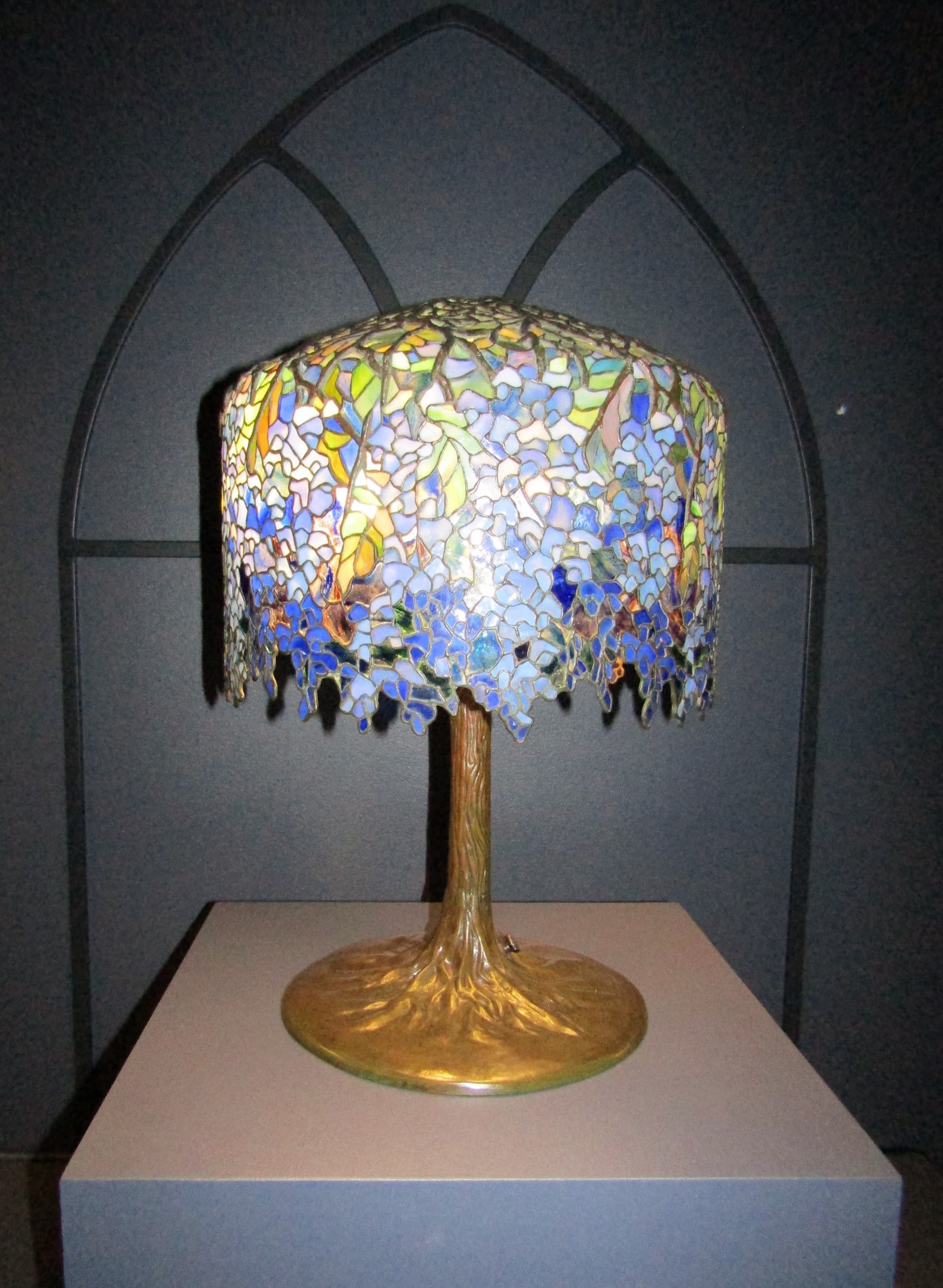
A table lamp whose shade is a cascade of wisteria, bunches of tiny purple and blue blossoms tumbling down over green leaves, all made of glass and lit from within. The base is a slender bronze tree trunk, so the whole lamp reads as a flowering vine. The shade is built from hundreds of small, individually chosen pieces of colored glass, held together with copper foil and solder, so that when the bulb is lit it glows like a living plant caught at the peak of bloom.
What makes it special
The color is in the glass, not painted on. This is leaded glass, the same family of craft as a cathedral window. Each petal is a real shard of colored glass, picked for its exact shade and streak, so the light comes through colored rather than bouncing off a painted surface. That is why a Tiffany lamp glows in a way a printed shade never can.
The edge breaks the rules. Look at the bottom of the shade. Instead of a neat metal rim, the glass ends in an irregular, branching line, like the real ragged edge of hanging flowers. Driscoll designed the shade with no bottom band at all, a difficult, almost reckless choice that makes the wisteria feel like it is really drooping into the room.
It turns a machine into nature. The lamp exists to hide a modern electric bulb, then a brand-new technology, inside something that looks grown rather than manufactured. The hard glare of electricity becomes soft, dappled, flower-colored light.
The story behind it
Tiffany Studios ran on the skilled labor of its workers, and the glass-selecting and design work for many lamps was done in a department of women led by Clara Driscoll. Women were employed partly because they were paid less than men and were expected to leave when they married. Driscoll was, by the evidence of her own letters, a brilliant and prolific designer, responsible for the Wisteria, the Dragonfly, and other icons. For generations, the company's marketing folded all of this into the single heroic name of Louis Comfort Tiffany, and the women vanished from the story until historians dug them back out.
One detail most people miss
A single Wisteria shade can contain close to two thousand separate pieces of glass. Each one had to be chosen by eye from thousands of sheets, cut to shape, wrapped in copper foil, and soldered into place, with the selectors matching color and texture petal by petal so the blossoms would shade naturally from deep violet at the top to paler tones below. It is less like manufacturing a lamp than assembling a mosaic the size of a bush, which is one reason genuine Tiffany lamps were expensive luxuries then, and sell for staggering sums now.
Where to see it
Tiffany lamps are spread across major museums and decorative-arts collections, including the Metropolitan Museum of Art and the New-York Historical Society, which holds an important group tied to the Tiffany Girls story. If you can see one lit in person, do, because a photograph flattens it. And when you admire the wisteria glowing in the dark, say the designer's name to yourself: Clara Driscoll.