On 14 January 1506, a man named Felice de Fredis was digging in his vineyard on the Esquiline Hill in Rome when he broke into an underground chamber and hit marble. Word reached Pope Julius II, who sent his architect Giuliano da Sangallo to take a look. Sangallo brought along a friend: Michelangelo.
According to the eyewitness account of Sangallo's son Francesco, then a boy, his father recognized the statue the moment he saw it. It was the Laocoön, a sculpture the Roman writer Pliny the Elder had praised 1,400 years earlier as better than any painting or bronze. The pope bought it within weeks and put it on display in the Vatican's Belvedere courtyard. That display is often considered the beginning of the Vatican Museums.
What you're looking at
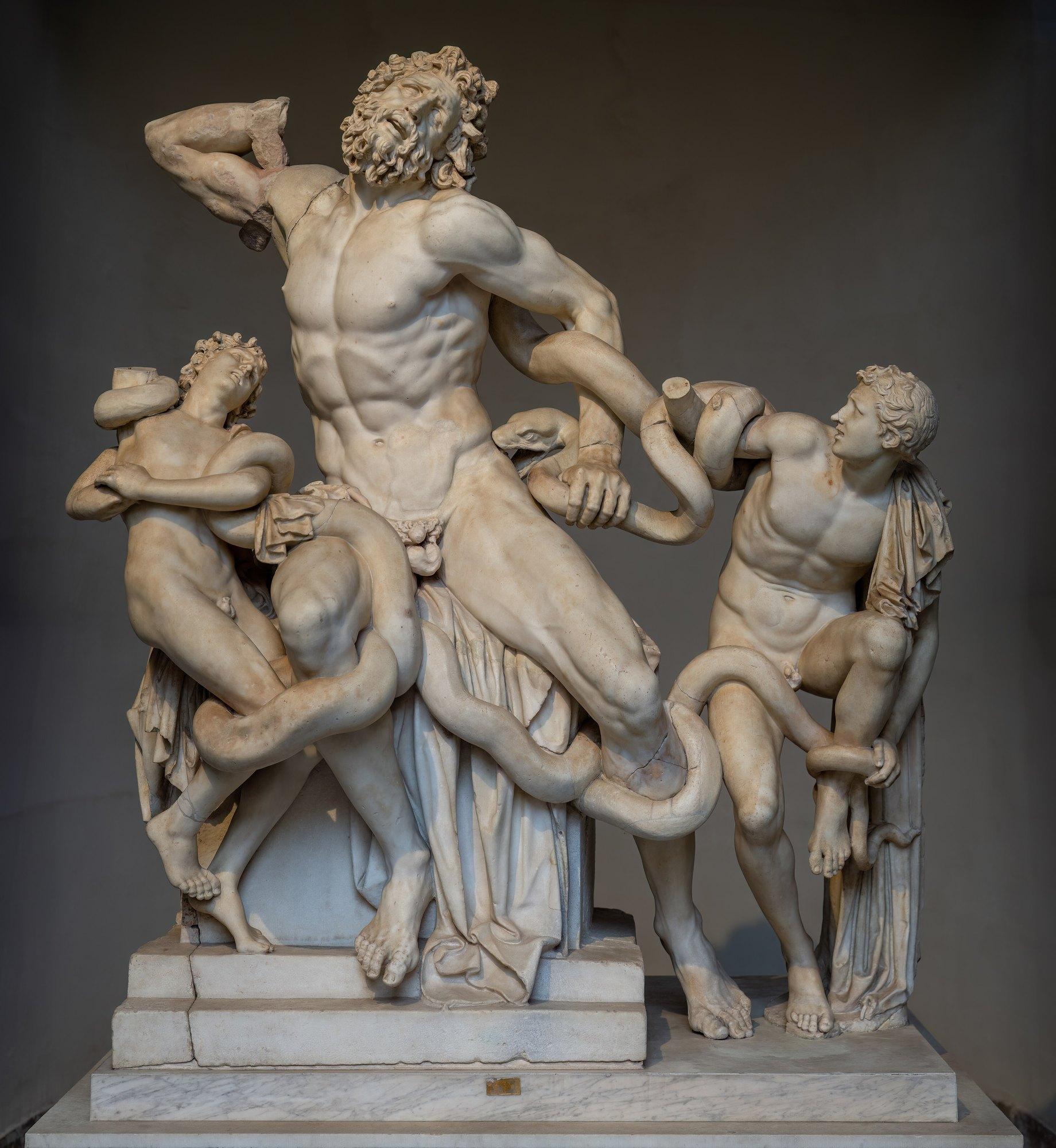
A marble group, a little over two meters tall, showing a bearded man and two young sons wrapped in the coils of two giant sea serpents. The father's body twists in agony, every muscle strained, as a serpent bites into his hip. His face tilts upward, mouth open, brows knotted. The son on the left is already collapsing; the one on the right is still trying to pull free, looking toward his father. Nobody escapes.
What makes it special
It is a story about a warning nobody heeded. Laocoön was the Trojan priest who begged his people not to bring the Greeks' giant wooden horse into the city. In Virgil's Aeneid he says the famous line "I fear the Greeks, even when they bear gifts." The gods, who wanted Troy to fall, sent two serpents from the sea to kill him and his sons. The Trojans took it as a sign, and wheeled the horse in.
It shows pain in a way earlier sculpture avoided. Classical Greek statues are usually calm. This one is all struggle, from the father's contorted torso down to his clenched toes. Michelangelo studied it closely, and you can see its twisting bodies echoed in his later work, including the Sistine Chapel.
It started an argument that lasted centuries. In 1766, the German writer Gotthold Ephraim Lessing wrote a whole book named after it, asking why the sculptor showed Laocoön with his mouth only half open when Virgil's poem has him roaring. His answer, that sculpture and poetry follow different rules, shaped art theory for generations.
The story behind it
The statue's date is still debated. Pliny named three sculptors from the island of Rhodes, and most scholars place the work somewhere between the 1st century BC and the 1st century AD. Some scholars argue it is a Roman marble copy of an earlier Greek bronze; others think it is an original.
It also had a detour through history. In 1798, after conquering Italy, Napoleon's army shipped it to Paris, where it was displayed in the Louvre. It came back to the Vatican in 1816, after his fall.
One detail most people miss
The father's right arm. When the statue was found, the arm was missing, and Renaissance artists argued about how to restore it. The winning version stretched it heroically up into the air. Then in 1906 an archaeologist named Ludwig Pollak spotted a marble arm in a stonemason's shop in Rome, bent back toward the head. It turned out to be the original. In the 1950s, restorers removed the outstretched arm and attached Pollak's find. The figure you see today is more cramped and more desperate, exactly as the sculptors intended.
Where to see it
Laocoön and His Sons stands in the Octagonal Court of the Pio Clementino Museum, part of the Vatican Museums in Vatican City, very close to where Julius II first displayed it. Arrive early or book ahead, since the museums are among the busiest in the world, and walk all the way around the group; the serpents' coils are carved with astonishing depth from every side.