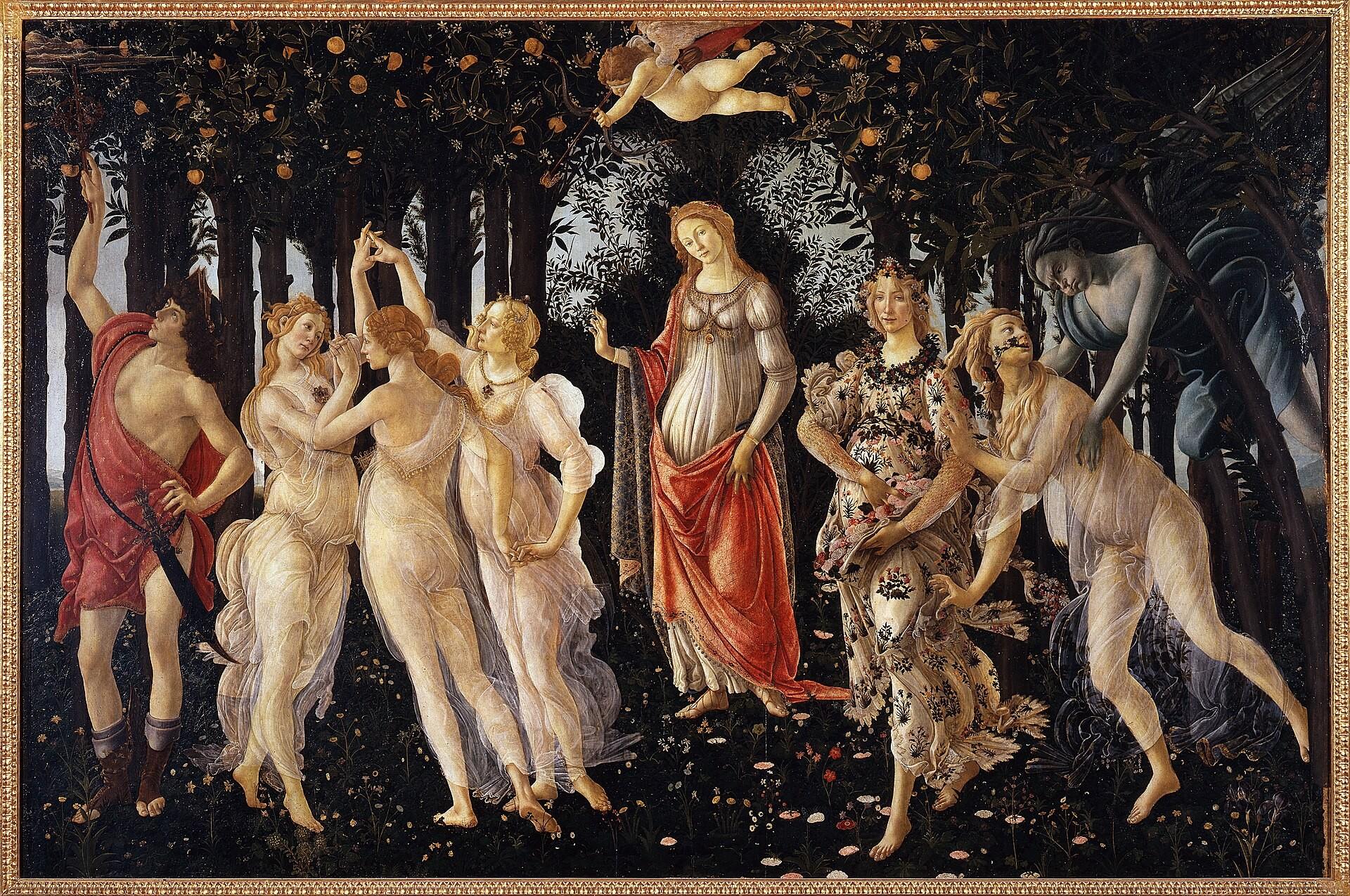
Botanists who studied this painting counted around 500 individual plants and identified roughly 190 flowering species. Nearly all of them grow around Florence, and nearly all bloom between March and May. Botticelli did not paint a vague carpet of flowers. He painted a specific Tuscan meadow in a specific season, with roses, violets, cornflowers, irises, strawberries and daisies in the right places, down to the weeds.
He did this on a panel more than three meters wide, in tempera, around 1480, for a house in Florence. The first record of the picture is an inventory from 1499, which lists it in the city townhouse of Lorenzo di Pierfrancesco de' Medici, a young cousin of Lorenzo the Magnificent. It hung in a room next to his bedroom, above a long wooden daybed. The most analyzed painting of the Italian Renaissance started life as bedroom furniture.
What you're looking at
Nine figures in an orange grove, on a dark lawn studded with flowers. Read it from right to left, because that is how the story moves. On the far right, a blue-skinned winged man bursts in through the trees: Zephyrus, the west wind. He grabs a frightened nymph, Chloris, who has flowers coming out of her mouth. Next to her stands a woman in a flowered dress scattering roses: this is Flora, goddess of spring, who is Chloris after her transformation. In the center, slightly set back under an arch of leaves, stands Venus, goddess of love, raising her hand. Above her flies her son Cupid, blindfolded, aiming a flaming arrow. To the left, three young women in transparent dresses dance in a ring: the Three Graces. On the far left, a young man in a red cloak and winged sandals lifts a staff toward the clouds: Mercury, messenger of the gods.
What makes it special
It tells a story you can watch unfold. The right third of the picture is a single myth from the Roman poet Ovid: the wind god seizes a nymph and she becomes the goddess of spring. Botticelli shows the before and after side by side, so the frightened girl and the serene goddess are the same person a moment apart. The flowers spilling from Chloris's lips become the flowers Flora strews on the ground.
Nothing in it is painted the way the eye sees. There is no real depth, no horizon, no single source of light. The figures stand in a row like a frieze, their feet barely touching the grass. The orange trees form a flat screen behind them. Botticelli was not interested in the illusion of a window onto the world, which other Florentine painters were perfecting. He wanted a tapestry of ideas, and he chose line and rhythm over realism.
It carries a hidden signature of its owners. The oranges were a Medici emblem. The family's coat of arms shows a cluster of red balls, which Florentines read as oranges or medicinal pills, and the orange was closely associated with the family. A viewer in 1480 would have understood whose garden this was.
The story behind it
Nobody knows exactly what the painting means, and the arguments have filled libraries. The most common reading is that it celebrates a Medici wedding. Lorenzo di Pierfrancesco married Semiramide Appiani in 1482, and some scholars argue the picture was commissioned around that time as a lesson in love and marriage, with Venus presiding over the union of passion (Zephyrus and Chloris) and civilized grace (the dancing Graces, watched over by Mercury).
Others point to the philosophers in the Medici circle, who were reading Plato and arguing that earthly love could lead the soul upward to divine love. In that reading, the picture moves from left to right: Mercury, guide of souls, looks away from the garden and up toward heaven. The Florentine poet Angelo Poliziano, tutor in the Medici household, wrote verses about Venus's garden that match the painting closely, and many believe he helped design the program.
The title is not Botticelli's. The art historian Giorgio Vasari saw the picture in 1550 at the Medici villa of Castello, hanging near The Birth of Venus, and described it as Venus "whom the Graces deck with flowers, denoting Spring." The nickname stuck. The two paintings have been displayed as a pair ever since, though they were made years apart and probably not for the same room.
One detail most people miss
Look at the Graces' hands. The three dancers link fingers in a way that would be impossible to hold for more than a second: wrists bent back, fingers interlaced over their heads. The pose is not natural, it is musical. Botticelli used their arms to draw a flowing line across the picture, and the same line continues in the folds of their dresses, which are painted so thinly that the bodies show through. The dresses are not transparent cloth. They are the painter's way of showing movement in a figure that is standing still.
Where to see it
Primavera hangs in the Uffizi Gallery in Florence, in the Botticelli rooms on the second floor, a few steps from The Birth of Venus. It is one of the most crowded spots in the museum, so go at opening time or in the last hour. The Uffizi website has a high-resolution zoomable image, which is the only way to actually see the 190 species of flowers. Bring a botanist, or a good plant identification app.