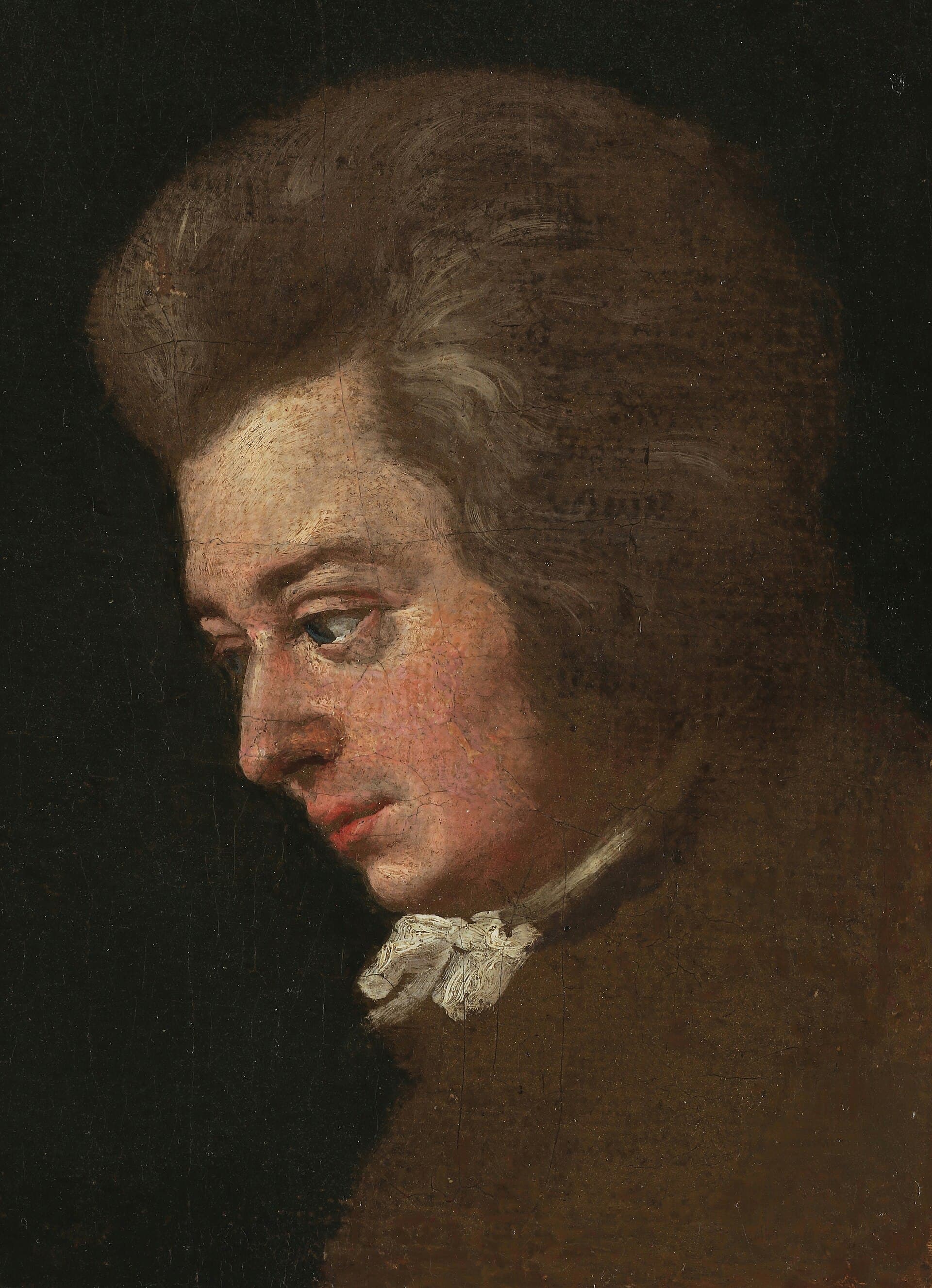
In the summer of 1791, a stranger arrived at Mozart's door in Vienna with an unusual offer: a generous fee for a requiem mass, on one condition - the commission must remain anonymous. Mozart, 35 years old, deep in debt and stretched across three major projects, took the money.
We now know the stranger was a messenger for Count Franz von Walsegg, an aristocrat with a habit of commissioning works from composers and passing them off as his own; his young wife had died that February and he wanted a requiem "by himself" to honor her. Mozart never learned this. As autumn came and his health collapsed, the unexplained commission grew in his mind into something else: a message. He told his wife Constanze, in his darker hours, that he was writing the requiem for himself.
By December 5, he was dead. The manuscript stops in the Lacrimosa - the movement whose name means "weeping" - after eight bars.
What you're listening to
The Lacrimosa is barely three minutes long. Strings sigh in slow pairs, like breathing, and the choir enters quietly on a rising line that keeps climbing - lacrimosa dies illa, "that tearful day" - swelling from a whisper to a full-voiced grief and settling into a final Amen. It is the emotional center of the Requiem in D minor, and the place where, on the original manuscript, Mozart's handwriting simply stops.
What you hear after bar eight was completed by Franz Xaver Süssmayr, Mozart's student, working from sketches, memory of conversations, and nerve, because Constanze needed the finished score to collect the fee. Scholars have argued for two centuries about how much is Mozart and how much is Süssmayr. Audiences have voted differently: they weep at the whole thing.
What makes it special
The rising line. Most laments fall; this one climbs. The choir ascends step by step, the way a lump rises in a throat, and the tension between upward motion and downward sorrow is the movement's genius. Once you notice it, it never stops working on you.
The unfinishedness is audible. Knowing where Mozart's pen stopped changes the listening: those first eight bars carry the weight of last words. Some performances in modern times have even ended the piece at bar eight, letting it break off into silence - a musical full stop at the exact edge of a life.
It made death listenable. The Requiem does not comfort at arm's length; it grieves with you, in first person. That is why it is performed at state funerals and memorials worldwide, from Chopin's funeral (at his own request) to countless national mournings since.
The story behind it
The mythology arrived almost immediately. Within decades, the story of the "gray messenger" and the self-requiem had grown supernatural edges, and a rumor - never supported by evidence - accused the composer Antonio Salieri of poisoning Mozart. Pushkin wrote a play about it; the play became an opera; the idea eventually anchored the film Amadeus, which is magnificent and, on this point, fiction. Mozart died of an illness his doctors could not name precisely and modern scholars still debate - rheumatic fever is a leading candidate. No poison required; 1791 was dangerous enough.
One scene from his final day is attested by people who were there. On December 4, friends gathered at his bedside and sang through parts of the unfinished Requiem with him, Mozart taking the alto line. The story goes that they reached the Lacrimosa, and Mozart set the music down and wept - whether from the music or the knowledge, no one could say. He died shortly after midnight.
Count Walsegg, remarkably, went through with his plan: in 1793 he conducted the completed Requiem under his own name. History has responded with the coldest justice available - he is remembered for exactly one thing, and it is that the Requiem was never his.
One detail most people miss
Listen to the very first two notes the choir sings - a small rising sigh, la-cri. The strings have already sung that sigh, twice, before any voice enters. Grief in this movement is contagious by design: the instruments weep first, and the humans catch it. That is the craft hiding under the emotion - even in his last completed bars, Mozart was engineering exactly how sorrow spreads through a room.
How to listen
Press play above. Three minutes; give it your full attention once, in stillness. Then, if you can bear it, listen again knowing where bar eight falls - right as the choir's first great climb crests. Everything after is the world trying to finish Mozart's sentence.