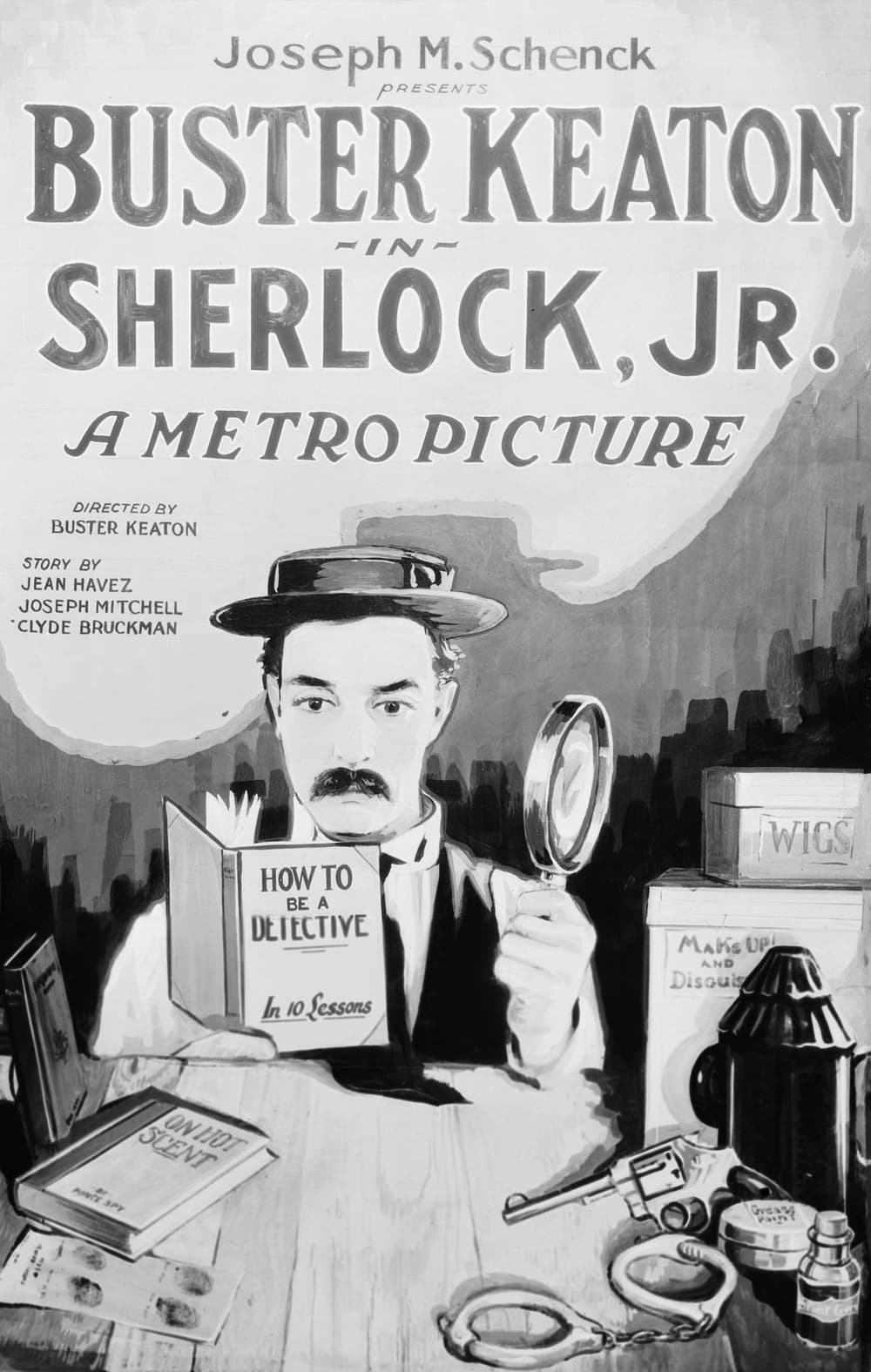
Every film where a character steps into a screen, a painting, a book, or a video game - every one of them - is quoting a 45-minute silent comedy from 1924. In its most famous scene, a lovesick movie projectionist falls asleep in his booth, and his dreaming double walks down the theater aisle, climbs over the orchestra pit, and steps directly into the film he is projecting.
The movie inside the movie then tries to eject him. The scenery cuts around him without warning: he sits on a garden bench and it vanishes, dropping him onto a busy street; he walks off a cliff edge that becomes a lion's den; he dives off a rock into what is suddenly a snowbank. The audience in 1924 had no framework for what they were seeing. Many people today, watching it for the first time, still quietly ask: how?
What you're watching
Keaton plays a small-town projectionist studying to be a detective. Framed for stealing a watch by a rival suitor, he fails as a real detective, falls asleep at work, and becomes, in his dream, Sherlock Jr.: the world's most elegant crime-solver, in white gloves and a silk hat, gliding through dangers that would kill anyone awake. The film runs three reels of setup and then detonates one impossible sequence after another - including a chase where Keaton rides the handlebars of a driverless motorcycle through intersections, over an aqueduct gap bridged for half a second by two passing trucks.
What makes it special
The screen-entry sequence rewrote what editing could do. To make the backgrounds change around a fixed Keaton, his crew used surveyor's instruments to measure his exact position and distance from the camera, then rebuilt the framing in a completely different location. The cuts align so perfectly that the effect still fools the eye a century later. It is craftsmanship pretending to be magic.
Every stunt is real and the camera makes sure you know it. Keaton famously performed his own stunts in wide, unbroken shots - no doubles, no hidden cuts - because the proof was the point. The motorcycle ride, the rooftop leap, the train sequence: what you see is what happened, at speed, to an actual human body.
It is short and completely dense. At 45 minutes, there is no padding: setup, escalation, payoff, repeat. Filmmakers from Jackie Chan to the Wachowskis have mined it; Chan built half a career on its grammar of props, geometry, and deadpan.
The story behind it
The film hurt him. In the sequence where Keaton runs along the top of a moving train and grabs a water spout to swing down, the released torrent slammed him neck-first onto the rail. He finished the take, treated the blinding headaches with whiskey, and went back to work. Nearly a decade later, a doctor examining an X-ray asked him when he had broken his neck. The answer was: on Sherlock Jr., without noticing.
The reception stung almost as much. Critics in 1924 found it clever but slight; the box office was fine, not spectacular. Audiences of the time preferred his features with grander stories. It took decades - and the film scholars of the 1950s and 60s rediscovering silent comedy - for Sherlock Jr. to be recognized as one of the most inventive films ever made. In 1991 the Library of Congress added it to the National Film Registry.
Keaton himself never called it art. He called the problems "gags" and solved them the way an engineer solves load-bearing questions: precisely, and with his own body as the test weight.
One detail most people miss
Watch the projectionist's booth in the final scene. Reunited with the girl, Keaton literally does not know what to do - so he glances at the movie screen, where the film's romantic hero demonstrates: take her hands, kiss her, produce a ring. Keaton copies each move, one beat behind, checking the screen between steps. Then the on-screen couple jumps forward in time to holding twin babies, and Keaton scratches his head. The movies can teach you everything, the film shrugs, except what comes next.
How to watch
Press play above for the full film - 45 minutes. Watch the screen-entry scene twice: once to enjoy it, once frame-stepping to catch the cuts. You still will not find the seams. Nobody does.