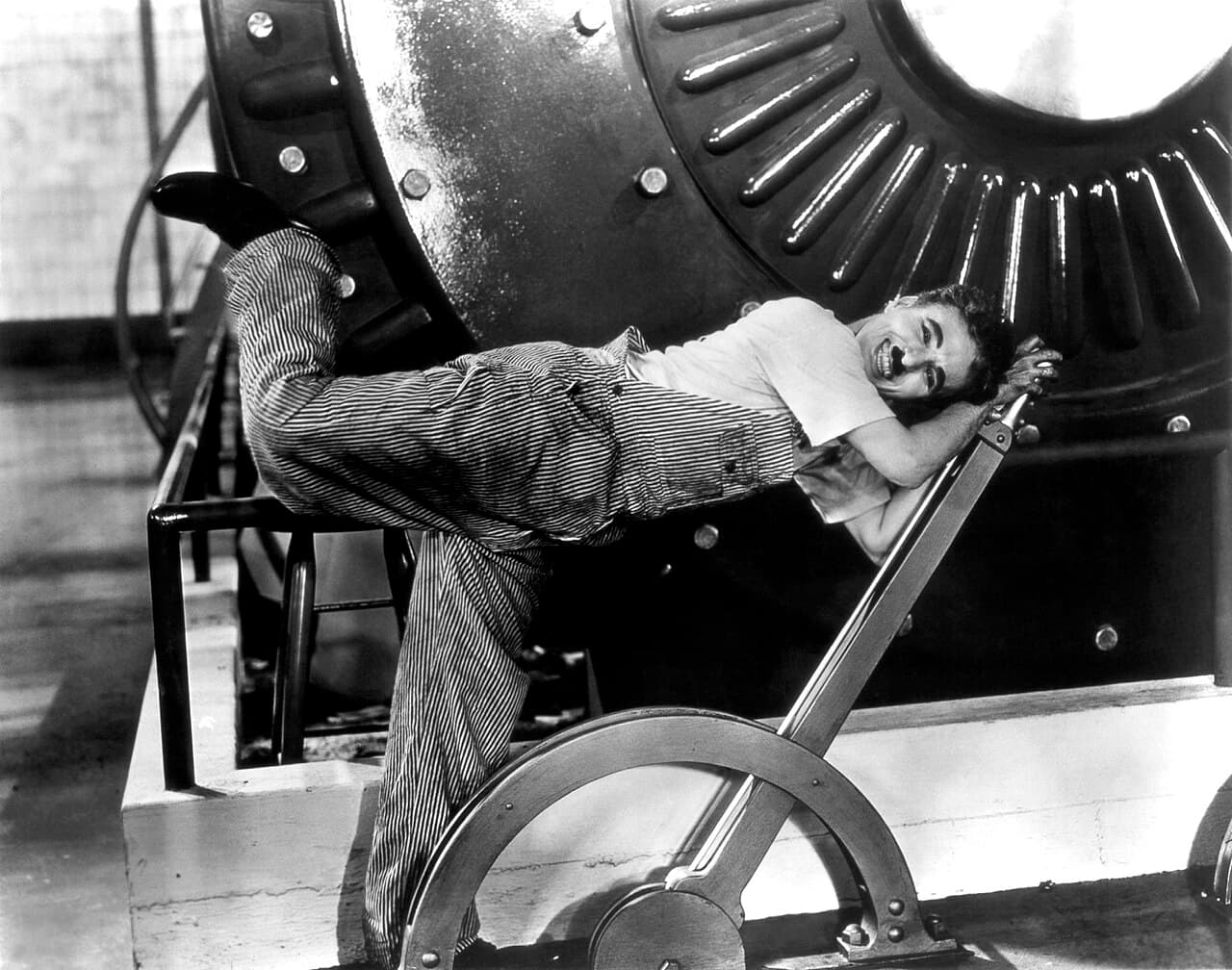
A man tightens bolts on an assembly line. The belt speeds up. He cannot stop; his hands keep twitching the wrench motion even when there are no bolts left. Then the machine simply swallows him, and we watch a human being glide through the gears like a sheet of paper. It is one of the funniest scenes ever filmed, and it is not really a joke.
By 1936, talking pictures had ruled Hollywood for nearly a decade. Charlie Chaplin, the most famous man on the planet, looked at sound and said no. Modern Times is his last stand as the silent Tramp, and the most modern film of its year precisely because it refused to be modern.
What you're watching
The Tramp tries to survive the machine age: a factory that automates him into a nervous breakdown, a jail he keeps accidentally leaving, a department store, a collapsing shack, and a gamine street orphan, played by Paulette Goddard, who becomes his partner in getting by. There is no plot so much as a man being repeatedly spat out by systems too big for him, and getting up every time.
What makes it special
The machines talk, the humans do not. Listen carefully: voices in this film reach you only through devices, a boss barking orders through a screen, a salesman's pitch from a phonograph. Real people, face to face, stay silent. In 1936 Chaplin already understood that technology does not just replace work. It replaces conversation.
The comedy is engineering. The feeding machine that assaults him with soup and corn, the roller-skating scene where he glides blindfolded a step from a drop: these gags are built and timed like machinery, funnier because the danger is real. Chaplin, 46 years old, did the skating himself.
It is a social document that never stops being funny. Assembly lines, surveillance, unemployment lines, strikes: the film catalogues the anxieties of the Great Depression. Nothing in it lectures you. The critique arrives disguised as laughter, which is why it still lands today, in the age of warehouse scanners and productivity apps.
The story behind it
Chaplin had toured the world in 1931 and been shaken by what he saw: closed factories, breadlines, and a conversation with Gandhi about what machines do to people. He returned determined to put the machine age on trial. The studio pressured him to make a talkie; he compromised only once. Near the end, the Tramp must sing in a café, loses the lyrics written on his cuff, and improvises a song in glorious nonsense language. It is the first time audiences ever heard the Tramp's voice, and the last. He speaks, and says nothing, on purpose.
One detail most people miss
The final shot: the Tramp and the gamine walk away from us down an empty road, broke, jobless, and smiling. Chaplin's earlier films end with the Tramp alone. This one, his farewell to the character, is the only ending where he walks off with someone. The machine age took everything else; it did not get that.
How to watch
The full film is easy to find on streaming services; above is the restored factory sequence, the ten minutes that contain the whole argument. Watch how his body never stops obeying the machine, even on a break. If that twitch of the wrists feels familiar after a day of scrolling, the film is about you too.