Most buildings are finished before they are famous. This one has been famous for a century while still wearing cranes. Begun in 1882, the Sagrada Família has outlived its architect, two world wars, a civil war that burned its workshop, and every completion date ever announced for it. It is the world's largest construction site, the world's strangest church, and Barcelona's most visited building, all at once.
Antoni Gaudí took over the project in 1883, at 31, and gave it the rest of his life: 43 years, the final twelve exclusively, eventually moving his bed into the workshop. Asked about the glacial pace, he gave the most serene answer in the history of deadlines: my client is not in a hurry.
What you're looking at
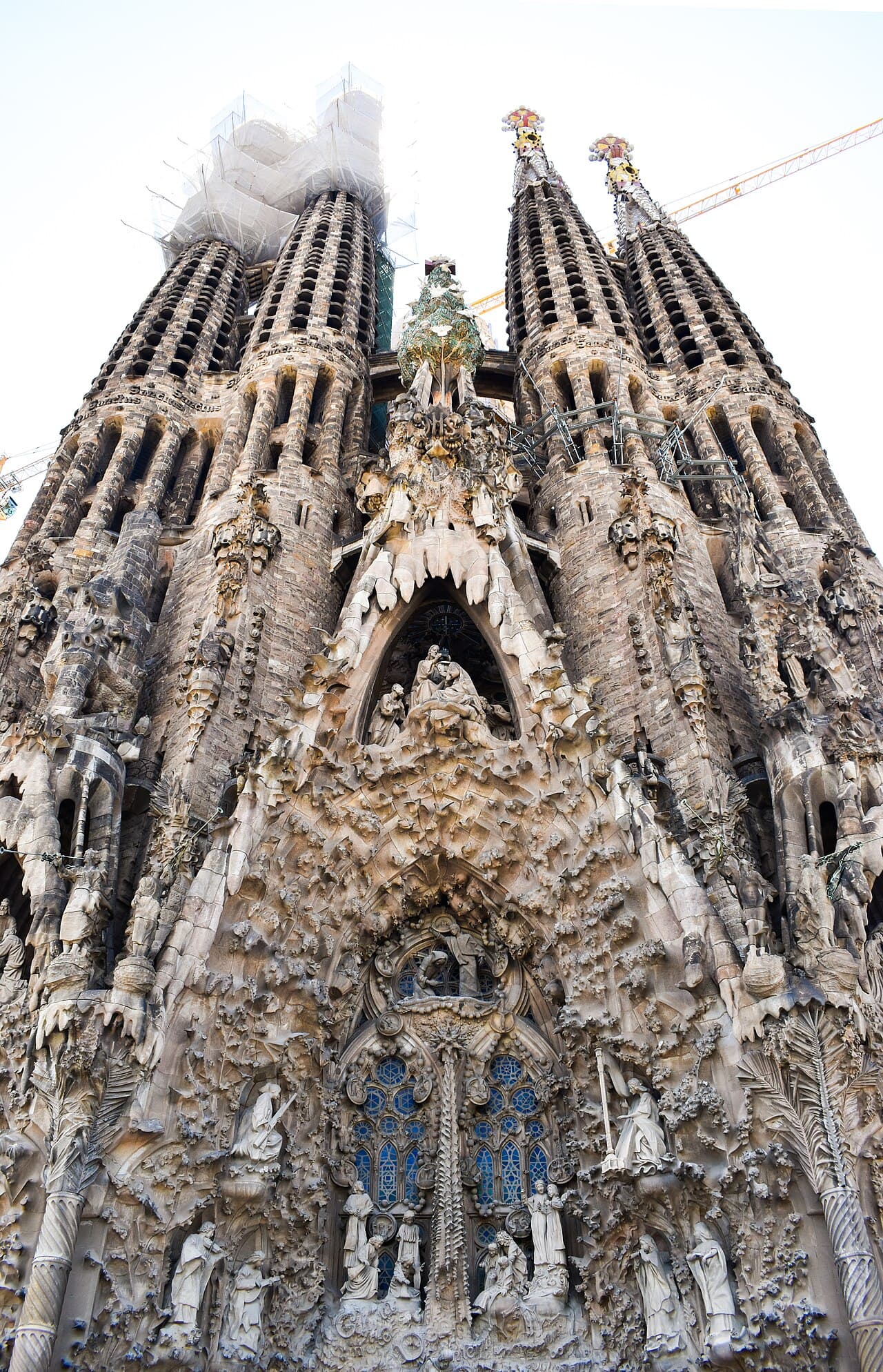
A basilica designed to have eighteen towers, dedicated to apostles, evangelists, the Virgin, and, tallest of all, Jesus Christ, planned to top out at 172.5 meters, deliberately one meter short of Barcelona's hill of Montjuïc, because Gaudí believed nothing made by man should outreach what God had made. The Nativity Façade, pictured above, is the one Gaudí finished himself: stone that drips and blooms, crowded with birds, turtles, angels and babies, less carved than grown.
What makes it special
It is engineered like nature, not like architecture. Gaudí studied how trees hold up their crowns and how bones carry weight. Inside, the columns lean and branch like a stone forest, and light falls through the canopy exactly as it does in woods. His tools were hanging chains, mirrors and photographs: he built the church upside down first, in string and birdshot, and let gravity draw the safest possible curves.
Every surface tells the story to the illiterate. Gaudí called it a Bible in stone. One façade is birth, joyful and overgrown; the opposite façade is the Passion, carved after his death in harsh, skeletal angles by sculptor Josep Maria Subirachs, a contrast so sharp it still starts arguments. The building does not decorate the story. The building is the story.
It is crowdfunded, and always has been. Its official name calls it an expiatory temple: built exclusively from donations and, today, from the tickets of millions of visitors. No state budget, no cathedral fund. Tourism finishes what piety began, which would have struck Gaudí as perfectly logical.
The story behind it
In June 1926, Gaudí, 73, dressed as always like a pauper, was walking to church when a tram struck him. Taxi drivers refused the shabby old man, and he was taken to the paupers' hospital; by the time friends identified him, it was too late. Barcelona gave him a funeral procession a kilometer long and buried him in the crypt of his unfinished church, where he still lies, under the building rising around him. His plaster models, smashed by anarchists in 1936, were pieced back together over decades and, joined now by 3D modeling, still guide the construction. The main tower has been scheduled for completion around 2026, a century after his death; the building, in its way, is keeping the appointment.
One detail most people miss
On the Passion Façade there is a 4 by 4 grid of numbers, a magic square: every row, column and diagonal adds up to 33, the age of Christ at the crucifixion. Two numbers repeat to make it work. Even the puzzle bends its rules for the story it serves.
Where to see it
Barcelona, booked online and well in advance. Go late afternoon, when the western light pours through the sunset-colored glass and the stone forest turns amber. Then find the crypt window and look down: the man who planned all of it is buried at the root of it, like a seed.