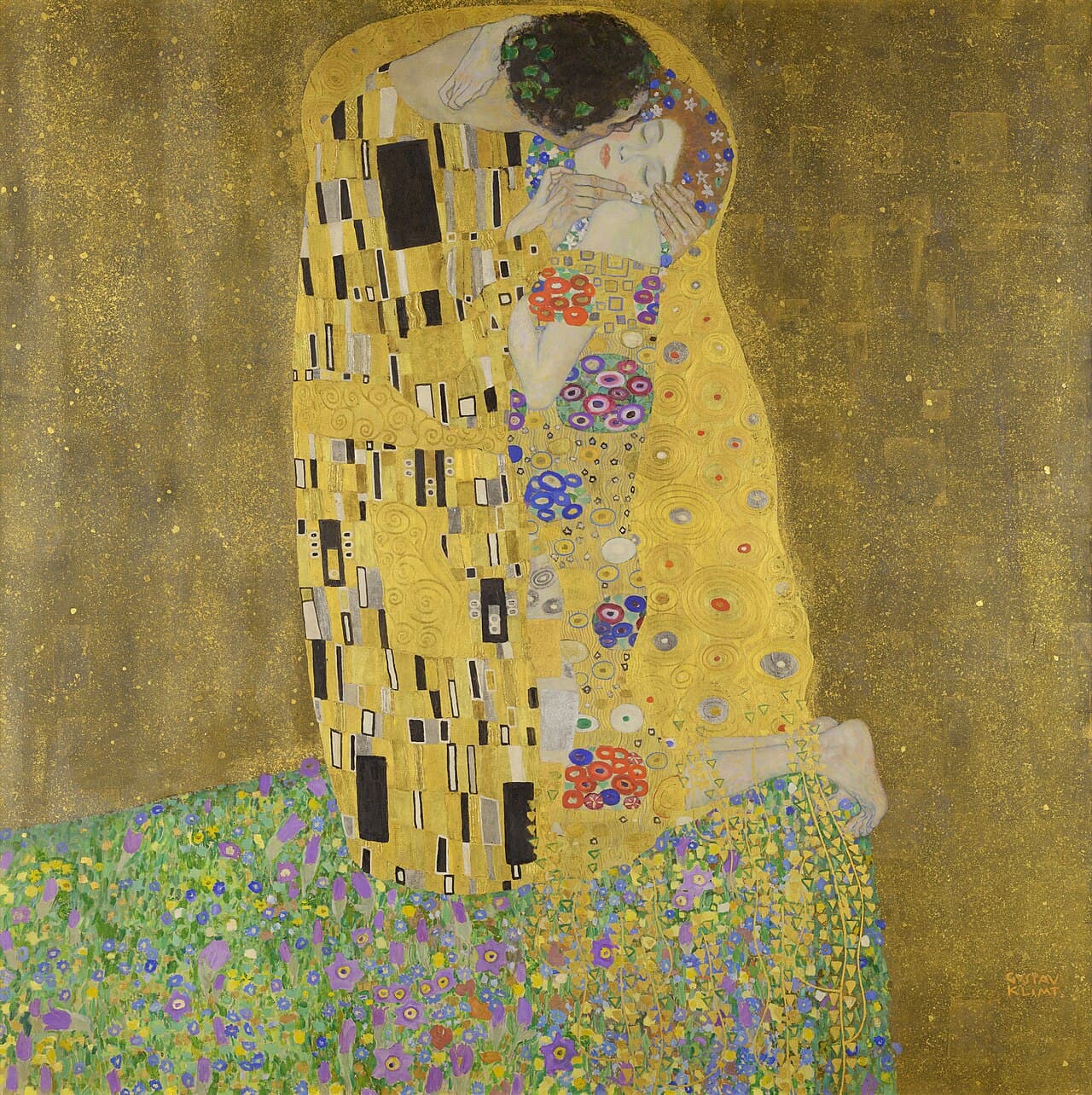
A man bends to kiss a woman's cheek. She kneels, eyes closed, her face turned up and out toward us, her hand curled around his. Around them both, a single golden cloak seems to swallow the world. It is the most reproduced romantic image in Western art, on more posters, mugs and museum-shop scarves than anyone can count. And almost everyone who owns it has missed where the couple is standing.
Gustav Klimt painted The Kiss in Vienna in 1907 and 1908, at the peak of what is called his Golden Period, and at the peak of his notoriety: his recent public commissions had been attacked as obscene, and the establishment considered him a scandal. Then he exhibited this, and Austria bought it for its national collection before the exhibition even closed, at a record price.
What you're looking at
A square canvas, unusually large, covered in oil paint and real gold and silver leaf. Two figures kneel in a meadow of tiny flowers that ends abruptly: look at the bottom right and you will see the flowered ground stop at a cliff edge, the woman's feet at the very lip of it, her toes gripping. Beyond is nothing, a golden void. The most famous embrace in art takes place on the last safe inch of ground.
What makes it special
The gold is doing theology. Klimt's father was a gold engraver, and Klimt had visited Ravenna to study the Byzantine mosaics, where gold backgrounds meant heaven, a space outside time. He took the visual language of sixth-century saints and spent it on two anonymous lovers. The claim is enormous: this moment, between these two people, is sacred the way altarpieces are sacred.
The patterns tell you who is who. Inside the single shared cloak, his robe is covered in hard black and white rectangles, hers in circles and flowers. Two geometries, masculine and feminine, distinct but wrapped in one golden envelope. Ornament, which critics of the era dismissed as decoration, is doing the painting's actual storytelling.
It is tender and precarious at once. He holds her head with both hands; she hangs on at the edge of a drop. Klimt gives you the sweetness and the vertigo in the same image, which is why the painting survives its own greeting-card fame. Stand in front of the original and the cliff is the first thing you feel.
The story behind it
Who are they? Klimt never said. The strongest candidate for the woman is Emilie Flöge, the fashion designer who was his companion for 27 years, in a relationship Vienna never quite classified; his dying words, after a stroke in 1918, are said to have been a request to send for her. Klimt left no diaries and famously insisted that anyone who wanted to know him should look carefully at his pictures. If so, this is the confession: a man who never married, painting devotion as the only gold that matters.
One detail most people miss
Her hand, the one wrapped around his. Look closely: the fingers are not relaxed. They are curled tight, almost gripping, one finger bent against his palm. Klimt paints surrender and holding on in a single hand, four centimeters of painting doing the work of an entire novel.
Where to see it
The Belvedere palace in Vienna, where it hangs in a room that stays crowded all day. The gold does not photograph; it performs only in person, shifting as you walk past. Go, stand slightly to the right, and check the edge of that cliff before you decide the painting is only about happiness.