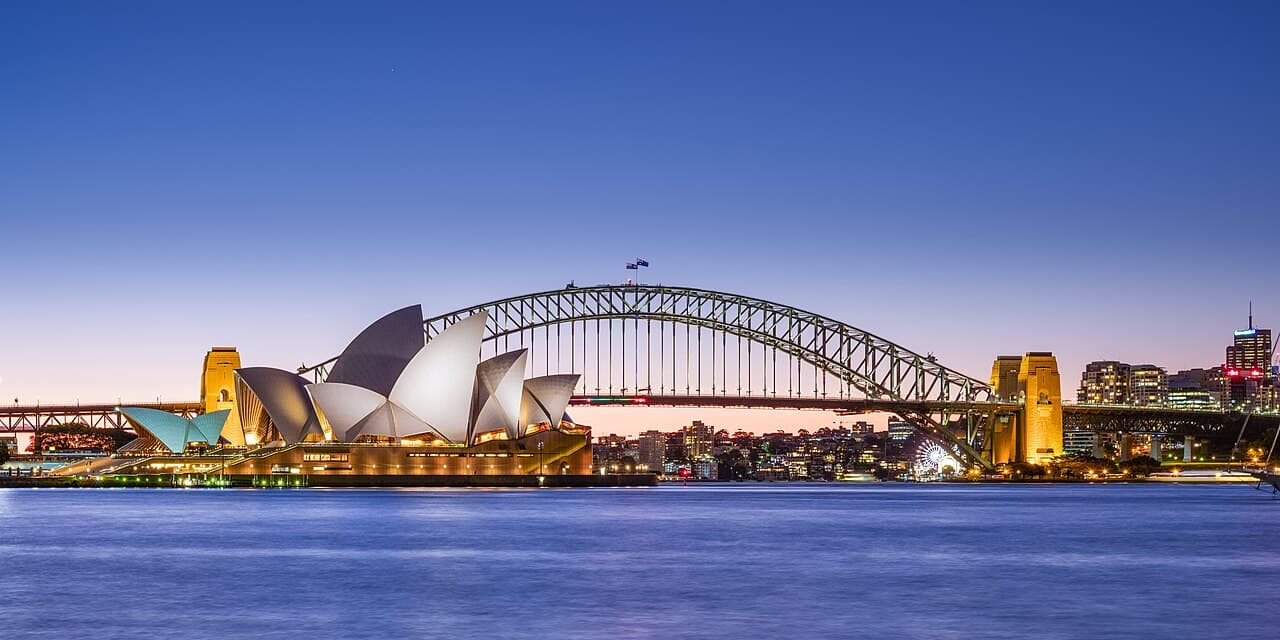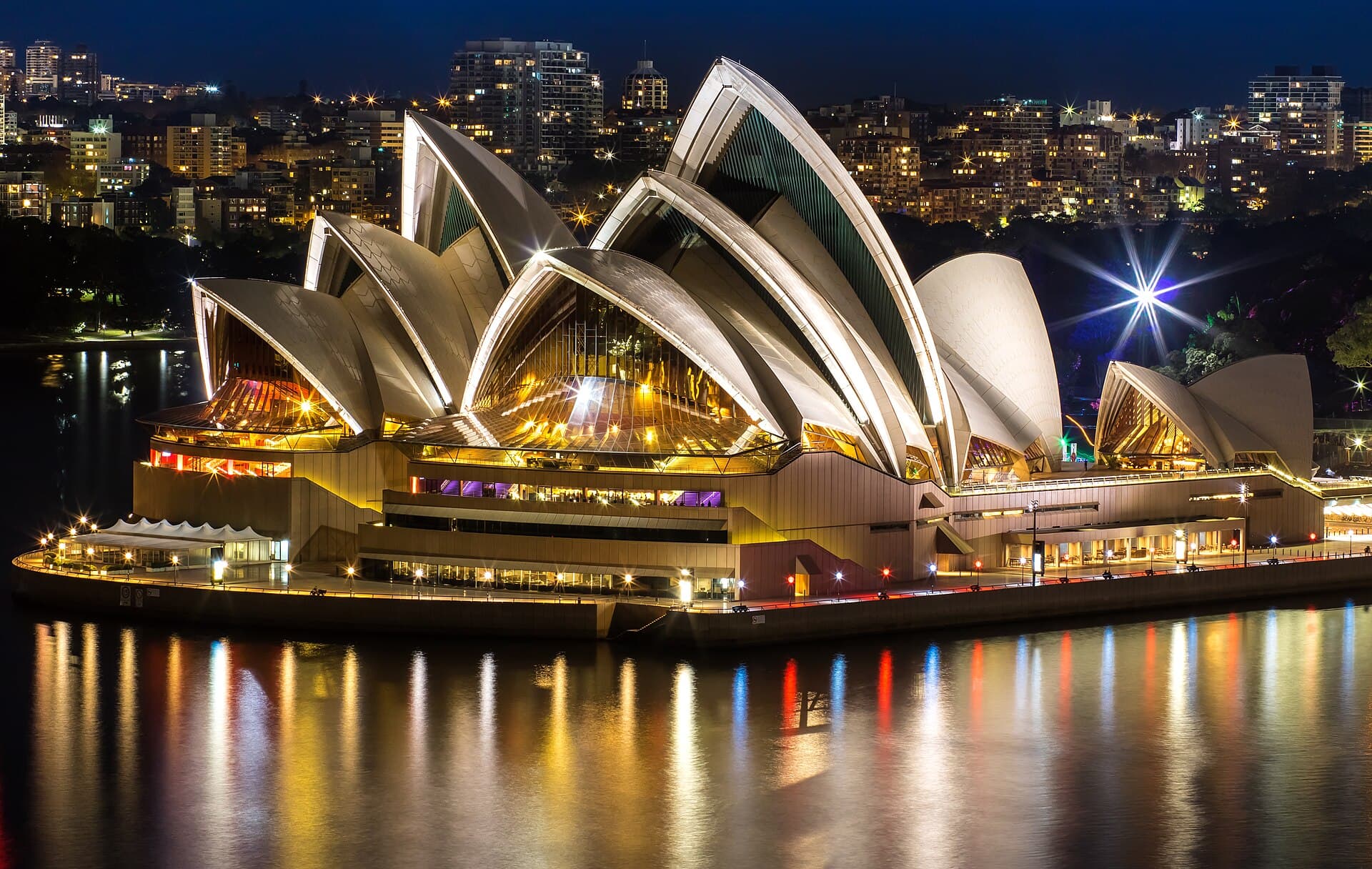
The Sydney Opera House is one of the most recognizable buildings on Earth, a cluster of great white shells rising like sails over the harbour. It is also the story of a catastrophe: a design nearly thrown away, an engineering problem that took years to crack, a budget that overran by a factor of ten, and an architect who was driven off the project in fury and never, for the rest of his long life, came back to see what he had made. The building is a triumph. Getting it built was a tragedy.
What you're looking at
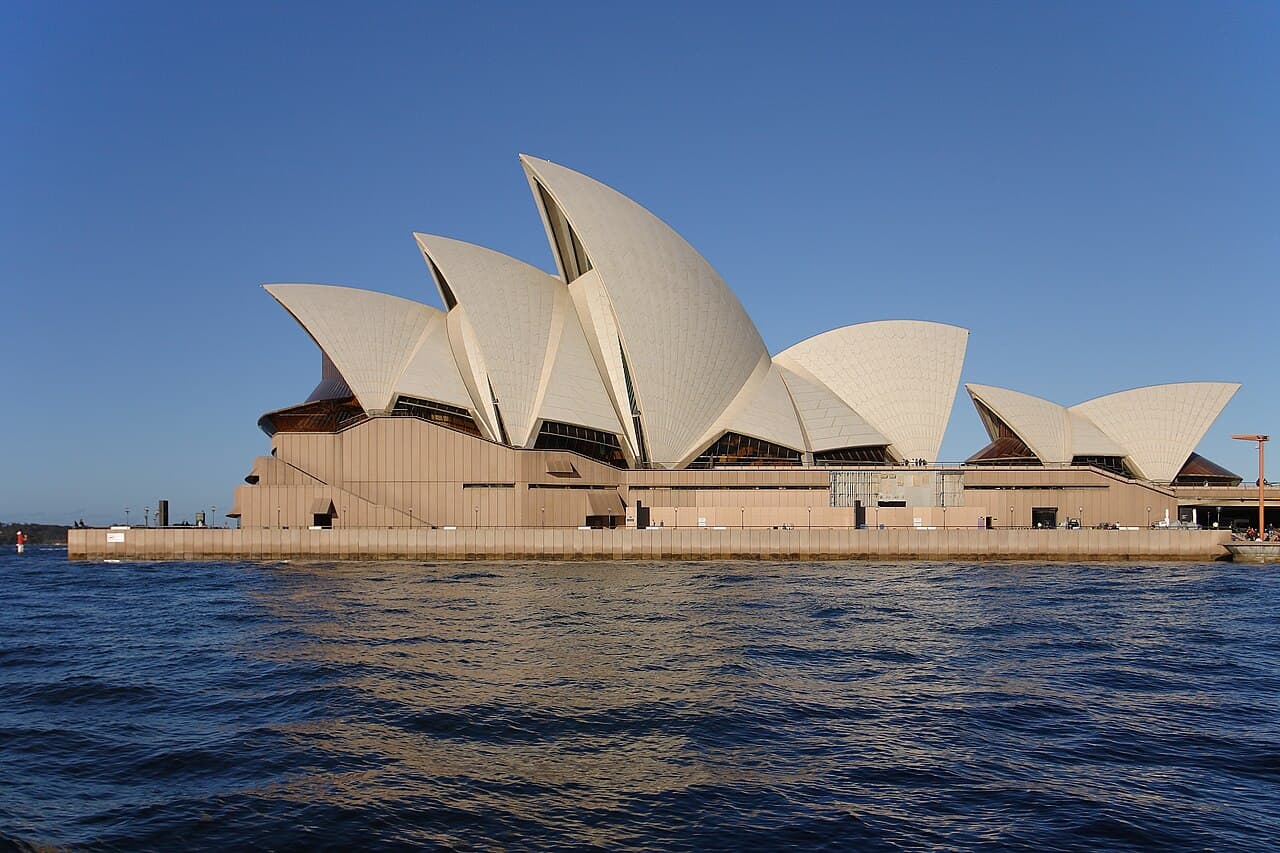
On a spit of land in Sydney Harbour sits a low platform, and rising from it, a series of soaring white concrete shells, clad in over a million glossy tiles, that catch the light and change with the weather and time of day. Inside are concert halls and theaters; outside, the shells read unmistakably as sails, or shells, or the wings of some enormous bird about to lift off. It was designed by a young and almost unknown Danish architect named Jørn Utzon, who had never built anything on this scale, and who beat hundreds of established competitors with a set of drawings so simple they were almost diagrams.
What makes it special
It looks like nothing else, and it looks inevitable. Great buildings usually announce their weight and structure. The Opera House seems to defy both, its shells rising with an ease that feels natural, as if the harbour had grown them. It is that rare thing, a genuinely original form that instantly became a symbol, of a building, a city, and a whole country.
Its beauty is built on a hidden idea. The shells appear free and organic, each one different. They are secretly the opposite: every shell is a section cut from the surface of a single imaginary sphere, all sharing one radius. This is the invention that saved the project, and it is invisible, buried inside the geometry, so that the eye reads freedom where the engineering is pure discipline.
It changed what people thought buildings could be. The Opera House proved that a piece of hard-nosed public infrastructure, a concert hall, could also be a work of sculpture on a civic scale, a thing people cross the world to see. It raised the ambition of architecture everywhere.
The story behind it
The near-disasters started at the very beginning. In the 1957 competition, Utzon's entry was, by legend, set aside in an early round, rescued from the pile of rejects by the famous architect Eero Saarinen, who arrived to judge late, went through the discarded schemes, pulled out Utzon's, and declared it the winner. It had won on the strength of a vision, not a plan, and the vision turned out to be almost impossible to build. Those beautiful shells had no defined geometry; nobody, including Utzon, initially knew how to construct them. He spent years searching for a solution, until the breakthrough came: make every shell part of one sphere. Only then could construction truly proceed.
But time and money were bleeding away. The project had been sold to the public with an optimistic budget of around seven million pounds and a four-year timeline. It ended up costing over a hundred million Australian dollars and taking fourteen years. A change of state government brought in officials hostile to Utzon, who began questioning his decisions and withholding his fees. In 1966, humiliated and unpaid, Utzon resigned, packed up his family, and left Australia. Other architects finished the interiors, and when the building opened in 1973, its creator was not invited to the ceremony and his name was barely mentioned. He never returned to Australia. He never saw his masterpiece in the flesh. Decades later there was a partial reconciliation, and in 2003 he won the Pritzker Prize, architecture's highest honor. He died in 2008, aged 90, having only ever seen the finished Opera House in photographs.
One detail most people miss
Look at the surface of the shells, and notice they are not plain white. They are covered in more than a million tiles, in two subtly different shades, glossy cream and matte off-white, arranged in a chevron pattern. Utzon designed it so the building would never look flat or dead: the two finishes catch light differently, so the shells seem to shimmer and shift as the sun moves and clouds pass, self-cleaning in the rain, glowing at dusk. From a distance you see one pure white sculpture. Up close it is a mosaic of a million pieces, engineered to make the concrete look alive. It is the final proof of how much obsessive care went into a building its own maker was never allowed to finish.
Where to see it
The Sydney Opera House sits on Bennelong Point in Sydney Harbour, a UNESCO World Heritage site and a working venue with performances almost every night. Walk around the base of the shells at different times of day to watch the tiles change, and if you can, see a concert inside, so the building does the job Utzon fought and lost so much to give it. Then look at the sails and remember the man who imagined them, and who only ever saw them in pictures.