In the late summer of 1888, in the town of Arles in the south of France, Vincent van Gogh was, for once, happy. He had rented a small yellow house, and he was waiting for his hero and friend, the painter Paul Gauguin, to come and live with him. Van Gogh dreamed that the Yellow House would become the start of a whole community of artists working together. To decorate the guest room and welcome Gauguin, he began painting sunflowers, fast, in a burst of energy, chasing the flowers before they wilted. Those paintings are now among the most famous and beloved images in the world. The dream that inspired them lasted about nine weeks.
What you're looking at
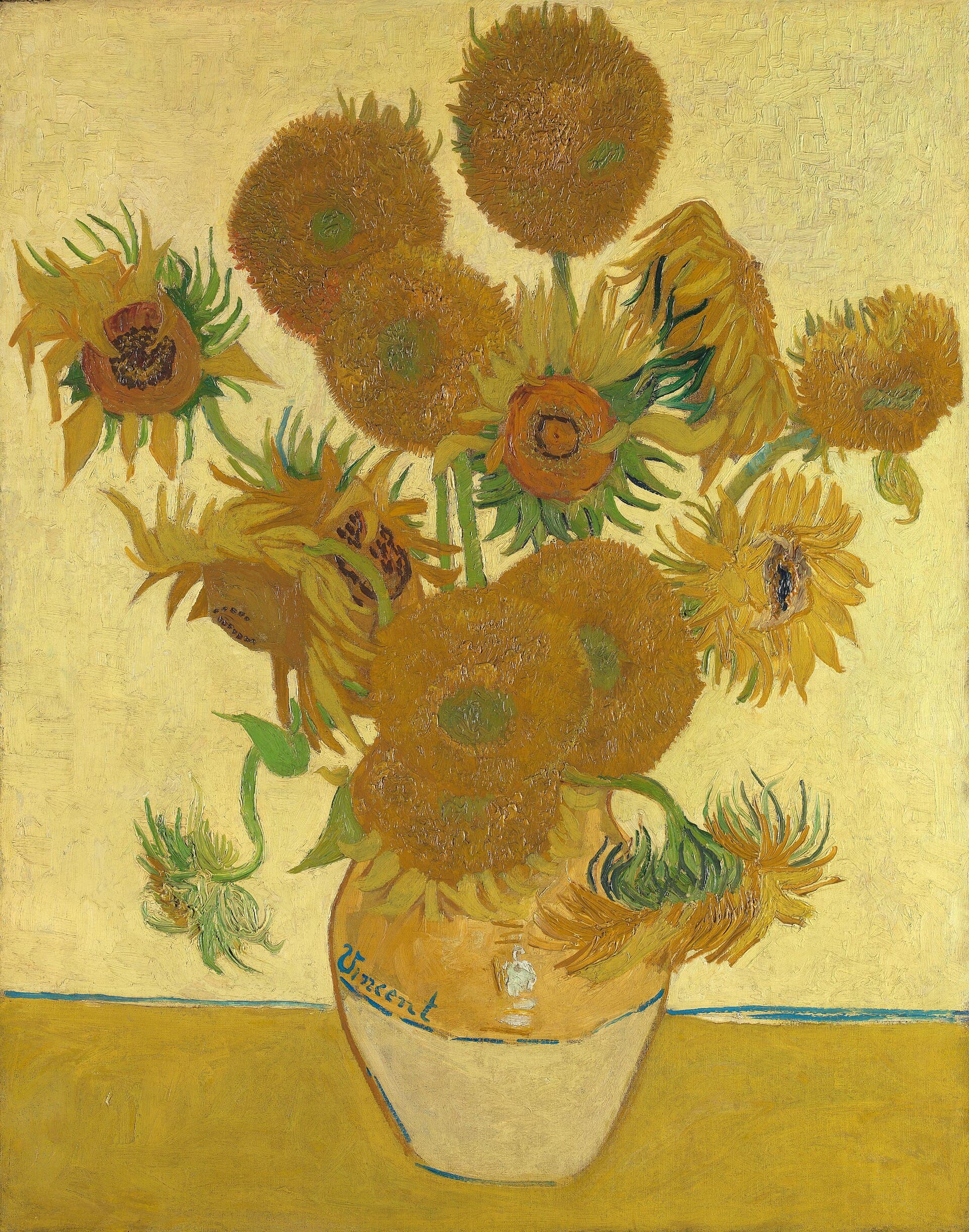
A bunch of sunflowers, some in full bloom, some already going to seed and curling brown, crammed into a simple earthenware vase on a table. That is the whole subject: no people, no story, no grand scene, just flowers in a pot. What makes it extraordinary is the color and the paint. The whole picture is a study in yellow, flowers, vase, table, and background all in different tones of gold and ochre, a near-impossible thing to pull off, since yellow on yellow should vanish into mud. Van Gogh makes it sing. And the paint is thick, loaded on, twisted and dabbed so that the petals stand up off the canvas in ridges, more sculpted than painted.
What makes it special
It is an entire painting built from one color. Van Gogh set himself a dare, to make a picture almost entirely yellow, and win. He separates flower from background not with contrasting colors but with texture, outline, and shade, so that the canvas glows like the inside of a flame. For Van Gogh, yellow was the color of sunlight, friendship, and hope, and here he pushes it as far as it can go.
The flowers are honestly mortal. Look closely and these are not perfect, florist-fresh blooms. Some are wilting, drooping, dropping petals, their centers dry and seedy. Van Gogh painted the whole life cycle in one vase, bright youth beside brown decay, which is part of why the image feels so alive: it is not a decoration, it is a portrait of living things in time.
The thickness is the emotion. Run your eye over the surface and you can practically feel the speed and pressure of his hand. The impasto, the built-up ridges of paint, records the physical act of making, the urgency of a man racing to capture a feeling before it, like the flowers, faded. You are not just seeing sunflowers. You are seeing the motion that made them.
The story behind it
The joy did not last. Gauguin arrived in the autumn, and the two painters, both intense and difficult, clashed almost immediately. Within weeks their friendship collapsed into bitter arguments. In December, after a final quarrel, Van Gogh suffered a breakdown and, in the most famous crisis of his life, cut off part of his own ear. Gauguin left. The dream of the Yellow House and the artists' community was over. Van Gogh spent his remaining time in and out of asylums, painting furiously, and in July 1890 he died of a gunshot wound widely believed to be self-inflicted, at the age of 37.
He had sold, by most accounts, almost nothing in his lifetime, perhaps a single painting, and died convinced he was a failure who had been a burden to his devoted brother Theo. The turnaround after his death is one of the great, painful ironies in art. Within a few decades he was a legend; the Sunflowers became one of the most reproduced images on the planet, printed on everything; and in 1987 one version sold at auction for a then-staggering sum, a record for any painting. The man who could not give his work away had made objects the world would eventually treasure above almost anything.
One detail most people miss
The dazzling yellow that is the entire point of these paintings is slowly dying. Van Gogh used chrome yellow, a bright new industrial pigment, and modern analysis has shown that it is chemically unstable: exposed to light over a century, it gradually darkens and browns. Conservators can measure it happening. It means the Sunflowers you see today are already a little duller than the ones Van Gogh saw wet on his easel, and that, protect them as we might, they are very slowly fading from the inside. The most life-affirming yellow in the history of painting is, quietly, mortal, exactly like the flowers it depicts.
Where to see it
Van Gogh painted several versions, and they are scattered among the world's great museums: the National Gallery in London, the Van Gogh Museum in Amsterdam, museums in Munich, Philadelphia, and Tokyo. See one in person if you can. No print can carry the thickness of the paint or the strange, humming intensity of all that yellow, applied by a man who, for a few short weeks, was full of hope.