In December 1940, F. Scott Fitzgerald died of a heart attack in Hollywood at 44, doing script work he considered beneath him, and convinced that he was forgotten. He had reason: The Great Gatsby, the novel he knew was his best, had sold modestly on release in 1925 - roughly 20,000-odd copies, a disappointment after his bestselling debut - and in his final royalty statements, sales had dwindled to a trickle. Some of the last copies of the first printing were reportedly still sitting in the publisher's warehouse.
Then came the strangest rescue in publishing history. During the Second World War, American publishers and the military distributed cheap paperback Armed Services Editions to soldiers - and Gatsby was one of them, printed in a run of over 150,000 copies for men in barracks, ships, and foxholes. A generation came home having read it. Critics rediscovered it; schools adopted it; and the failure of 1925 became "the great American novel," selling on the order of half a million copies every year since.
What you're reading
A short novel - nine chapters, readable in an evening - narrated by Nick Carraway, a Midwesterner selling bonds in New York in the summer of 1922. His neighbor on Long Island is Jay Gatsby, a mysterious new millionaire who throws citywide parties he barely attends, all staged for one purpose: to be seen by Daisy Buchanan, the woman he loved five years earlier and lost to the rich, careless Tom Buchanan, who lives with her directly across the bay. Gatsby believes money can buy back time. The summer disagrees, with a body count.
What makes it special
The prose is jewelry that moves. Fitzgerald wrote sentences people get tattooed - the green light at the end of Daisy's dock, the "boats against the current" ending - but the real magic is economy: whole social classes are executed in a phrase. Tom and Daisy "smashed up things and creatures and then retreated back into their money." Fifteen words, a complete indictment.
It is the myth of self-invention, weighed honestly. James Gatz of North Dakota invents "Jay Gatsby" the way America invented itself - by declaration. The novel loves him for the audacity and bills him for the fraud. A century of readers keeps arguing whether it is a romance or an autopsy; the correct answer is yes.
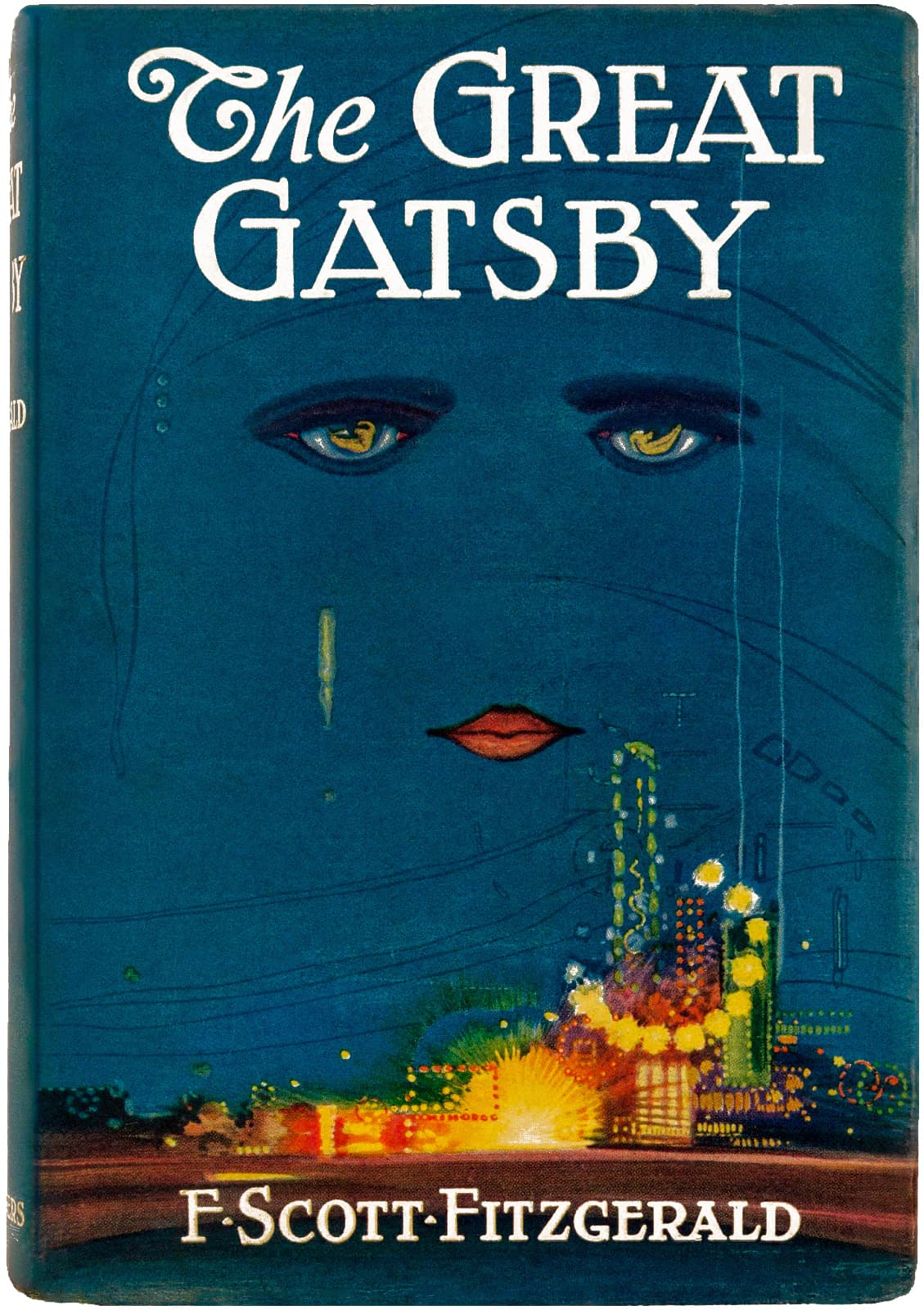
The cover came before the book. The publisher commissioned Francis Cugat's jacket painting - a woman's eyes and lips floating over a carnival night sky - while Fitzgerald was still writing. Fitzgerald saw it and wrote to his editor asking to keep it, saying he had written the image into the book. The haunted eyes over the valley of ashes, the billboard of Doctor T. J. Eckleburg, arrived on the dust jacket first: the rare masterpiece that absorbed its own marketing.
The story behind it
Fitzgerald wrote much of Gatsby on the French Riviera in 1924, while his marriage to Zelda was cracking under an affair of hers - the wound of the beloved choosing elsewhere is in the book's bones. He also knew the territory personally: as a poor officer in 1918 he had courted Zelda, a Southern belle, and been judged financially insufficient until his first novel made him rich. Gatsby standing outside Daisy's world, certain that enough success would open the door, was not research.
The title was nearly a catastrophe: Fitzgerald lobbied late for "Trimalchio in West Egg" and, weeks before printing, cabled his editor wanting "Under the Red, White, and Blue." Deadlines saved him. Reviews in 1925 were mixed and sales flat; Fitzgerald diagnosed the causes himself with painful accuracy: the title was weak, and the book had "no important woman character" for the readers who bought novels. What he could not diagnose was timing: a lament for the hollowness of a boom, published in the middle of the boom. Only after 1929 turned the party into a hangover did the book read as prophecy - and only after the war put it in a million duffel bags did the country notice.
One detail most people miss
Count how much Gatsby is actually in his own novel: he does not appear until chapter three, disappears for pages at a time, speaks in guarded formulas, and is dead before the end. The book is not really the story of Gatsby; it is the story of Nick deciding what Gatsby meant - a bystander turning a bootlegger into a knight. Every legend, the structure quietly says, is a collaboration between someone who dreams and someone who narrates.
How to read it
The novel entered the US public domain in 2021, so it is free everywhere: Project Gutenberg and Standard Ebooks have clean editions. It is about 47,000 words - two or three evenings. Read the first and last pages twice; Fitzgerald built the frame before the house, and the echo between them is the whole art.