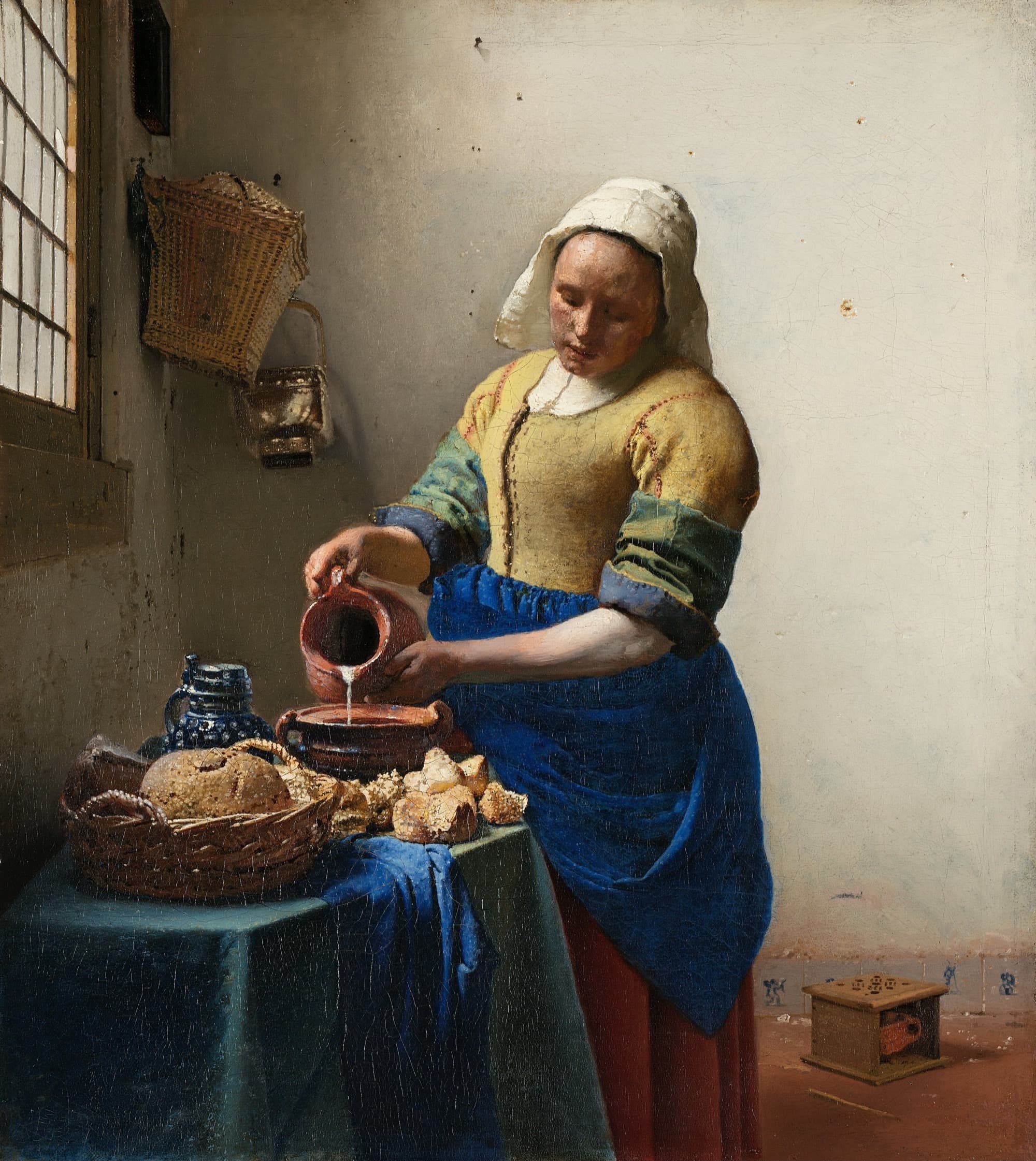
The blue apron worn by the servant in this painting is made from ultramarine, a pigment ground from lapis lazuli, a semi-precious stone that in Vermeer's time had to be mined in distant Afghanistan and shipped across the world. Ounce for ounce, it could cost more than gold. Painters usually hoarded it for the robes of the Virgin Mary.
Vermeer spent it on a maid pouring milk.
That decision tells you almost everything about this small, strange, perfect picture. It takes the least important person in a seventeenth-century household, doing the most ordinary possible task, and treats her with the materials and the seriousness normally reserved for saints and royalty.
What you're looking at
A single woman stands in a plain corner of a kitchen, carefully pouring milk from a jug into a bowl. That is the entire event. The canvas is small, smaller than you expect, barely larger than a sheet of office paper. Light comes from a window on the left and falls across a table of bread, a basket, a blue cloth. The maid is solid, broad-shouldered, utterly absorbed. The only thing moving in the whole painting is the thin white thread of milk, caught forever mid-pour. Everything else is held in a deep, concentrated stillness.
What makes it special
Nothing happens, and that is exactly the point. There is no story, no drama, no message being delivered. Vermeer takes a moment so humble it would normally be invisible and gives it the weight of a monument. The maid's quiet focus becomes a kind of dignity, and the painting insists that ordinary work, done with care, is worth looking at as hard as any battle or coronation.
The light is made of dots. Look closely at the crust of the bread and the woven basket and you will see tiny beads of pale paint, Vermeer's pointillé, scattered to catch the sparkle of light on rough surfaces. It is a technique that makes the bread look almost edible, and many scholars believe Vermeer was partly painting what he saw through a camera obscura, which turns bright highlights into exactly these soft glowing points.
It spends a fortune on a servant. That ultramarine apron, set against the warm yellow of her bodice, is the painting's quiet luxury. Vermeer uses his most expensive color not to flatter a wealthy patron but to dignify a working woman, and the blue and yellow together give the whole picture its calm, glowing balance.
The story behind it
Vermeer is one of the rarest major painters who ever lived. Only around thirty-five works are confidently attributed to him. He worked slowly, almost entirely in his home town of Delft, and sold little. He fathered eleven surviving children, fell into debt, and died at forty-three, after which his name was largely forgotten for nearly two centuries. It was only in the 1800s, led by the French critic Théophile Thoré-Bürger, that Vermeer was rediscovered and elevated to the first rank of art. The Milkmaid, luckily, was always admired, even when its maker's name was not.
One detail most people miss
The wall behind her is almost empty, and that emptiness was a deliberate decision. Scientific examination has shown that Vermeer originally began with more clutter in the background, including a large wall hanging or map and a basket, and then painted them out, stripping the scene down to bare plaster so that absolutely nothing competes with the woman and her task. Down at floor level, though, he left two small clues: a foot warmer and a wall tile showing Cupid. For a Dutch audience, those were gentle hints that this plain, still scene might hold a flicker of warmth, or longing, beneath its calm surface.
Where to see it
The Milkmaid lives at the Rijksmuseum in Amsterdam, not far from Rembrandt's Night Watch. Because it is small, it is easy to walk past; do not. Get as close as the guards allow and look for the dots of light on the bread, the single frozen stream of milk, and the astonishing blue. The museum also publishes a very high-resolution image online, which lets you zoom in on brushwork you could never see from behind the rope.