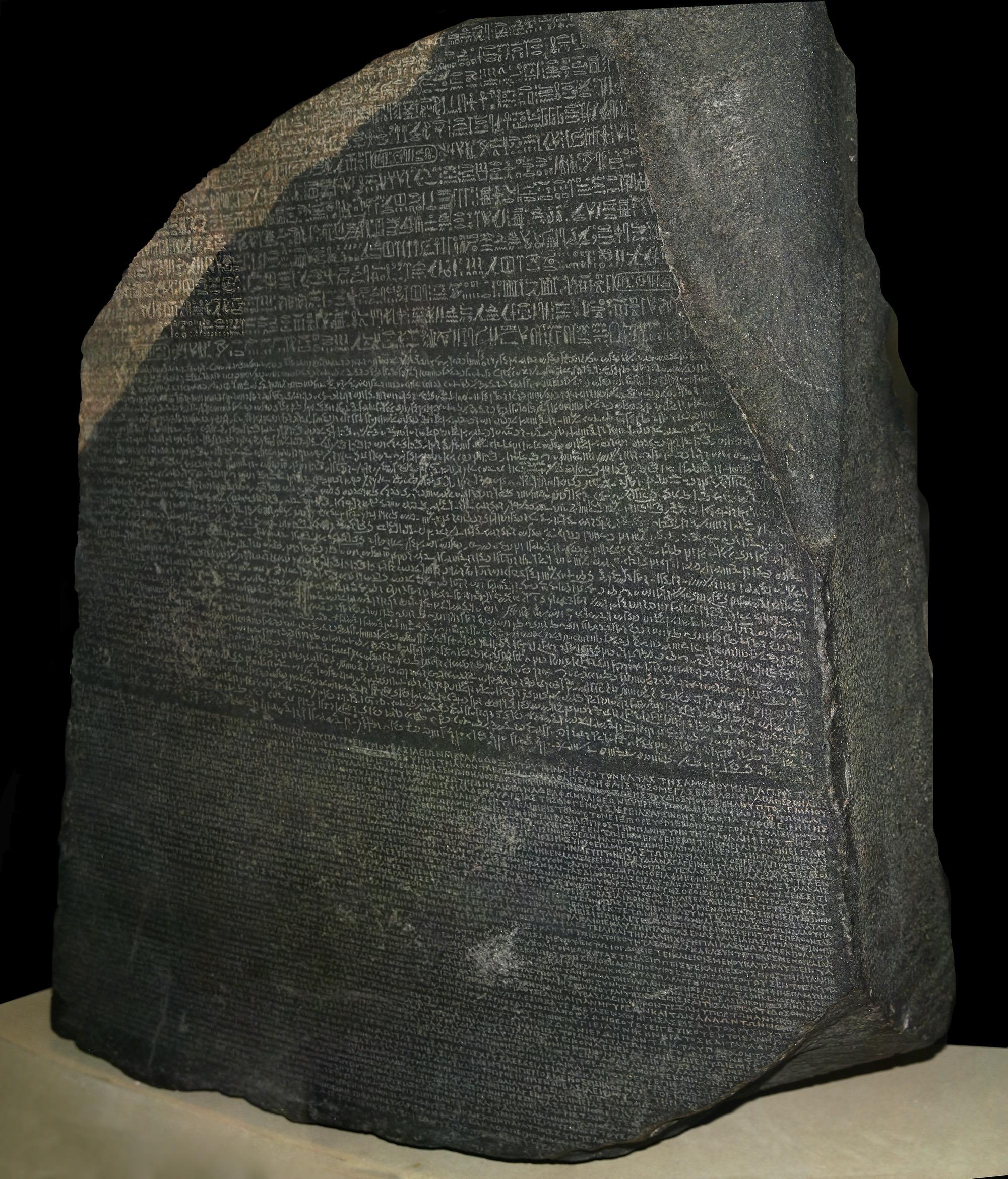
In July 1799, during Napoleon's invasion of Egypt, French soldiers were rebuilding an old fort near the town of Rashid, which Europeans called Rosetta, in the Nile Delta. Built into a wall, they found a broken slab of dark stone, just over a meter tall and weighing around 760 kilograms, covered on one side with tiny carved writing.
The officer in charge, Pierre-François Bouchard, realized at once it might be important: the writing was in three different scripts, and one of them was Greek, which scholars could read. If the three texts said the same thing, the stone might be the key to the one script no one on Earth had understood for well over a thousand years: Egyptian hieroglyphs.
What you're looking at
A slab of granodiorite, a hard dark grey stone, with its top and lower right corner broken away. It is a fragment of a larger monument called a stela, which once stood in a temple. The polished front carries a single decree issued by a council of priests at Memphis in 196 BC, honoring the young king Ptolemy V on the first anniversary of his coronation. It is written three times: at the top in hieroglyphs, the sacred script of temples; in the middle in Demotic, the everyday script of Egyptian documents; and at the bottom in ancient Greek, the language of the ruling Ptolemaic dynasty.
What makes it special
It is the same message in three scripts. That is what made it a key. Scholars could read the Greek, and so they knew what the other two texts were supposed to say.
The content is surprisingly ordinary. The most famous text in the history of decipherment is, mostly, about tax breaks for temples, the king's good deeds, and instructions to set up copies of the decree. Its fame comes from what it unlocked, not what it says.
It opened up an entire civilization. Once hieroglyphs could be read, thousands of inscriptions on temples, tombs, statues, and papyri began to speak. Much of what we now know about ancient Egypt, from the names of its kings to its prayers and its laundry lists, comes from that breakthrough.
The story behind it
The French did not keep their find. After their defeat, the stone was handed over to the British under the Treaty of Alexandria in 1801, and it has been in the British Museum since 1802, where it is one of the most visited objects in the collection.
Decipherment became a race. The English scientist Thomas Young made real progress in the 1810s, showing that the oval frames called cartouches held royal names and identifying some sound values. But the decisive step came from Jean-François Champollion, a French scholar who had studied Coptic, the late form of the Egyptian language. In 1822 he showed that hieroglyphs mixed signs for sounds with signs for ideas. According to a famous story, he ran to his brother's office, shouted "I've got it!", and fainted. Some historians treat that detail with caution, but the breakthrough was real.
Egypt has asked for the stone's return, and the question remains open.
One detail most people miss
Look at the sides of the stone. Painted on them, in white, are two lines of English: one says it was "Captured in Egypt by the British Army in 1801," and the other that it was "Presented by King George III." They are a record not of ancient Egypt, but of the war that brought the stone to London.
Where to see it
The Rosetta Stone is on permanent display in Room 4, the Egyptian sculpture gallery, at the British Museum in London. Entry to the museum is free. It sits behind glass in the center of the room and is almost always surrounded by a crowd, so go early in the morning. Full-size replicas, which you can touch, are on show in the museum's Enlightenment Gallery.