In May 1800, Napoleon Bonaparte led an army of about 40,000 men over the Great St Bernard Pass, the high, snowy route between Switzerland and Italy. Soldiers dragged the cannons up the mountain in hollowed out tree trunks. Napoleon himself rode a mule, a sure footed animal far better suited to icy paths than a horse, with a local guide walking alongside. A month later he won the Battle of Marengo and tightened his grip on power in France.
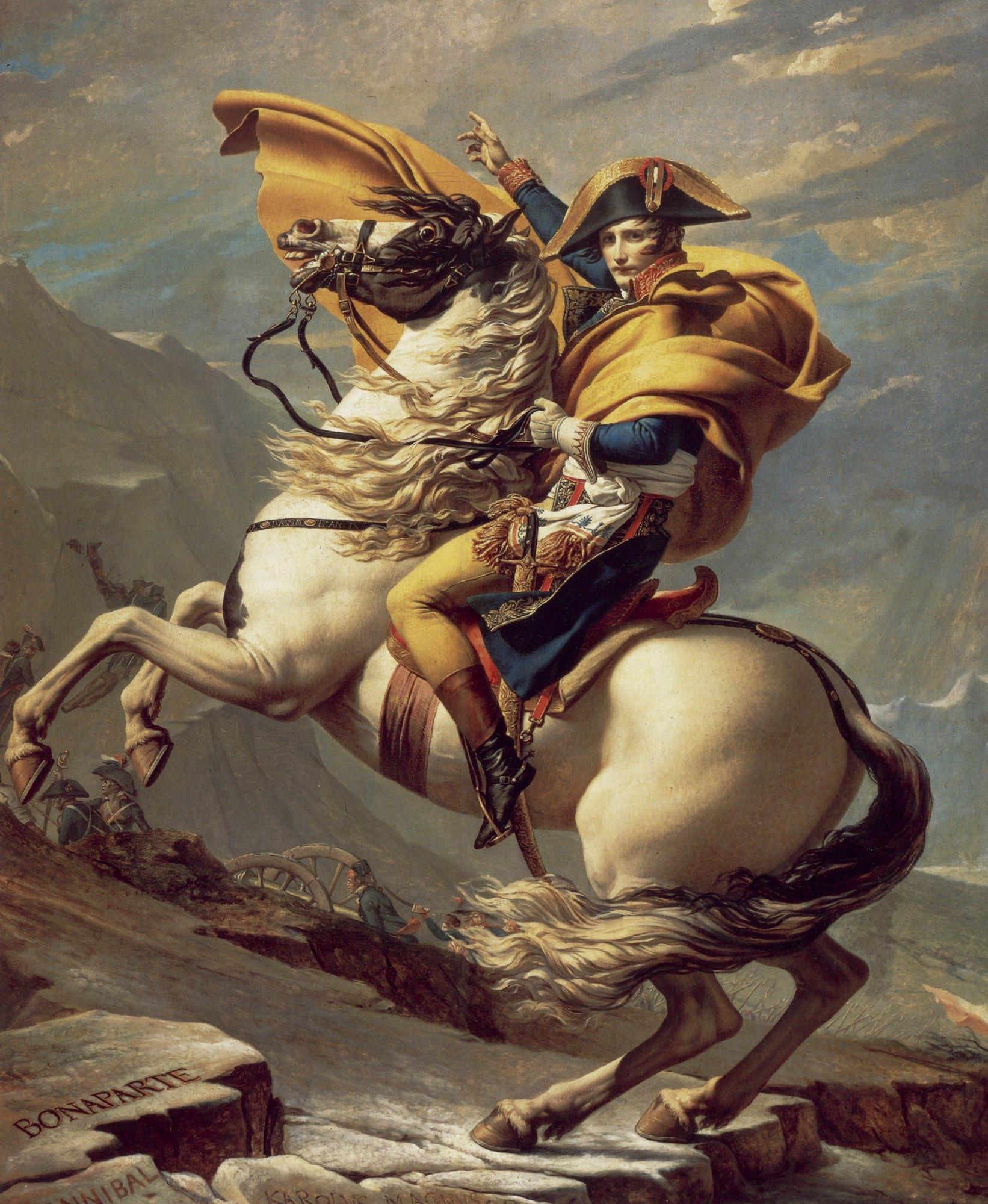
That is what happened. This painting is what he wanted people to remember: a young general on a rearing white stallion, cloak whipping in the wind, pointing calmly toward the summit while a storm rolls in behind him. It is one of the most successful pieces of political image making ever produced.
What you're looking at
Napoleon, about 30 years old, sits on a horse rearing up on a steep mountain slope. His face is serene, almost bored, while everything around him is in motion: the horse's mane and tail, the huge orange cloak, the dark clouds. Far below and behind him, tiny soldiers haul a cannon up the path. On the rocks in the lower left, three names are carved into the stone: BONAPARTE, HANNIBAL, and KAROLUS MAGNUS, which is Latin for Charlemagne. All three led armies across the Alps.
What makes it special
It shows the man exactly as he asked to be shown. According to accounts of the commission, Napoleon told David he wanted to be painted "calm on a fiery horse." The contrast is the whole message: chaos everywhere, total control at the center.
He refused to pose. Napoleon would not sit for the portrait, arguing that nobody checks whether portraits of great men look like them; what matters is that their character comes through. So David worked from earlier likenesses and from the uniform Napoleon had worn at Marengo, and some accounts say a stand in posed for the body. The face is an idealized mask, and that was the point.
The rocks rewrite history in real time. By carving his subject's name next to Hannibal and Charlemagne, David placed a general who was still alive among the legends of the past. The painting does not report an event; it files it straight into the history books.
The story behind it
The first version was commissioned in 1800 by King Charles IV of Spain, as a diplomatic gesture toward France. Napoleon liked the result so much that he ordered copies, and David's studio produced five versions between 1801 and 1805, with different colors for the cloak and the horse. They hung in palaces and helped turn Napoleon's face into a brand across Europe.
The version shown here, the first one, had an adventurous life. When Napoleon's brother Joseph lost the Spanish throne and fled in 1813, he took the painting with him, eventually into exile in the United States. It returned to France much later and has hung at the Château de Malmaison, Napoleon and Josephine's country house near Paris, since 1949.
One detail most people miss
Fifty years later, the French painter Paul Delaroche answered David with a deliberately honest version, Bonaparte Crossing the Alps (1850). His Napoleon is tired and wrapped in a grey coat, riding a mule through the snow, led by a guide. Put the two side by side and you see the difference between a historical record and propaganda. Delaroche's version is closer to the truth; David's is the one on postcards, stamps, and album covers.
Where to see it
The first version hangs at the Château de Malmaison in Rueil-Malmaison, just west of Paris. Others are at Charlottenburg Palace in Berlin, the Belvedere in Vienna, and the Palace of Versailles, which has two. If you visit Versailles, look at the cloak: the color changes from version to version, which is a quick way to tell them apart.