In 1509, a 26-year-old painter from Urbino started work on a wall in the private library of Pope Julius II. A few rooms away, under the same roof, Michelangelo was lying on a scaffold painting the ceiling of the Sistine Chapel. The two men did not like each other.
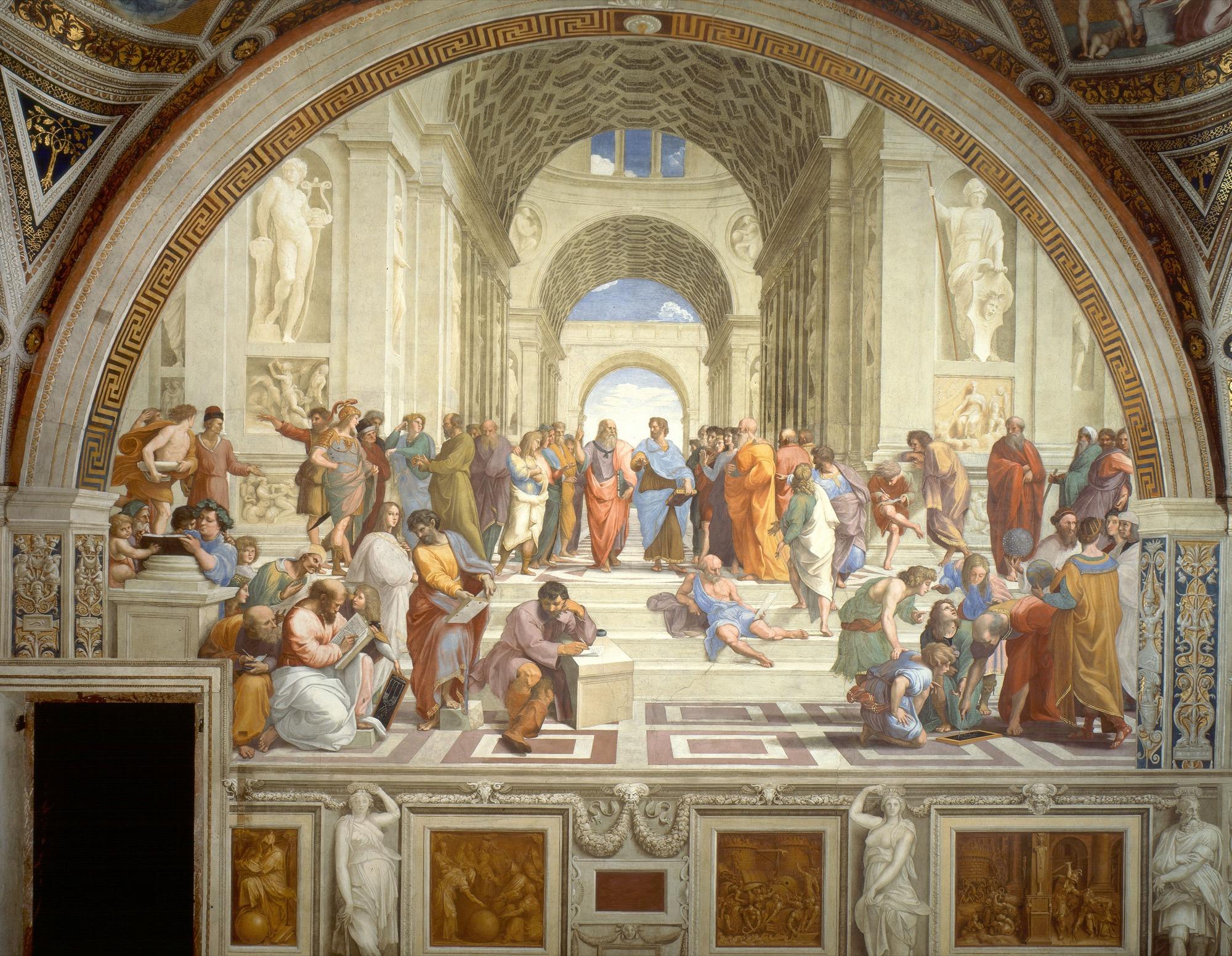
Two years later Raphael had finished a fresco about 7.7 meters wide, crowded with more than fifty figures: the greatest philosophers, mathematicians, and scientists of ancient Greece, gathered in one imaginary building. And somewhere in the middle of the job, he added one more person. A brooding man in a stonemason's boots, slumped against a block of marble in the foreground, who looks a lot like Michelangelo.
What you're looking at
A vast hall of arches and coffered vaults opens up under a blue sky. In the exact center, walking toward us, are the two giants of Greek philosophy. On the left, the white-bearded Plato points up at the heavens, the world of ideas. On the right, the younger Aristotle holds his hand out flat toward the earth, the world we can observe. That single pair of gestures sums up two ways of understanding reality, and the rest of the crowd spreads out around them like an argument.
Around them, everyone is busy. Pythagoras writes in a book on the left. Euclid, or perhaps Archimedes, bends over a slate with a compass on the right, surrounded by students. Diogenes sprawls across the steps, ignoring everyone. Ptolemy holds a globe of the earth.
What makes it special
The space pulls you in. Raphael built the whole architecture with linear perspective, and every line of the floor and the vaults runs toward a vanishing point placed right between Plato and Aristotle. Wherever you start looking, your eye ends up at the two philosophers.
The ancients have Renaissance faces. Plato is traditionally said to have the features of Leonardo da Vinci, then around sixty. Euclid is often identified as the architect Bramante, who came from Raphael's hometown and helped bring him to Rome. Raphael turned a gathering of the ancient world into a portrait of his own.
It is an argument about knowledge itself. The room was the Pope's library, organized by subject. Facing this wall is a fresco about theology. Raphael's message, painted for the most powerful churchman in Europe, was that pagan reason and Christian faith belonged in the same room, in balance.
The story behind it
Raphael arrived in Rome around 1508, young and still little known, and Julius II was so impressed by his first work in the room that he handed him the whole commission. The rooms are now called the Raphael Rooms, and this one, the Stanza della Segnatura, made his name.
The figure of Heraclitus, the moody philosopher in the foreground, is the clue to the Michelangelo story. He does not appear in Raphael's full-size preparatory drawing, which survives in the Pinacoteca Ambrosiana in Milan. He was added directly onto the plaster later, and many scholars argue it was after Raphael had seen the first half of the Sistine ceiling, unveiled in 1511. The heavy, muscular, inward-looking figure is painted in Michelangelo's style, and the face is widely read as his. It may be a tribute, a joke, or both.
Raphael died in 1520 on his 37th birthday. He is buried in the Pantheon.
One detail most people miss
Look at the far right edge, just above the group around Euclid. A young man in a dark cap looks straight out of the picture at you, the only figure in the crowd who does. That is Raphael himself. Next to him stands an older man in white, usually identified as the painter Sodoma, who had worked in the room before him. Some scholars argue it is Raphael's teacher Perugino instead.
Where to see it
The fresco is in the Stanza della Segnatura, part of the Raphael Rooms inside the Vatican Museums in Vatican City. The usual route passes through these rooms on the way to the Sistine Chapel, so you can see both rivals' masterpieces on the same visit, a few minutes apart. Arrive early: the rooms are small and fill quickly. The full-size cartoon, a drawing nearly three meters tall, can be seen in Milan at the Pinacoteca Ambrosiana.