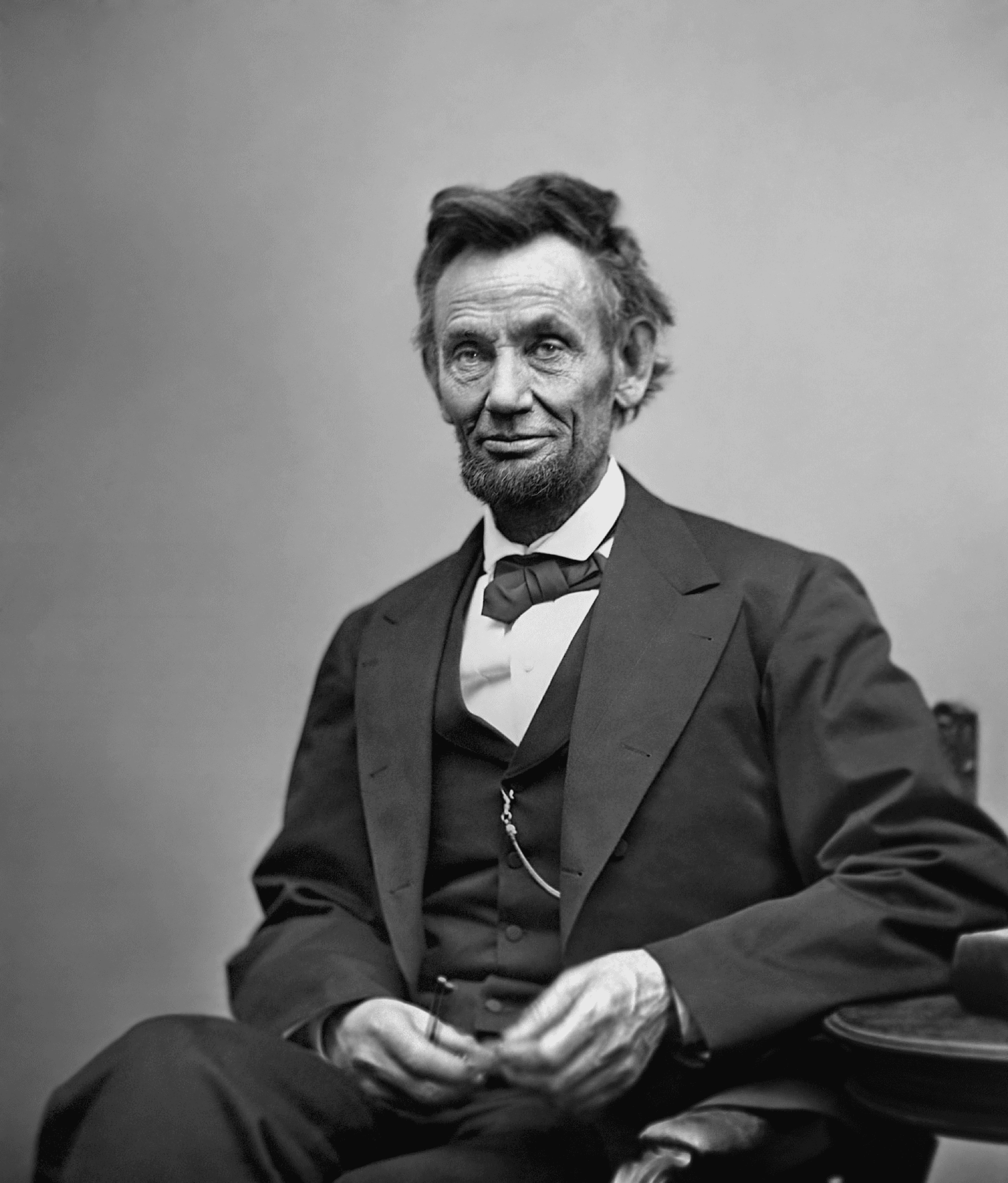
Look at how old he looks. Abraham Lincoln sat for this portrait on February 5, 1865. He was fifty-six. Four years of civil war, the bloodiest in American history, had hollowed his cheeks, carved deep lines around his eyes, and left him looking far older than his age, worn almost to transparency. There is a faint, tired warmth in his expression, the look of a man who can see the end of a long ordeal.
He did not live to rest. Nine weeks after this picture was taken, on April 14, 1865, he was shot in the back of the head at Ford's Theatre, and he died the next morning. Photography had arrived just in time to do something new: to record, image by image across a presidency, exactly what the job and the war were doing to one human face.
What you're looking at
A seated studio portrait of the sixteenth president of the United States, made by Alexander Gardner, one of the great photographers of the American Civil War. Lincoln sits three-quarters to the camera in a plain dark suit, long legs crossed, hands resting in his lap. There are no props of power, no grand backdrop, just a tall, gaunt, exhausted man in a chair. It was taken during one of his last photographic sessions, only two months before his assassination, which makes it one of the final clear looks we have at him alive.
What makes it special
It is history caught by a new machine. Lincoln was among the first leaders of the photographic age. Earlier presidents survive only as paintings and engravings, flattering and composed. Lincoln we can see almost as his contemporaries saw him, in dozens of real photographs, aging visibly from the vigorous man of 1861 to the spent figure here.
The exhaustion is the content. There is no attempt to make him look strong or triumphant. The picture's whole power is in the toll written on his face: the sunken cheeks, the lines, the heavy eyes. It is a portrait of what leadership through catastrophe actually costs, and it does not look away.
He understood the camera's power. Lincoln grasped, earlier than most, that photographs shaped how the public saw a leader. He once half-joked that a photographer and a famous speech had made him president. In an era before film or broadcast, these still images were how millions of people met their president's face.
The story behind it
Alexander Gardner had photographed the horrors of the war itself, including the first images of battlefield dead ever shown to a wide public, pictures that shocked a nation used to imagining war as glory. By 1865 he was among Lincoln's favored portraitists. This sitting came as the war was finally grinding toward its end; within weeks the Confederacy would collapse, and within two months Lincoln would be dead. The photographs from his final sessions have an unavoidable weight, because we know what he did not: how little time was left.
One detail most people miss
At that same February 1865 session, Gardner took another, closer portrait of Lincoln, and the glass negative cracked across the top before he could make more than a single print. That one flawed image, with a pale fracture line running above Lincoln's head, has become one of the most haunting photographs in American history, because the crack falls almost exactly where, nine weeks later, the assassin's bullet would strike. It was an accident of broken glass, nothing more. But people have never been able to unsee it.
Where to see it
Original prints and negatives of Lincoln's portraits are held by institutions such as the Library of Congress and the National Portrait Gallery in Washington, and high-resolution scans are freely available online, in the public domain. Look at this 1865 face beside a photograph of Lincoln from 1861, when he first took office. The same man, four years apart. Few images show so plainly what history can do to a person.