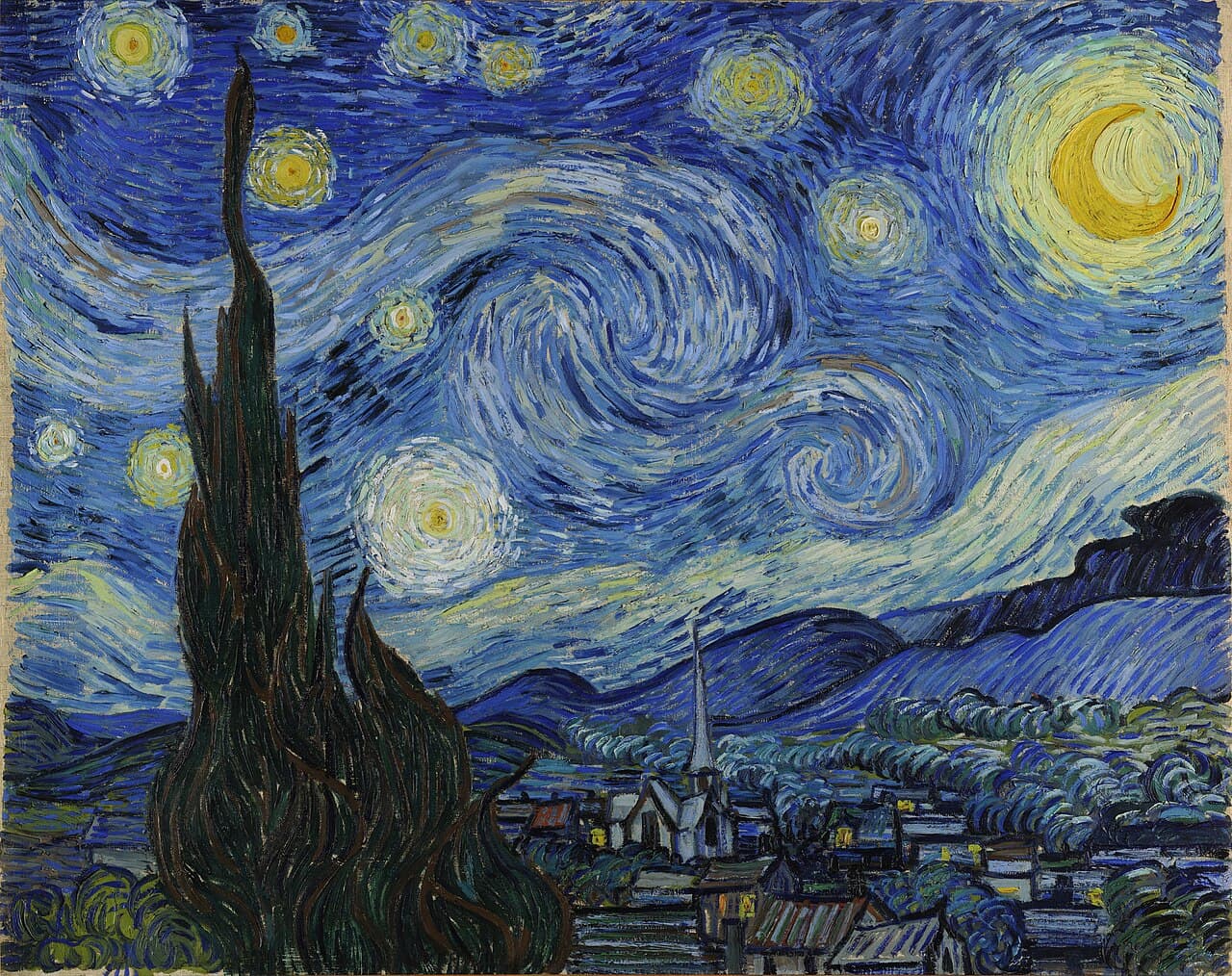
You have seen this painting on mugs, phone cases and dorm-room posters so many times that it is easy to forget how strange it is. Nobody before van Gogh had ever painted a night sky like this - not because they couldn't, but because it would not have occurred to them. The sky here is not a backdrop. It is the main character, and it is moving.
Vincent van Gogh painted it in June 1889, from his room in the Saint-Paul-de-Mausole asylum in southern France. He had committed himself after the breakdown in which he cut off part of his ear. The view through his barred window - a village, hills, one huge cypress tree - became the raw material. The rest came from memory and imagination.
What you're looking at
A sleeping village at the bottom, a flame-shaped cypress tree on the left, and above them a sky taken over by eleven swirling stars, a crescent moon, and two enormous spiral currents of light rolling through the middle. The brushstrokes are thick enough to cast tiny shadows - a technique called impasto - so the painting has a physical texture, like frosting on a cake.
What makes it special
The sky has turbulence. Look at the two great swirls in the center. Van Gogh painted the wind itself - the invisible made visible. More than a century later, physicists analyzing the painting found that its swirls closely match the mathematical structure of real atmospheric turbulence, something science itself couldn't describe properly until the 1940s. He painted it by feel.
It was painted from imagination, not observation. This was a radical break. Van Gogh's friends, the Impressionists, insisted on painting exactly what they saw, outdoors, in real light. Here van Gogh trusted feeling over fact - the village church spire is Dutch, not French; he imported it from his homesickness. That decision, emotion over accuracy, opens the door to most of modern art.
The quiet below, the storm above. The village windows glow with calm little lights while the heavens churn. You can read the whole painting as a self-portrait: the ordinary world asleep, and one wide-awake mind above it, burning.
The story behind it
Van Gogh mentioned the painting almost casually in letters to his brother Theo, and later listed it among works he considered failures. He sold almost nothing in his lifetime and died the following year, at 37, believing himself unsuccessful. His sister-in-law, Johanna van Gogh-Bonger, spent decades promoting his work; without her, you would likely never have heard his name.
One detail most people miss
Count the stars - eleven. Some historians link this to the Bible story of Joseph, who dreamed that "the sun, the moon and eleven stars" bowed to him - a dreamer mocked by his brothers who turned out to be right. Whether van Gogh intended it or not, it fits him perfectly.
Where to see it
The Museum of Modern Art (MoMA) in New York, where it has hung since 1941. There is almost always a crowd in front of it. Stand slightly to the side and look at the paint itself, in relief, at an angle - that is where the painting is most alive.