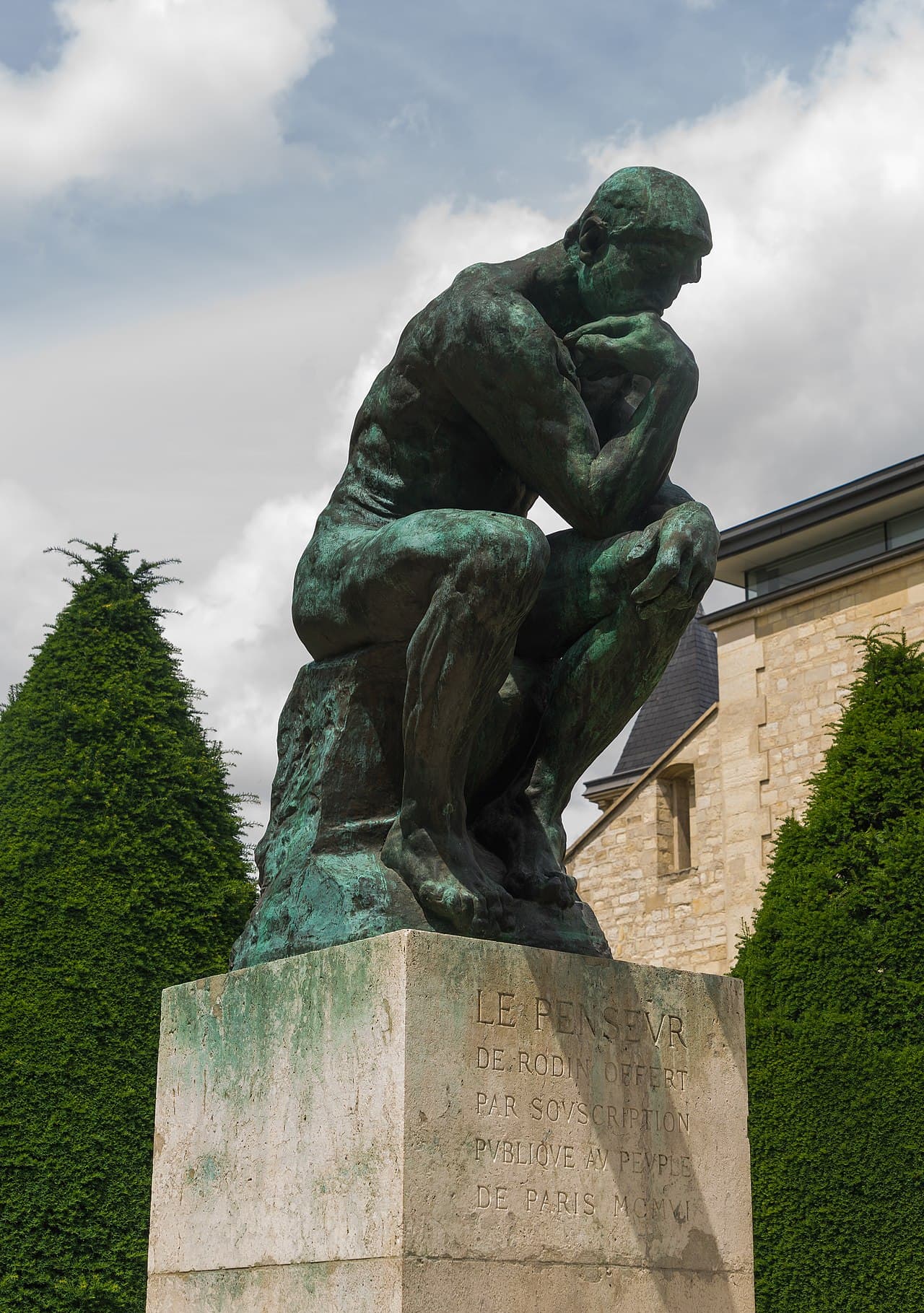
A naked man sits on a rock, chin on the back of his bent hand, elbow driven into the opposite knee. Try the pose yourself, right now, and you will discover something: it is not comfortable. It is not restful. Every muscle has to work. That discomfort is the entire idea.
Auguste Rodin modeled the figure around 1880, small, and enlarged it to monumental size in 1904. By the time he died in 1917, it was already the most famous sculpture of the modern age. Today it may be the only statue in the world that works as an emoji: one silhouette, instantly readable as thinking.
What you're looking at
A bronze man, larger than life, on the edge of a rock that is going nowhere. The pose knots the body: right elbow on left knee, twisting the torso; toes curled and gripping; the back one ridge of tension. Rodin left the surface rough, full of gouges and swellings that catch light, so the figure seems to flicker between flesh and molten metal.
What makes it special
He is thinking with his whole body. Rodin said it directly: his thinker thinks not only with his brain, but with his knitted brow, his distended nostrils, his compressed lips, every muscle of arm, back and leg, his clenched fist and gripping toes. Western art had always shown thought as calm, a raised finger, a distant gaze. Rodin showed it as effort, closer to labor than to leisure. Once you see the gripping toes, you never unsee them.
He was designed to watch Hell. The figure was created for the crown of The Gates of Hell, a colossal bronze door based on Dante's Inferno that Rodin worked on for 37 years and never finished. The seated man, first called The Poet, was Dante himself, brooding above the damned, and perhaps the sculptor above his own swarming creation. Enlarged and freed from the door, he lost the context and gained the world: no longer thinking about something, just thinking.
There is no single original. Rodin embraced casting: multiple bronzes of the same model, made in his lifetime and legally after his death by the French state, which inherited his molds. Full-size Thinkers sit in Paris, Cleveland, Philadelphia, Tokyo, Buenos Aires and beyond. The sculpture pioneered something we now find normal: a masterpiece that exists in many places at once, none of them a copy.
The story behind it
Rodin was rejected three times by the École des Beaux-Arts and accused, early on, of faking his most lifelike figure by casting it from a living man, an insult that pushed him toward the expressive exaggeration that became his signature. When he finally exhibited the enlarged Thinker in 1904, critics sneered but the public subscribed money to buy it for the city of Paris. It ended up guarding Rodin's own grave at Meudon: the watcher of Hell, retired to watch its maker.
One detail most people miss
The right elbow rests on the left knee. It sounds trivial; it is the whole engine. Rest the natural elbow on the natural knee and the pose opens, relaxed. Cross it over and the torso wrings itself like a cloth. Rodin found the single small wrongness that turns sitting still into visible struggle.
Where to see it
The garden of the Musée Rodin in Paris is the classic setting, against roses and sky. The Cleveland Museum of Art's cast has a harder story: in 1970 a bomb shattered its base and legs, and the museum chose to display it unrepaired, damage and all. A statue about the weight of thought, permanently marked by the era that attacked it: Rodin would not have fixed it either.