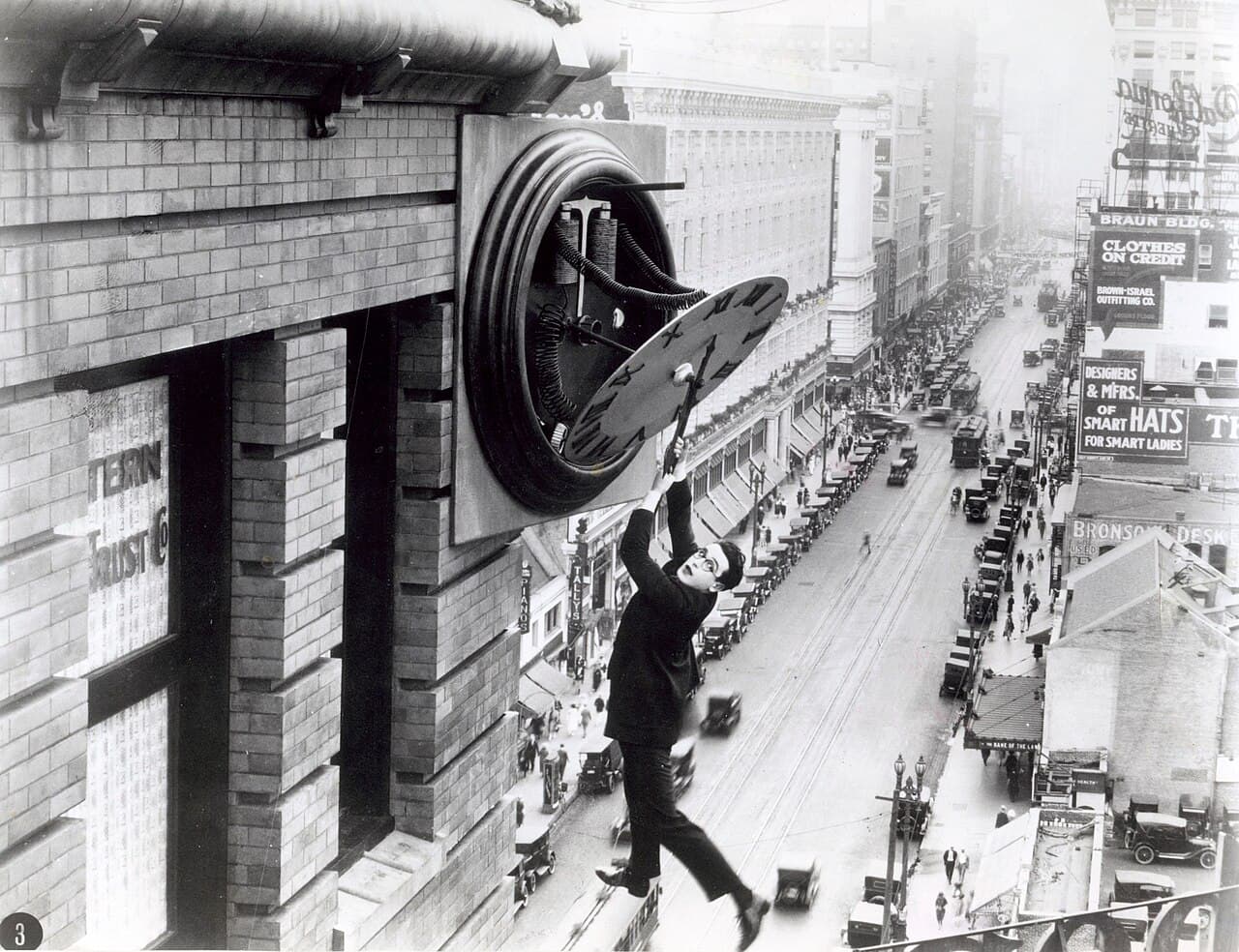
A young man hangs from the hands of a giant clock on the side of a skyscraper. The clock face tears loose and swings. Below him: real cars, real streetcars, a real Los Angeles street, terribly far down. It is the most famous image of silent comedy, and a century of action cinema, from Jackie Chan to Tom Cruise on the Burj Khalifa, is dangling from that same clock.
Harold Lloyd was, in the 1920s, as big as Chaplin at the box office, and his character could not have been more different: no tramp costume, no pathos, just an ordinary ambitious young man in round glasses, the kind of person who might sell you socks. Which, in Safety Last!, is exactly what he does.
What you're watching
A country boy moves to the city to make good, takes a job as a department store clerk, and pretends in letters to his girlfriend that he is already a success. When the store offers a thousand dollars for a publicity stunt, he arranges for a friend to climb the building's outside wall. The friend gets chased off by a policeman, and our hero has to climb the twelve stories himself, floor by floor, obstacle by obstacle: pigeons, a tennis net, a plank, a rope, and finally that clock.
What makes it special
The climb is a comedy structure disguised as a stunt. Each floor introduces a new small disaster that tops the last one. This is escalation, the deepest law of comedy, made literal: the joke and the altitude rise together. Screenwriting classes still teach the sequence as perfect structure.
It was real enough to hurt. No stunt double for most shots: Lloyd did the climbing on facade sets built atop real high-rises, with a platform of mattresses a couple of meters below and the genuine street far beneath that. A fall meant broken bones at minimum. Audiences in 1923 reportedly fainted; the film invented a genre the trade press called the thrill picture.
The man had seven and a half fingers. In 1919, a prop bomb that was supposed to be a photo gag turned out to be live; it exploded in Lloyd's hand, taking his right thumb and index finger. He climbed, gripped, and dangled wearing a prosthetic glove, and told almost no one. Knowing this does not make the clock scene funnier. It makes it close to unbelievable.
The story behind it
Lloyd's glasses had no lenses. He called the character Glasses, an everyman defined by one prop, invented after he realized audiences loved optimists more than victims. Off camera, Lloyd was the businessman his character pretended to be: he owned his films outright, and decades later kept them out of circulation, which is partly why Chaplin and Keaton are household names and Lloyd, their box-office equal, is the one people rediscover with astonishment.
One detail most people miss
Look at the title. It is a pun so quiet people read past it: the phrase safety last, the opposite of safety first, plus an exclamation mark doing the work of a wink. The film announces its whole philosophy, thrills sold with a smile, in two words on the poster.
How to watch
The full film, embedded above, runs about 74 minutes; the climb is the final 20 and loses half its power out of context, so let the sock-counter's small humiliations build first. Then, when he grabs the minute hand, remember the glove. Some scenes age; this one has only ripened.