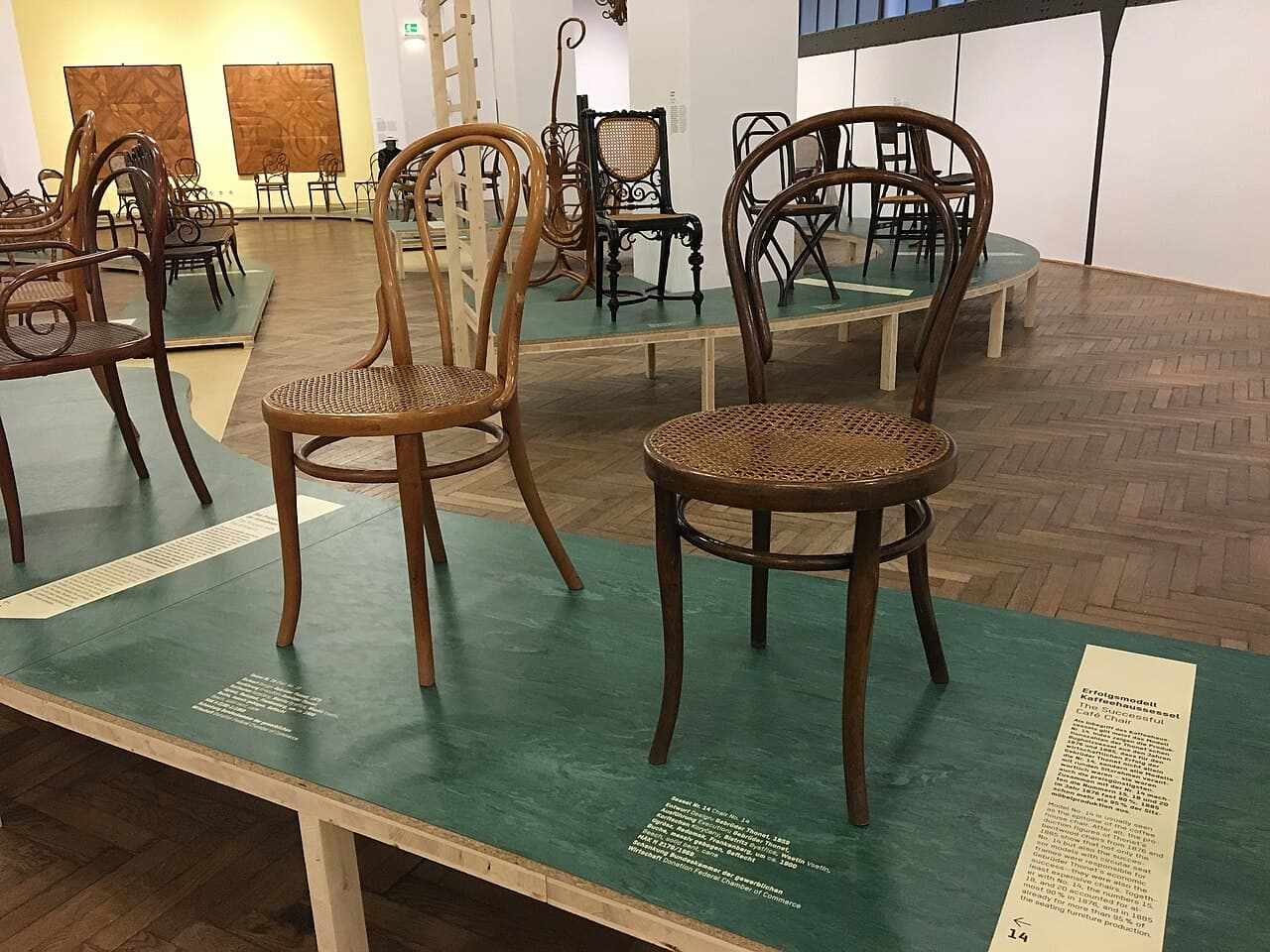
You have almost certainly sat in this chair, or one of its descendants, without ever looking at it. It is the classic café chair: a round seat, a gently curved back made of a single loop of wood, four splayed legs, the whole thing light enough to lift with one finger. It has been in bistros, bentwood everywhere from Paris to Buenos Aires for over 150 years. It is called Chair No. 14, it was designed by Michael Thonet in 1859, and it may be the most quietly revolutionary object of the entire industrial age.
What you're looking at
Chair No. 14 is made from just six pieces of steam-bent beechwood, ten screws, and two washers. That is the whole chair. There is no carving, no upholstery, no joinery of the old handmade kind. The curves that make it elegant, the swooping back, the little supporting loop under the seat, were not cut by a craftsman; they were produced by bending solid wood in metal molds, a technique Thonet spent decades perfecting. The result looks effortless and slightly impossible, like a line drawn in the air and then made solid.
What makes it special
It was the first chair built for the factory, not the workshop. Before Thonet, a chair was a one-off, assembled by a skilled cabinetmaker. Chair No. 14 was designed from the start to be made by machines and semi-skilled workers, in enormous numbers, every copy identical. It is, in a real sense, the first modern piece of furniture: an object whose design assumes mass production.
It solved shipping before anyone else understood the problem. The chair was shipped disassembled, flat, in pieces, to be screwed together at its destination. Thirty-six of them fit inside a single one-cubic-meter crate. This is the flat-pack idea, the entire logic of IKEA, invented and perfected a full century before IKEA existed. It is why the chair could conquer the world: you could send a thousand of them across an ocean in the space that a few finished chairs would have taken.
It disappeared into everyday life, which is the highest success. By 1930, around fifty million had been sold. It is still in production today. Le Corbusier, the great modernist architect, adored it and used it in his buildings. And yet almost no one who sits in it thinks of it as "designed" at all. It has become simply what a chair looks like, which is the strange fate of perfect design: it stops looking like a choice and starts looking like the truth.
The story behind it
Michael Thonet was a cabinetmaker in the Rhineland who became obsessed with a single question: could you bend wood into strong, graceful curves cheaply and repeatably? His early experiments, gluing together thin layers of veneer, failed and were vulnerable to heat and damp. The breakthrough was learning to bend solid rods of beech with steam and pressure, so the curve was the wood itself, not a fragile laminate. It took him years, patent battles, and a move to Vienna, where the imperial capital's cafés became his first great market.
Chair No. 14 was the payoff. Cheap enough for ordinary cafés to buy by the dozen, light enough for a waiter to stack and move, strong enough to survive decades of daily abuse, and beautiful enough that it never went out of style. Thonet had not just designed a chair. He had designed a system: a way of making, packing, shipping, and selling furniture that the entire modern industry would eventually copy. The unassuming chair was the visible tip of an invisible revolution in how objects get made.
One detail most people miss
Pick one up, if you ever get the chance, and notice how little it weighs, and how few parts it has. Then consider that this simplicity was the hard part. Anyone can add; the genius was subtraction, reducing a chair to the smallest number of pieces that could still hold a person, still look graceful, still survive a bar fight. A design magazine once asked leading designers to name the most perfect industrial object ever made, and this humble café chair kept appearing near the top of the list, beating cars, phones, and lamps. It had a century's head start on all of them, and it is still winning.
Where to see it
Original Thonet chairs are in design collections worldwide, including the MAK in Vienna and the MoMA in New York, but the truest place to meet Chair No. 14 is a café. Look down at what you are sitting on next time you order a coffee. There is a good chance you are resting on the object that taught the modern world how to make things.