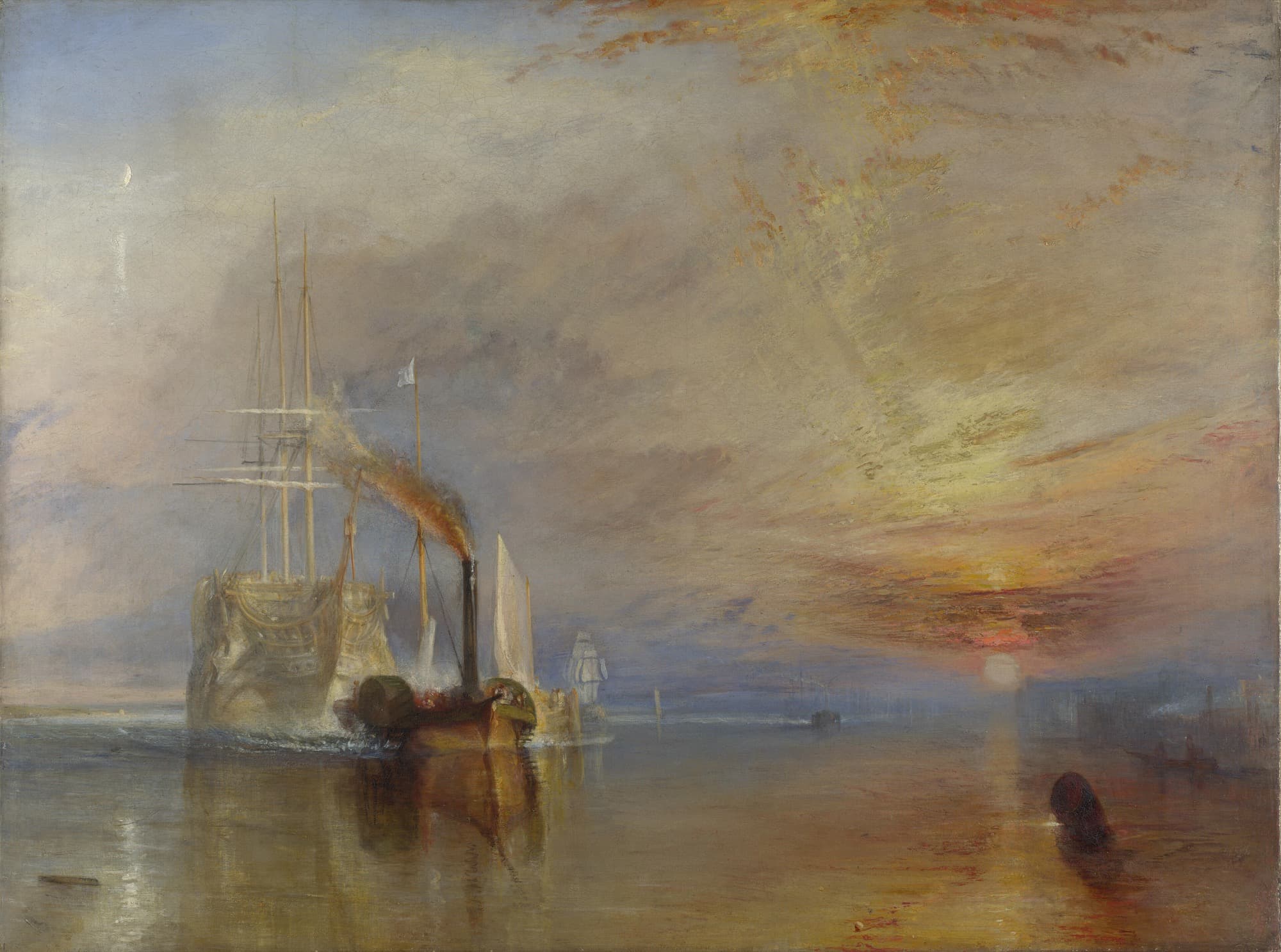
A great old warship, pale and ghostly, her tall masts still reaching up, is being towed along the river to be taken apart for scrap. She was the Temeraire, a ninety-eight-gun ship that had fought gloriously at the Battle of Trafalgar in 1805, Nelson's famous victory. Now, decades later, she is finished, and the thing dragging her to her death is a small, dark, ugly steam tug, low in the water, belching fire and black smoke from its funnel. Over it all, the sun sets in a blaze of gold and red.
Turner changed the facts to paint this. The real Temeraire had already been stripped of her masts and was a bare hulk when she was towed; the sun, by the geography of the journey, would not have been setting ahead of her at all. None of that mattered to him. He was not painting a towing job. He was painting the end of an era.
What you're looking at
On the left, luminous and almost transparent in the evening light, floats the old sailing warship, beautiful and insubstantial, like a memory. Ahead of her, small and solid and black, chugs the modern steam tug, the future, hauling the past to the breaker's yard. The right half of the sky and water erupts into one of Turner's spectacular sunsets, so that the whole scene becomes a farewell lit by a dying sun. It hangs in the National Gallery in London and is routinely voted the nation's favourite painting.
What makes it special
It makes a goodbye out of light. The contrast is the whole story: the pale, towering ghost ship against the squat, fiery tug; the golden glow of the old world against the hard black shape of the new. Turner lets color and light do the mourning. You feel the loss before you have worked out what you are looking at.
It catches history turning over. The painting sits exactly on the hinge between the age of sail and the age of steam. A hero of the old wooden navy is being dismantled by a machine, and Turner knew precisely what that meant. Industry was replacing craft, engines were replacing wind, and an entire world of sailing ships was passing into history.
The facts bow to the feeling. By removing the real journey's dull truths and staging a dramatic sunset, Turner shows what Romantic painting is really for. Accuracy was never the goal. Emotion was. He rearranged reality to make you ache.
The story behind it
Turner was already the most celebrated and controversial British painter of his age, famous for dissolving ships, storms, and whole landscapes into swirls of light and color that puzzled and dazzled his contemporaries. He loved this particular painting, called it his "darling," and refused to sell it, eventually leaving it to the nation. It arrived at a moment when Britain was changing fast under steam power and industry, and audiences seem to have felt, then and now, that the painting was quietly saying goodbye to something larger than one ship.
One detail most people miss
Look at the sun and then at the moon. On the right, the sun is sinking in a furnace of color, the obvious emotional heart of the picture. But over on the left, in the cooler sky above the old ship, a pale moon has already risen. Turner sets the setting sun and the rising moon in the same sky, day ending on one side, night beginning on the other, so that the painting marks not just the end of a ship or an age, but the turning of time itself.
Where to see it
The Fighting Temeraire is in the National Gallery in London, where admission is free. Give it a moment from a distance to feel the full sweep of the sunset and the ghostly ship, then move closer to see how thinly and freely Turner painted the glowing sky. Few pictures have made so many people stand quietly in front of a towing job and feel, unexpectedly, like saying goodbye.