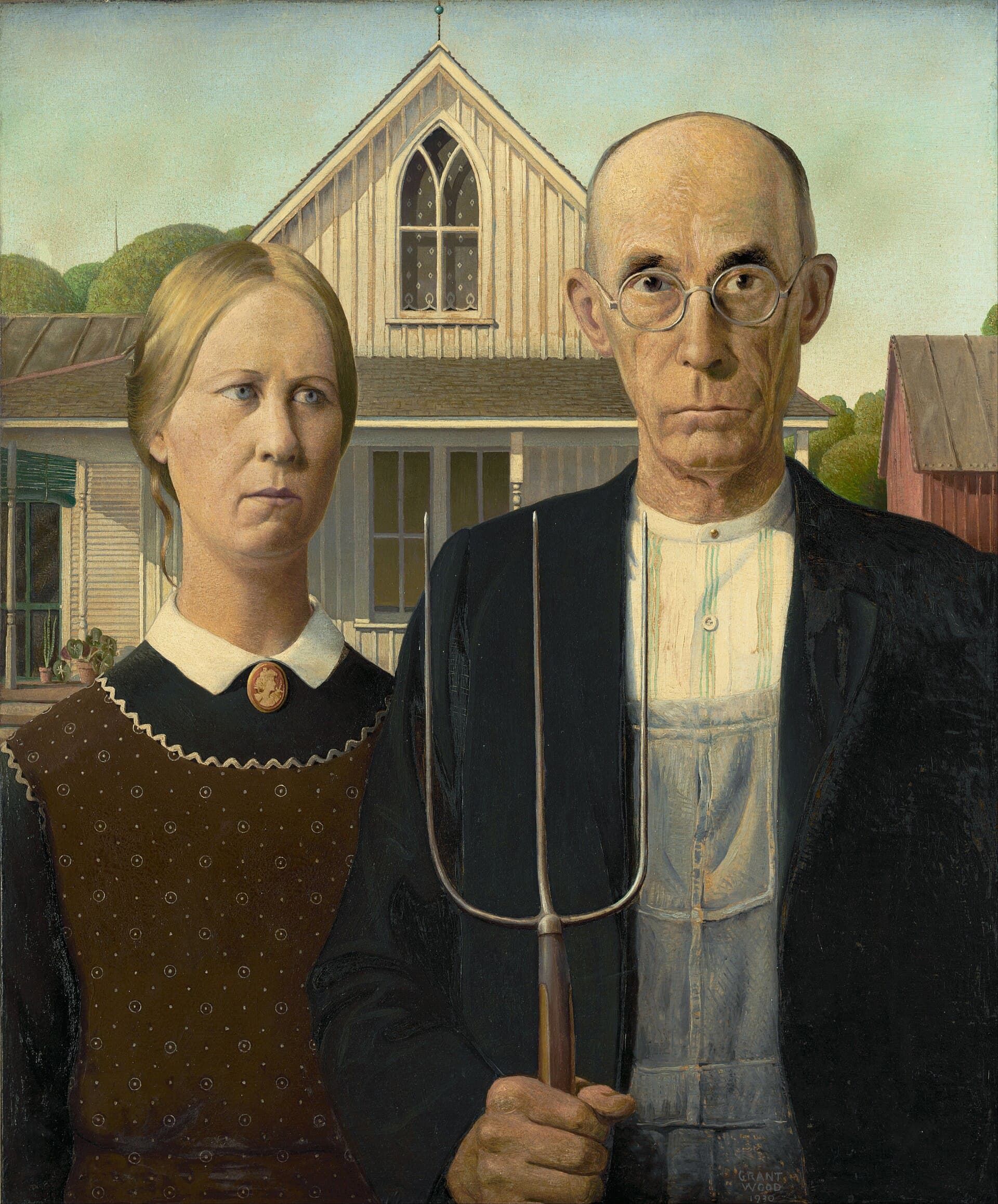
You already know this painting, even if you have never thought about it. A gaunt man in overalls stares out at you, a three-pronged pitchfork gripped upright in his fist. Beside him, a woman looks off to the side, mouth set, a cameo brooch at her throat. Behind them, a white farmhouse with a single pointed window. It is the second most parodied image in the world, after the Mona Lisa: put any two figures in that pose, hand one of them a pitchfork, and everyone gets the reference. And almost everything the average person believes about it is wrong.
What you're looking at
In 1930, the painter Grant Wood was driving through the small town of Eldon, Iowa, when he saw a modest white house with an incongruously fancy pointed window, a style called Carpenter Gothic, a cottage pretending to be a cathedral. He was struck by the gap between the plain house and its one grand aspiration, and imagined the kind of people who might live in it: severe, hardworking, proud, a little rigid. He did not paint a real couple standing there. He posed two models separately, in his studio, and combined them: the man was Wood's own dentist, Dr. Byron McKeeby, and the woman was Wood's sister, Nan. Which is the first surprise. The two people in the most famous portrait of American married life are a dentist and the painter's little sister, and Wood always insisted they were not husband and wife at all, but father and unmarried daughter.
What makes it special
It is deliberately, weirdly flat and sharp. Wood had recently traveled in Europe and fallen in love with the crisp, hard clarity of early Flemish painters like Jan van Eyck. He brought that Old World precision home and aimed it at an Iowa farmhouse: every seam of the overalls, every tine of the pitchfork, every strand of hair rendered with almost uncomfortable exactness.
The details rhyme. Once you see it you cannot unsee it: the pitchfork's three prongs are echoed in the seams of the man's overalls, and again in the mullions of the Gothic window behind him. The whole painting is quietly stitched together by that one shape, a visual rhyme running from tool to clothing to architecture.
Nobody can agree on the mood. Is it a mocking cartoon of narrow, joyless rural life? A dignified tribute to the people who fed the country? Wood said it was a tribute, an affectionate portrait of solid Midwestern character. But plenty of viewers, then and now, read it as satire, and the painting refuses to settle the argument. That ambiguity is exactly why it has lasted.
The story behind it
When American Gothic was first shown at the Art Institute of Chicago in 1930 and won a prize, it made Grant Wood famous almost overnight. But not everyone was flattered. Some Iowans were furious, reading the painting as an insult, a portrait of their state as pinched, grim, and backward; one farm wife reportedly threatened to bite Wood's ear off. He spent years insisting he had meant no mockery, that these were people he admired.
The timing gave the picture a second life its maker never intended. It arrived at the start of the Great Depression, and as the country cracked, those two unsmiling faces came to stand for something: American endurance, the stubborn refusal to be broken, plain people holding their ground while everything fell apart. A painting Wood made about a fancy window became a national symbol of grit. And then, as fame does, it curdled into a gag, endlessly copied and captioned, until the actual painting nearly disappeared behind its own reputation.
One detail most people miss
Look at the woman, and then look just past her, at a loose curl of hair that has escaped from her severe, pulled-back style and falls against her neck. Everything else about her says control, restraint, propriety. That one stray curl says otherwise. Art historians have argued for decades about what Wood meant by it, whether it hints at a suppressed warmth or wildness under the starched surface. In a painting famous for looking rigid and closed, the most human thing is a single strand of hair that would not stay in place.
Where to see it
American Gothic has hung at the Art Institute of Chicago since 1930 and rarely travels. Go see the real thing if you can: it is smaller than you expect, and far stranger. Standing in front of it, the joke falls away, and you are left with two people looking back at you across a century, and no clear idea whether they want to feed you or judge you.