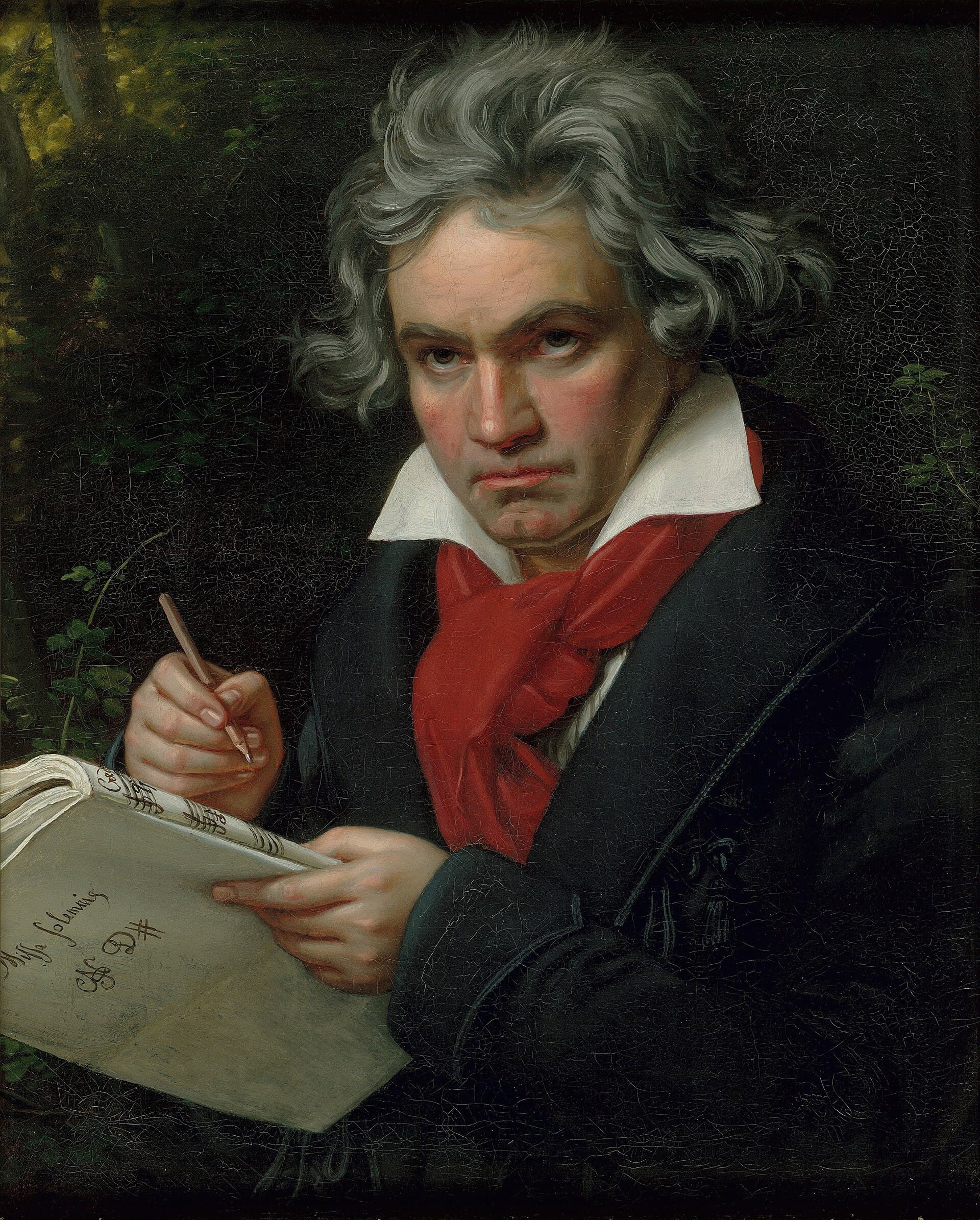
Press play and you already know what happens. Three short notes, one long one, a beat of silence, and the same shape again, lower and darker. You have heard it in cartoons, in commercials, in elevators, hummed by people who could not name a single other piece of classical music. It might be the most famous eight seconds of organized sound in human history.
Now the strange part: the man who wrote it was going deaf while he did, and the audience that heard it first nearly froze to death.
What you're listening to
A symphony in four movements, about 35 minutes, built with an almost frightening economy. The opening motif - short-short-short-LONG - is not just a beginning; it is a seed. Beethoven plants it in the first movement and then finds it everywhere: galloping in the strings, whispering in the horns, hiding in the rhythm of the slow movement, thundering back in the third. The last movement erupts from the third without a pause, minor turning to major, darkness to blazing C major daylight - one of music's great sunrises. For the finale Beethoven added piccolo, contrabassoon, and three trombones, instruments no symphony had used before, essentially inventing a bigger orchestra because his ending needed one.
What makes it special
It runs on one idea. Composers before Beethoven wrote beautiful melodies and elegant structures. Beethoven wrote a rhythm - barely even a tune - and demonstrated that development, not decoration, is where music's power lives. Every film score that builds tension from a repeating cell is using his discovery.
It has a plot. C minor to C major, struggle to triumph, darkness to light. Beethoven did not label it, but audiences have heard the story from the first night: something fights, and something wins. After him, symphonies were expected to mean something.
It survived its own premiere. December 22, 1808, Theater an der Wien, Vienna: a four-hour concert of entirely new Beethoven - the Fifth, the Sixth, a piano concerto, and more - in a hall with no heating, with an under-rehearsed orchestra that broke down mid-piece and had to restart. The audience sat in coats, exhausted and shivering. From that wreckage came the most celebrated symphony ever written.
The story behind it
Beethoven sketched the symphony over four years, in the period after he had admitted, in a letter never sent, that his hearing was failing and had considered ending his life. He decided instead, in his own words, to seize fate by the throat. The famous claim that the opening represents "fate knocking at the door" comes from his unreliable assistant Schindler, decades later - probably invented. But the myth stuck because the music makes it believable.
Confirmation of the symphony's power arrived quickly. In 1810, the writer E.T.A. Hoffmann published a review so ecstatic it practically founded music criticism, declaring that the symphony opened "the realm of the colossal and immeasurable."
The strangest afterlife came in wartime. The opening rhythm - short-short-short-long - happens to be Morse code for the letter V. During World War II, the BBC used it as the sound of "V for Victory," and Beethoven's most German symphony became the audio signature of resistance to Germany. The motif had grown larger than any nation that claimed it.
One detail most people miss
After the stormy third movement fades to a strange, held hush - just timpani ticking under suspended strings - the finale does not simply begin. It emerges, connected by a bridge, the movements fused so that triumph arrives without you noticing the door it came through. Then, mid-finale, the ghost of the third movement briefly returns, as if doubt knocked once more, before being swept away for good. Victory, Beethoven insists, has to be won twice.
How to listen
Press play on the full performance above - Iván Fischer conducting the Concertgebouw Orchestra. Listen once all the way through, and count how many disguises the four-note motif wears. You will lose count. That is the point.