Here is a fact that reorganizes how you see these paintings: the pond is artificial. Monet did not find this scene; he built it. In 1893, already famous, he bought a strip of marshland next to his garden in Giverny, diverted a small arm of the local river against his neighbors' loud objections, planted imported water lilies, and arched a Japanese bridge over the result. The most celebrated natural motif in painting is a construction project.
Then he spent the last thirty years of his life painting almost nothing else.
What you're looking at
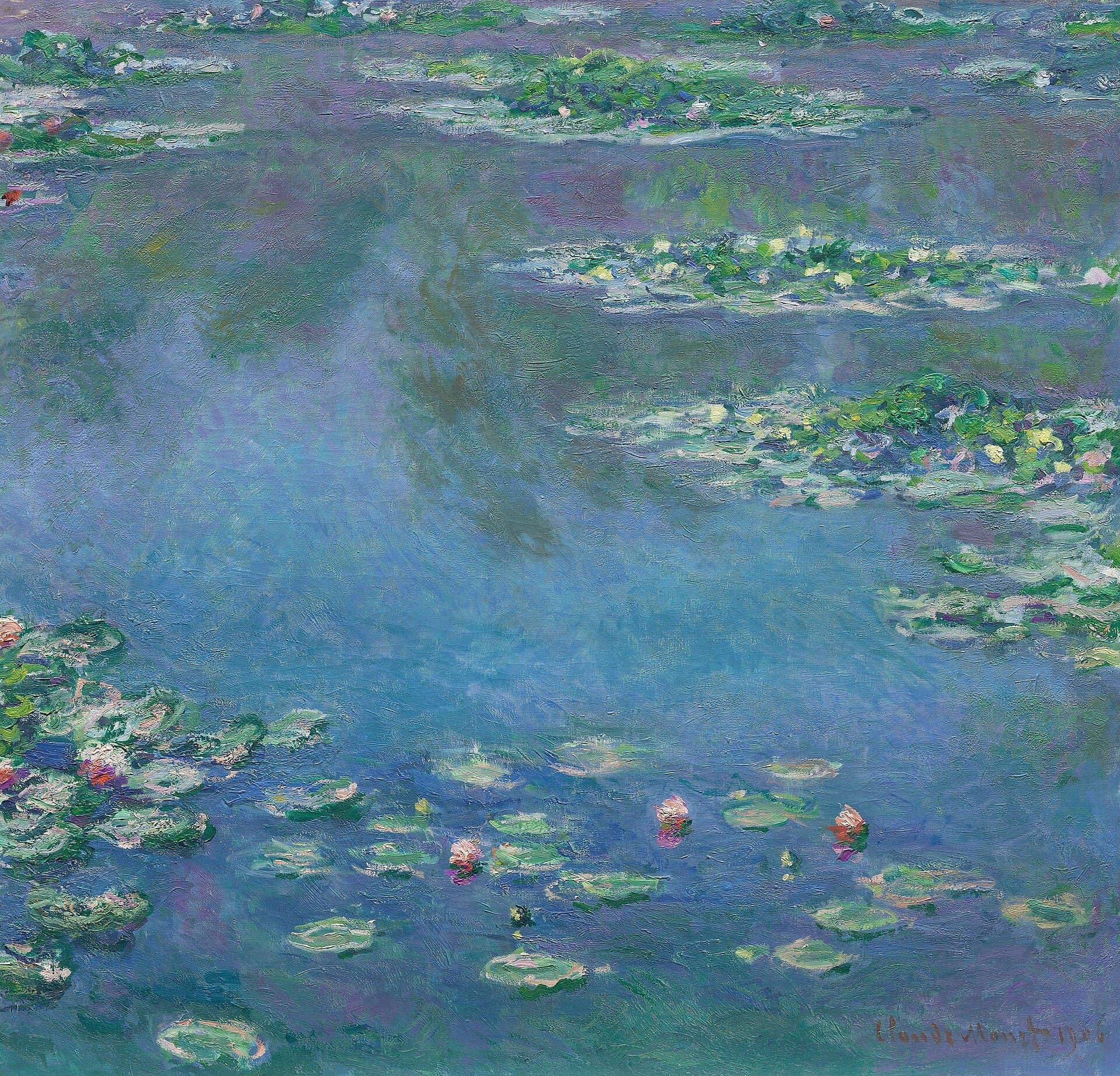
Our piece, from 1906, hangs in the Art Institute of Chicago, and it demonstrates the move that made the series revolutionary: Monet cropped out the world. No horizon, no sky, no bank, no bridge - just the surface of the water, floating islands of lilies, and the upside-down reflections of clouds and willows. You cannot tell where you are standing, because you are not standing anywhere; there is no ground in the picture. Up is a reflection, down is a lily pad, and the painting quietly abolishes the difference.
What makes it special
It dissolved the landscape. For five centuries, Western painting organized space like a window: foreground, distance, horizon. By painting only the water's surface, Monet made a picture that is simultaneously flat and infinitely deep. Critics at the time noticed something strange was happening; the abstract painters of the next generation knew exactly what it was, and claimed him as their ancestor.
It records seeing, not scenery. Each canvas is timestamped light: morning haze, noon glare, evening pink. Monet worked on multiple canvases at once, switching as the light shifted, chasing effects that lasted minutes. The subject is not the lilies; it is the act of looking at them.
The last ones were painted half-blind. Cataracts clouded Monet's vision for years; by 1922 he was legally blind in one eye, seeing the world through what he described as a fog, with colors distorted toward muddy reds and yellows. He kept painting, partly labeling his tubes and relying on the fixed order of colors on his palette. After surgery in 1923, some canvases shocked him and he destroyed or reworked them. The late water lilies hover on the edge of abstraction partly by intention and partly by biology - and no one can say exactly where the line is.
The story behind it
The pond began as a rich man's hobby and became something closer to a monastery. Monet rose before dawn, painted in sessions timed to the light, employed a gardener whose duties included dusting the lily pads and rowing out to groom the water surface before the master arrived. When he lost his second wife and then his eldest son, he painted the pond. When the First World War came close enough that he could hear artillery from his garden, he refused to leave and painted the pond.
The war gave the series its monument. The day after the Armistice in November 1918, Monet offered France a donation: a set of monumental water lily panels as a memorial to peace. He worked on them, in a purpose-built studio, until his death in 1926. They were installed in the Orangerie in Paris in 1927, in two oval rooms designed around them - a 360-degree pond with no beginning and no end. The painter André Masson later called the rooms "the Sistine Chapel of Impressionism."
One detail most people miss
There are no edges anywhere. Look at where a lily pad meets the water, where a reflection meets a real leaf: no outlines, only touches of color deciding to be one thing or another. Your eye assembles the pond from pure suggestion. Stand close and the painting falls apart into strokes; step back and the water returns. Monet is making you do the final brushwork yourself.
Where to see it
This canvas: Art Institute of Chicago. The monumental panels: Musée de l'Orangerie, Paris - go at opening time, sit in the middle of the oval room, and give it ten unhurried minutes. The pond itself still exists at Giverny, an hour from Paris, complete with gardener-groomed lilies. All three are worth the trip; together they are a pilgrimage.