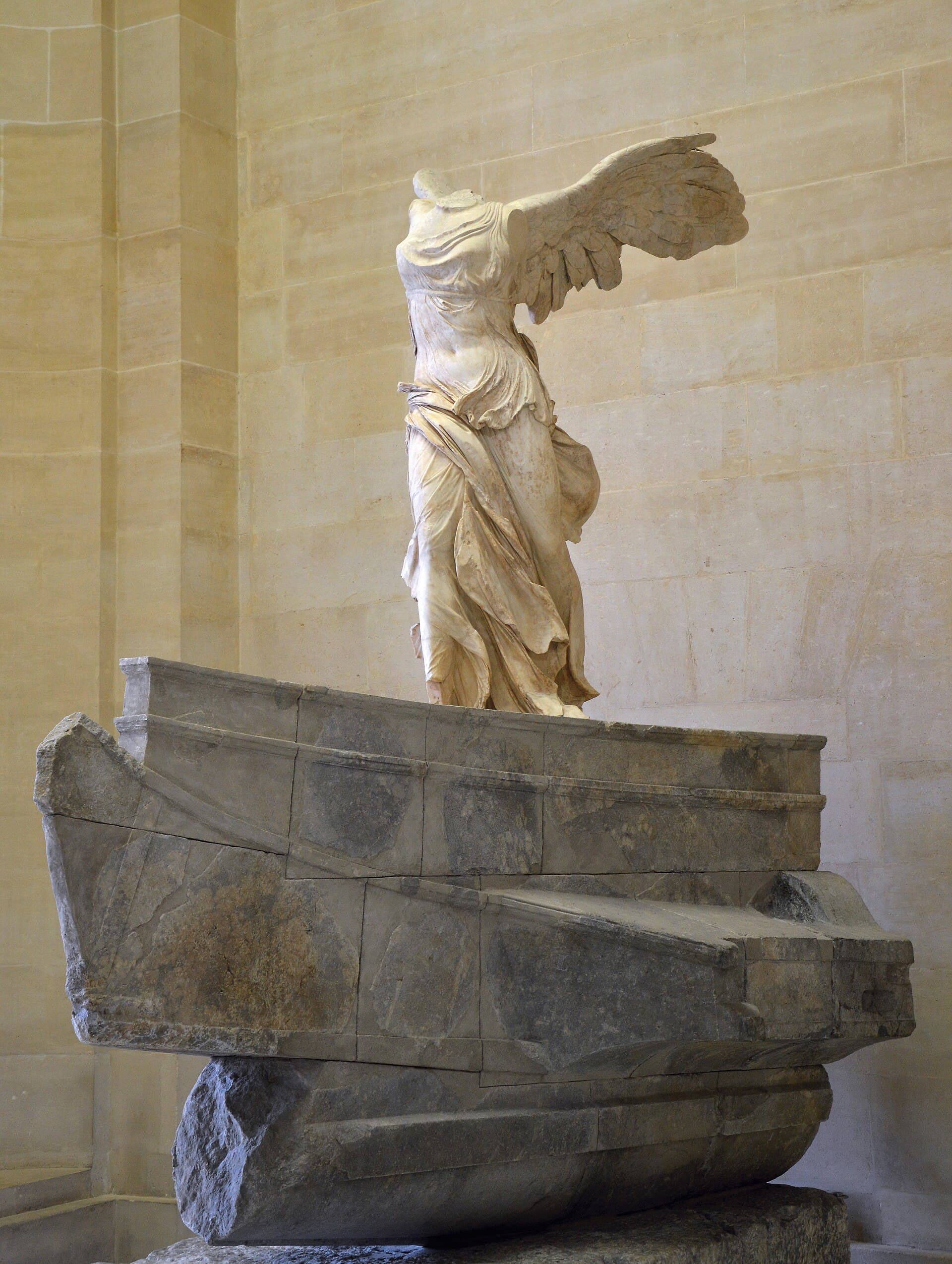
At the top of the Daru staircase in the Louvre, positioned so you see her the moment you begin to climb, stands a woman with wings and no face. Tourists rushing toward the Mona Lisa stop here without planning to. Something about her - the forward surge, the wings still braking, the sea wind pressing her dress against her body - reads instantly, across 22 centuries, with no head required.
She is Nike, the Greek goddess of victory, touching down on the prow of a warship. And she may be the best argument in existence that a damaged artwork can be more powerful than a perfect one.
What you're looking at
The statue commemorates a naval victory - most scholars point to the fleet of Rhodes, around 190 BC. Nike descends onto the ship's bow at the instant of landing: right leg forward, wings swept back, torso twisting against the wind. The sculptor carved the impossible moment between flight and arrival. Her missing arms changed the composition forever - the right one, we now know from a recovered hand, was raised high, probably in the open-palmed gesture of announcing victory.
The gray marble ship beneath her is not a pedestal; it is part of the work. Goddess and vessel together stood in a hillside sanctuary on the island of Samothrace, likely above a pool of water, angled so pilgrims saw her from below and from her left - a goddess landing out of the actual sky.
What makes it special
It is sculpture as pure motion. Most ancient statues stand, sit, or lean. Nike arrives. The diagonal thrust of her body, the counter-twist of her hips, the drag of the drapery - every line records force and direction. The Hellenistic era loved drama, and this is its masterpiece.
The damage became the meaning. Without a face, she cannot be serene or triumphant or anything human at all. What is left is the body's language: momentum, wind, salt air. Many sculptors have quietly admitted she is better this way - victory as a force rather than a person.
She was designed for her spot. The right side of the statue is noticeably less finished than the left - the sculptor knew exactly where the viewers would stand and spent the effort where their eyes would go. Even masterpieces have a backstage.
The story behind it
In April 1863, Charles Champoiseau, a French consul and amateur archaeologist digging on Samothrace, found a woman's torso in the ruins of a hilltop sanctuary - then wings, then hundreds of fragments of carved gray stone that seemed to belong to a boat. The pieces sailed to Paris, where restorers spent years reassembling the puzzle. In 1884 she was placed at the head of the Louvre's grand staircase, a piece of theatrical curation that turned a broken statue into the museum's beating heart.
The story kept unfolding. In 1950, archaeologists found her missing right hand on Samothrace - fingers open, confirming the raised gesture of proclamation. The hand is displayed in a case beside her, a small ruin next to a great one.
And she collected enemies worth having. In 1909, the poet Marinetti published the Futurist Manifesto, declaring that a roaring racing car was "more beautiful than the Victory of Samothrace." He chose her as the thing to overthrow precisely because everyone agreed nothing more beautiful existed.
One detail most people miss
Look at where the wings meet the body. There is no strap, no harness, no anatomical excuse - wings simply grow from a human back, and your eye accepts it without protest. That acceptance is engineering: the sculptor angled the wings along the exact lines of force the body implies, so they read as physics instead of costume. It is why every superhero landing pose since owes her a royalty.
Where to see it
The Louvre, Paris, top of the Daru staircase - restored and re-lit in 2014, she practically glows. See her twice: once from the bottom of the stairs, the way the architects intended, and once up close, from her left, the way her original sculptor did.