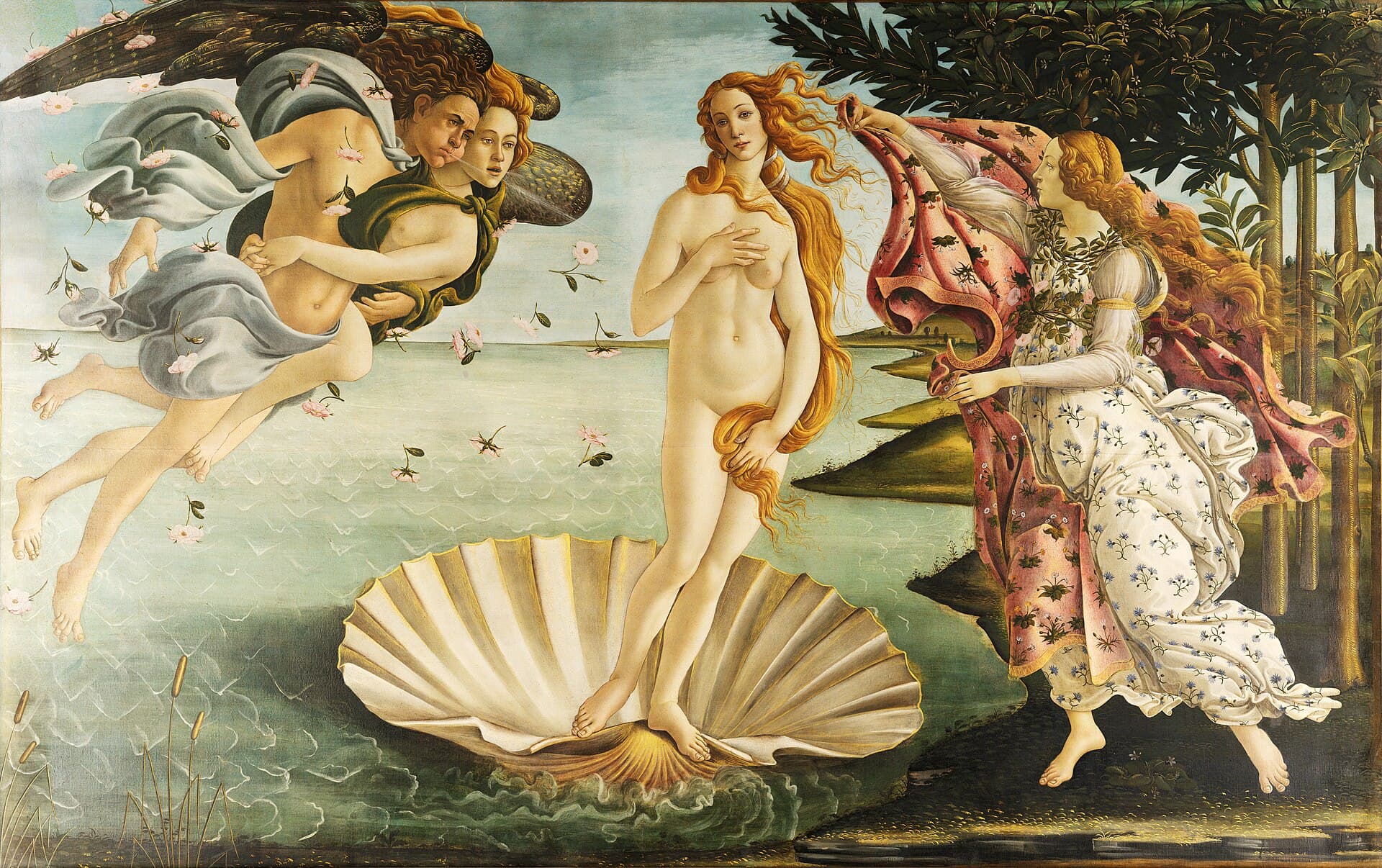
For roughly a thousand years, between the fall of Rome and the 1480s, European art had a firm rule about naked women: only Eve, and only ashamed. Then a Florentine painter working for the Medici family produced a life-size goddess, entirely nude, entirely unashamed, floating ashore on a seashell - and somehow made paganism feel as serene as an altarpiece.
The Birth of Venus was, as far as we know, the first monumental female nude on a non-religious subject painted in the West since antiquity. It hangs today in the Uffizi in Florence behind unbreakable glass, and it remains what it was in 1485: slightly too beautiful to argue with.
What you're looking at
Venus, goddess of love, born adult from the sea, arrives at the shore standing on a giant scallop shell. On the left, the wind god Zephyr and a companion blow her landward through a shower of roses; on the right, a nymph of the seasons rushes to wrap her in a flowered cloak. The composition reads like a diagram of grace: wind, drift, welcome. Venus covers herself with hands and hair in the modest pose copied directly from ancient statues - the Venus pudica - which let Botticelli claim classical authority for something otherwise scandalous.
What makes it special
The anatomy is wrong on purpose. Her neck is far too long, her left shoulder slopes at an angle no skeleton allows, and her weight floats over the shell's edge in a way that should tip her into the sea. Botticelli could draw correctly; he chose not to. Every distortion serves the melody of the outline - the long S-curve from her hair to her ankle. Corrected by anatomy, the figure loses the music. Artists have been choosing rhythm over correctness ever since, and citing her as permission.
It is painted like a giant drawing. Botticelli worked in tempera on canvas and kept his contours crisp - dark elegant outlines, pale enameled skin, gold heightening the hair strand by strand. While his contemporaries chased sculptural depth, he doubled down on line. The result looks less like a window than like a tapestry woven from light.
It smuggled philosophy into a bedroom picture. The Medici circle was steeped in Neoplatonism, which taught that contemplating physical beauty could lift the soul toward divine beauty. A naked goddess could therefore be defended as a ladder to God. Whether the young Medici who likely commissioned it was climbing that ladder or simply enjoying the view is a question the painting declines to answer.
The story behind it
The painting survived its own era's backlash, and that is the miracle. In the 1490s, Florence fell under the spell of the friar Savonarola, who preached against luxury and pagan vanities and organized the Bonfire of the Vanities in 1497, where Florentines burned mirrors, cosmetics, and paintings. Vasari-era accounts suggest Botticelli himself, a genuine convert, may have thrown some of his own works into the flames. The Birth of Venus escaped - most likely because it hung safely in a Medici villa outside the city walls. The most famous mythological painting in existence may owe its survival to being out of town.
There is also the legend of the model: Simonetta Vespucci, the celebrated beauty of Florence, who died at 22, nearly a decade before the painting. The story that Venus wears her face is romantic, persistent, and unprovable - Botticelli was buried, at his request, near her church, which keeps the rumor eternally alive. Historians shrug; tour guides do not.
One detail most people miss
Look at the roses falling around Zephyr. Each has a tiny gold heart, and they fall at different angles, like a snapshot of wind. Renaissance legend held that roses first bloomed at the moment of Venus's birth - beauty and love arriving in the world together, with thorns included. Botticelli scattered the entire myth into the background weather, for the two or three viewers per century who look away from the goddess long enough to notice.
Where to see it
Uffizi Gallery, Florence, in the Botticelli rooms, sharing a wall with his Primavera - the greatest one-two punch in any museum. Go at opening or book the first evening slot; by mid-morning the crowd is six deep. She has waited five centuries and photographs badly through other people's phones.