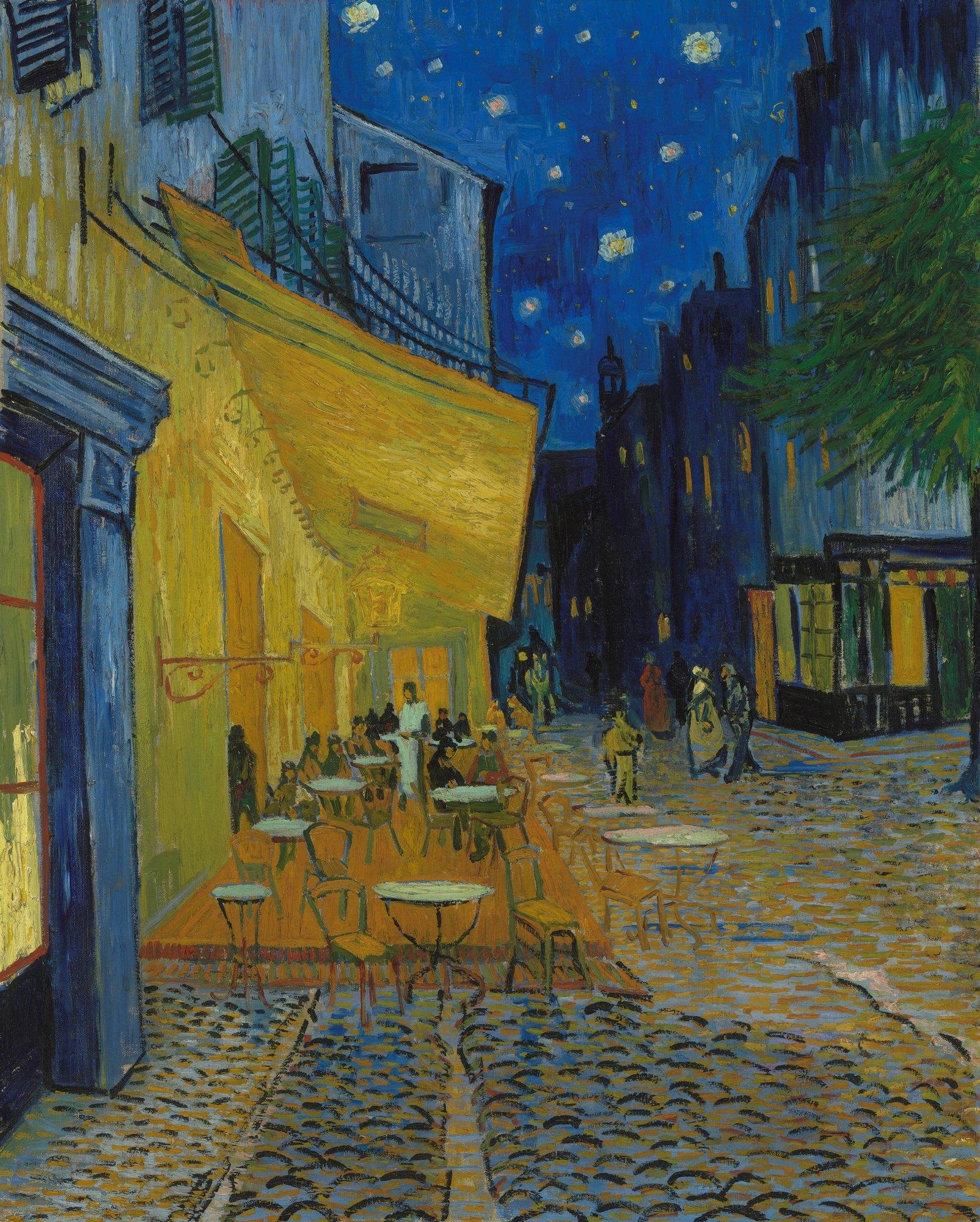
For centuries, painters treated night as a problem of darkness. They painted it in their studios, with lots of black and brown, and lit their scenes with a candle or a moon. In September 1888, Vincent van Gogh went the other way. He carried his easel out into the Place du Forum in Arles, in the south of France, after dark, and painted a café terrace on the spot, by the light of a gas lamp.
He was proud of the result. In a letter to his sister Wil, he described it as "a night picture without any black in it," made only of blue, violet, and green, with the lit square in pale sulphur and lemon yellow. It was also the first time he painted a sky full of stars. The Starry Night was still nine months away.
What you're looking at
A café terrace on a cobbled square at night. A big yellow awning glows under a gas lamp, lighting up the tables, the chairs, the pavement, and a few customers. A waiter in a white apron stands among the tables. To the right, a dark street leads away between houses and a tree. Above, a narrow strip of deep blue sky is scattered with stars that look like small flowers. The lit terrace is a warm pocket of light in the middle of a cool, dark city.
What makes it special
There is no black anywhere. The darkest areas, the sky and the shadowy doorways, are painted in deep blues and violets. Van Gogh believed night was full of color, and he was right: human eyes see color in the dark, just less of it.
The colors fight each other on purpose. The yellow and orange of the terrace sit directly against the blue of the sky, two complementary pairs that make each other vibrate. The effect is warmth and cold, light and dark, inside the same small canvas.
The perspective pulls you in. The cobbles, the awning, and the line of the street all rush toward a point in the middle distance, so your eye moves straight into the scene, as if you were walking toward an empty table.
The story behind it
Van Gogh had moved to Arles in February 1888, hoping to found a community of artists in the southern light. That autumn was one of the most productive periods of his life: The Yellow House, The Bedroom, the Sunflowers, and Starry Night Over the Rhône all date from the same months. In his letter to Wil, he mentioned that the café scene reminded him of the opening of Guy de Maupassant's novel Bel-Ami, which describes a starry night over the lit cafés of Paris.
The painting was not sold in his lifetime. Today it belongs to the Kröller-Müller Museum in the Netherlands, which holds one of the largest Van Gogh collections in the world.
One detail most people miss
Count the figures and look at the waiter. In 2013, the researcher Jared Baxter argued that the painting hides a Last Supper: twelve seated figures around a central, long haired figure in white, with small cross shapes in the window frame behind him. Van Gogh was the son of a pastor and once trained to be a preacher himself. Most art historians are not convinced, but once you have seen the theory, it is hard to unsee.
Where to see it
The painting hangs at the Kröller-Müller Museum, inside the Hoge Veluwe National Park near Otterlo in the Netherlands; you can borrow a free white bicycle at the park entrance to reach it. The café itself still exists on the Place du Forum in Arles. It has been renamed Le Café Van Gogh and repainted yellow to match the picture, so you can sit at a table at night, in the same spot, under the same sky.